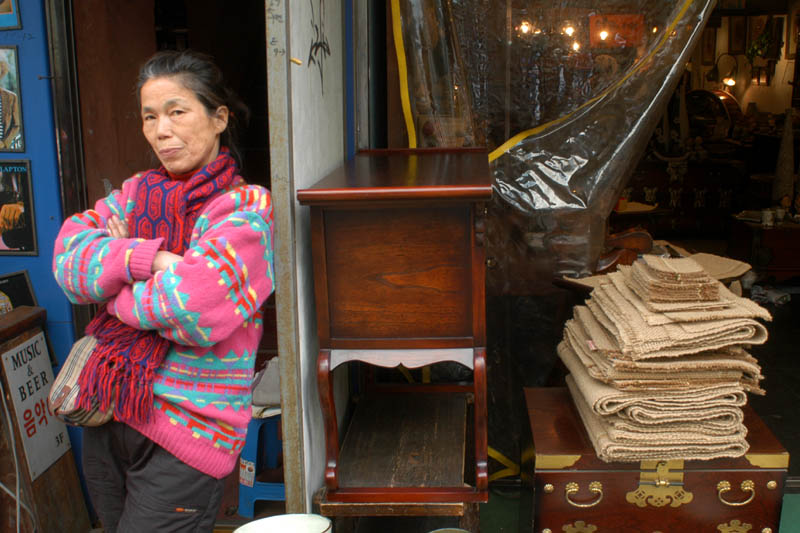
Sunday, March 12, 2006

Endings and beginnings. The last two weeks have seen both. Some things came to an end, such as my beloved H1 class.


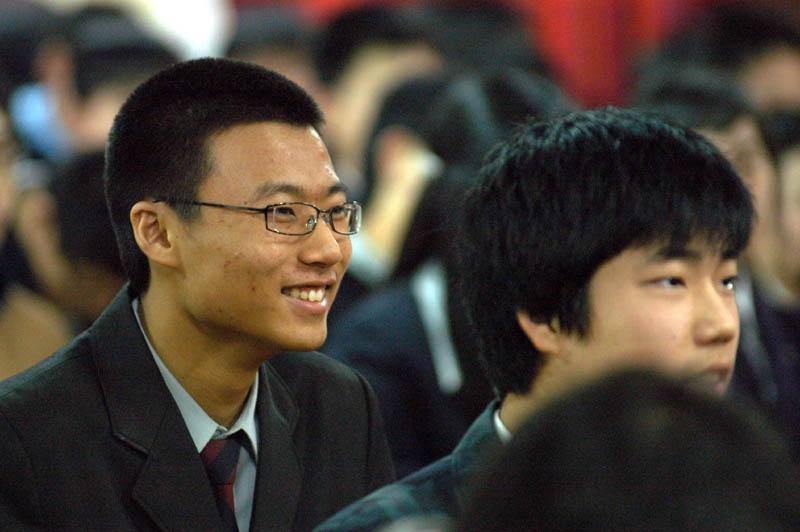
They presented their research projects on famous Koreans. Their Korean teacher, Ms. Kang, sat in the back of the classroom and watched with a proud smile as they discussed famous Korean historical figures such as Park Jeong Hee, Sejong the Great and Yi Sun Shin. They were the most dedicated group of students I have yet taught. I will miss them.

There will be no more H1 Saturday classes, either. As most of you read last week, the senior middle school students, the 3E1s and 3E2s graduated from ESS. Normally, these graduates would return to ESS on Saturday to further improve and polish their English skills. When I asked Ms. Kang about the 3E’s, she shook her head.

"They are not right for the H class," she said with an embarrassed smile. "They are not good enough students."

I thought about the 3E1s and nodded. A much more apathetic group, at least when it came to English. There were a few standouts, such as Yeo Jin and Seong Hoon, but on the whole the students were not as dedicated to the study of English as my former H1 class.

As a side note, I remember once talking to my friend Jennifer about her graduating high school class. We both remarked on how charismatic and strong the personalities in her class tended to be, including Jennifer herself. As a class, the Decatur High School class of 1996 was distinguished by their irresistible creativity and magnetic charm. My own graduating class was distinguished by its extraordinary academic achievements (present company not included, sadly).

During my tenure at ESS, I have begun to appreciate the way a group of students can take on a distinct set of characteristics built from the amalgam of all the wildly unique individuals contained within the classroom. Every class is different, and it is difficult to link the set of traits to tangible elements such as age, class size, designation or social class.

The form a class might take is an incorporeal feature, as unforeseeable as the future, as difficult to grasp as the ocean. I come to know my classes the way a farmer might come to know a plot of land. Through the long passage of time one gains an awareness of the land wholly separate from the rocks, roots and soil from which it is composed, and it is when one grasps this subtlety that one can decide what to plant and how to make it grow tall and strong.

As mentioned before, the last two weeks have seen things end and things begin. I began teaching new classes last Monday. In truth, the new classes started the previous Thursday, but I had no syllabus. Many of my classes have different names, but with the same children. My 5A became my 6A, my TC class became 1G, and my quick-witted Advanced 3 became Advanced 4. There are a few new children who have either moved up or moved down in rank, but on the whole, I have had these classes for a few months now. I know these plots of land well.

Other classes are wholly new to me. My 1-2B class has two students, one of which I know nothing because she never ever spoke up while in 1-2P last semester, and one I don’t know whatsoever because I’ve never laid eyes upon her before. Ji-hyun and Ji-eun.

Now that she is free of the overpowering loudmouths in 1-2P, Ji-hyun is beginning to show her true colors. She is both ridiculously bright and disturbingly apathetic all at once. When I pick up my ‘numbers’ flash cards, eight-year-old Ji-hyun rolls her eyes like she’s 15.

"Teacher, 1-2-3-4-5-6-7-8-9-10," she rattles off quickly. The other girl gapes at her in what I take must be amazement.

The 'other girl' is Ji-eun, who is visibly dumbstruck by the sight of me like I am some sort of exotic beast. Her jaw drops open and her mind appears to shuts down as I cover vowels. Her mouth doesn’t appear to move and her voice is barely audible when she answers my questions, like a baby bird. After teaching these two little girls the alphabet one day, Ji-eun’s mother bought me a cup of coffee from a vending machine and bowed repeatedly.

I also help run the hour-long 1-2 auditorium class, which is currently little more than twenty students big. An hour is a long time to ask a group of eight-year-olds to sit still. Soo-hyun fills the time with games, dancing and singing. At the beginning of the first class, we sat the kids according to height. Soo-hyun lined them all up and then sat them shortest in the front and tallest in the back.


More video you will never see: Me performing the hokey-pokey with the children of 1-2. I really didn't want to do this, but Soo-hyun gave me the 'you'll do it because I said so' look common to all women over the age of 14. I got my revenge by singing the first round with a rising intonation. You stick your right leg in? In what?

It was fun dancing with the kids, even with Na-ri laughing at me. Their simple joy is a happy virus.

Sadly, one of the tallest boys in the 1-2 auditorium class, Jeong-han, is racked with a classic case of Attention Deficit Hyperactivity Disorder, or ADHD. While the other children sit bolt upright and quiet, Jeong-hand rolls around in his desk, frantically doodles or runs up and down the aisles laughing hysterically.

The first class, Na-ri used her break time to occupy Jeong-han. Like many ADHD children, Jeong-han is very intelligent. He learns fast in a one-on-one situation. The numbers one through ten were no sweat to this smart boy.


The following auditorium class, I spent the entire class with Jeong-han, teaching him how to write the English alphabet. At the beginning of the class the boy didn’t know an R from a K, but by the end of class he could take letter-by-letter dictation. I worry about him. Soo-hyun is taken up by teaching the rest of the class, so if no one is there to personally steer him, Jeong-han usually relegates himself to the back of the auditorium where his imagination fills sheets of paper with fantastical doodles.

We have a new Korean teacher at the hagwon, Eun-hee. Actually, she is not a stranger to the blue steel doors of ESS. She taught for three years at ESS, but left to attend graduate school, where she studied education and history. Her english is some of the best in the school and she has a high-energy, engaging personality.

One of the things I like about Eun-hee is how she contrasts sharply with her coworkers. First of all, she took an unexpected interest in Gavin and I, where as most of the other Korean teachers were very cautious in getting to know us. Eun-hee also demonstrates a deeper awareness of the outside world and a set of surprising viewpoints.

In the middle of the teachers office during a conversation about the tipping habits of American restaurant-goers, Eun-hee revealed that she has friends who are lesbians. Ms. Ha didn’t flinch, but I saw Ji-hyun and Na-ri shift uncomfortably in their seats. To be openly gay in Korea is to commit the most painful form of social suicide. It is a non-topic in Korea, and is rumored to be grounds for dismissal at most hagwons. Eun-hee didn’t appear to care about any of this. She was visibly proud of her forward-thinking attitude, and we talked about it for a few more minutes. It was the second time she’s mentioned it to me.

For a going-away present to the departing teachers Ji-hyun and Ms. Kang, we all went to eat Samgyupsal together. I sat by Eun-hee and Ji-hyun and Ms. Ha sat across the table from us. The disparity between the three women was inescapable. Eun-hee talked excitedly, setting the table for mirth and laughter with her rapid-fire, high-energy persona. Ms. Ha and Ji-hyun sat across from her like two lounging tabby cats, listening attentively, preening between bouts of highly composed laughter. What I liked most about the scene was how well these different personalities seemed to mesh.

There is a new Native teacher, too: A married high school history teacher from Ottawa, Canada named Dave. This is Dave’s third tour in Korea. His wife works down the street at ESS Adult, and according to Dave, she is a gifted teacher. Dave began his Korean teaching career in Dadaepo, living above a kimchi factory. Actually, listening to some of his stories, I feel luckier and luckier to have the job that I do.

He once worked at a hagwon where the director regularly came in drunk and beat his receptionist (who was also his wife), sometimes so badly that she would bounce off the walls of the office and shake Dave’s classroom. His kimchi-smelling apartment in Dadaepo was infested with cockroaches and the teacher before him said there was a giant rat living in the couch.

Dave asked many questions of Gavin and I his first week, focusing on the mechanics of ESS: Where is this, how do they organize that, what do I do with these? Eventually he settled into the job with the self-possessed familiarity of a grizzled veteran. He asked repeatedly if we had been paid on time, and maybe he didn’t believe or hear us when we told him ‘yes,’ because he asked again a few days later.

I got the impression from Dave that being ripped off or deceived was just part of the hagwon system. He recounted story after story of hagwon directors cheating teachers, both native and Korean, as well as other hagwons. He didn’t seem convinced that ESS was the reliable, accountable institution that I claimed it to be. I hope for my sake as much as his that I am correct in my assessment of the school.

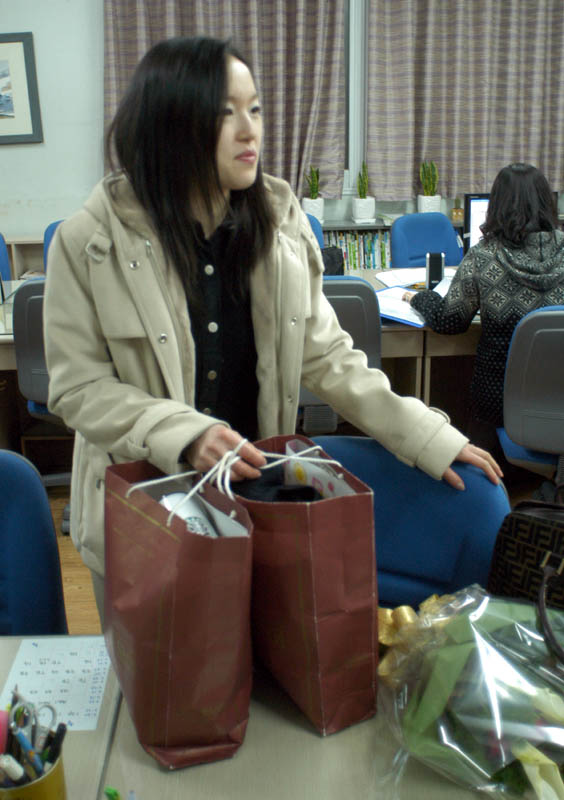
The recently-departed Ji-hyun made an appearance at ESS to collect her last paycheck Friday. She bragged to Gavin and I that she had 'gained weight.' Considering the Korean teachers' normal feminine obsession with weight and appearing thin, this seemed at first an unusual, condradictory statement. Then Gavin pointed out that Ji-hyun probably left ESS to have a baby. Beginnings and endings. With the ending of a job comes the beginning of a baby. Here she is getting ready to go.


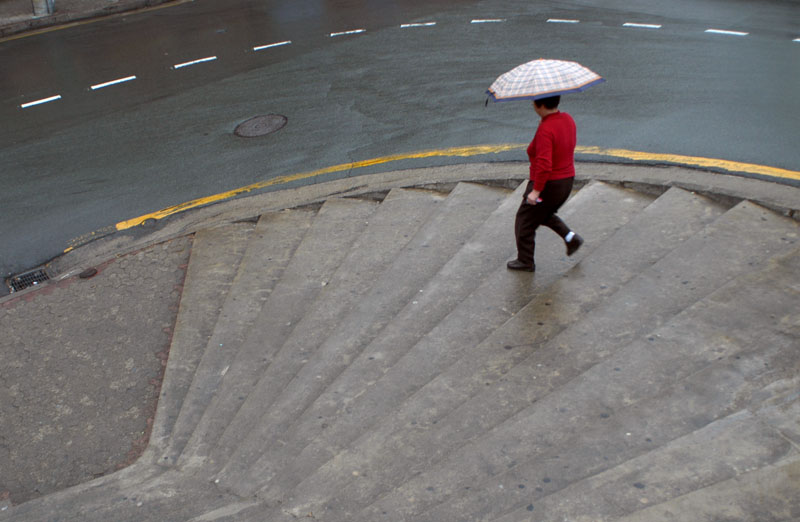
Spring is in the air! The season for beginning is beginning. Old smells from when I first arrived here have returned. One afternoon while crossing the elevated footbridge into Nampo-dong, the distinct twang of the ocean reached my nostrils for the first time since November, bringing back memories of riding to Haeundae on the back of Julie’s bike (now my bike). Other, far less pleasant though still notable odors have returned or gotten stronger as the warming weather has given strength to the bacteria that inhabit the sewers, drains and gutters of Busan. There is a one-hundred yard stretch of the road leading to our favorite restaurant that is so rank Gavin and I cross the street to avoid it.

On Saturday I mounted my motorcycle, strapped on my helmet, and set course for Jangsan Mountain north of Haeundae. The weather was warm, humid, and impossibly hazy. CNN.com said the unusual haze was due to a duststorm that had blown over from China. A friend of Gavin’s joked that it was the dandruff from a billion people.

A pale sky hung over my head as I carefully picked my way through the hazardous Busan traffic. My bike vibrated at a high frequency, giving me the impression that it might jump backwards in time at any moment. “1.21 jigowatts!” I yelled periodically as I slipped in and out of traffic. The humid air made the sooty stench of automobiles seem to cling to me. By the time I reached Daechun park at the base of Jangsan Mountain I felt like the human muffler.

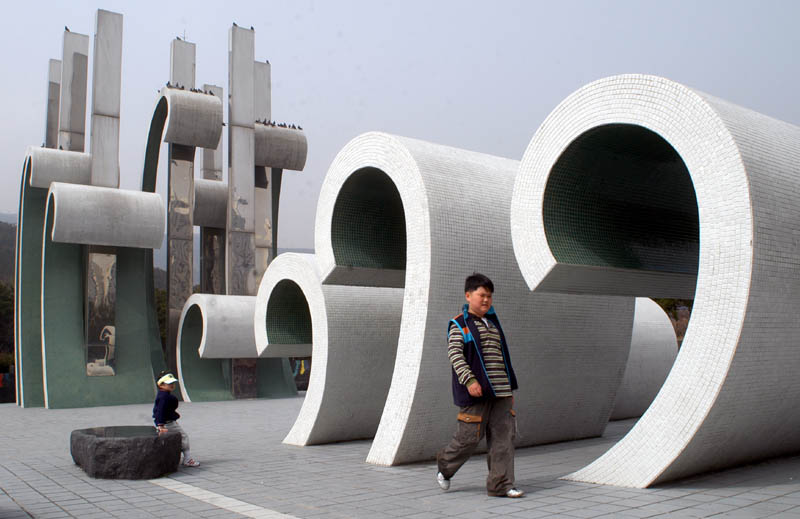
I parked the bike by some drunk rent-a-cops who pointed at me, said something about a “Mi-gook” to each other in Korean and laughed. I waved, smiled and did my best to hold my tongue. The park was awash in people: People skating, people biking, people out for a stroll or a moment alone with the one they love in the lukewarm, hazy sunshine. I passed a massive sculpture of ocean waves where children climbed and chased each other under and around the frozen stone and tile whitecaps.


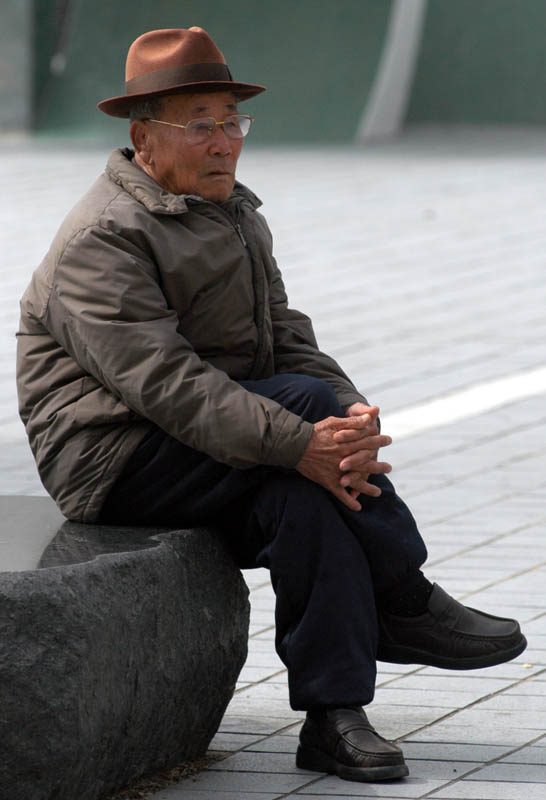
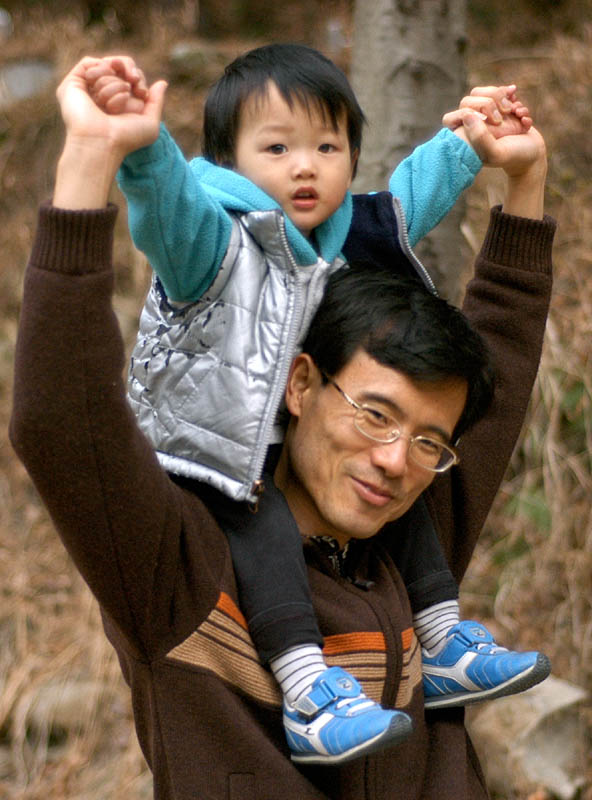
It’s just not SoKoNotes without an old guy shot. Western Kentucky, here I come...


I walked the road through the park, up towards the towering peak of Jangsan. The carefully manicured, 'civilized' shrubbery and hand-laid tile road ended by a garden, giving way to gravel and a more wild, taller assortment of pines and hardwoods. I walked the trail by a river leading down from the mountain. I passed scores of people as I walked. There were many families out.


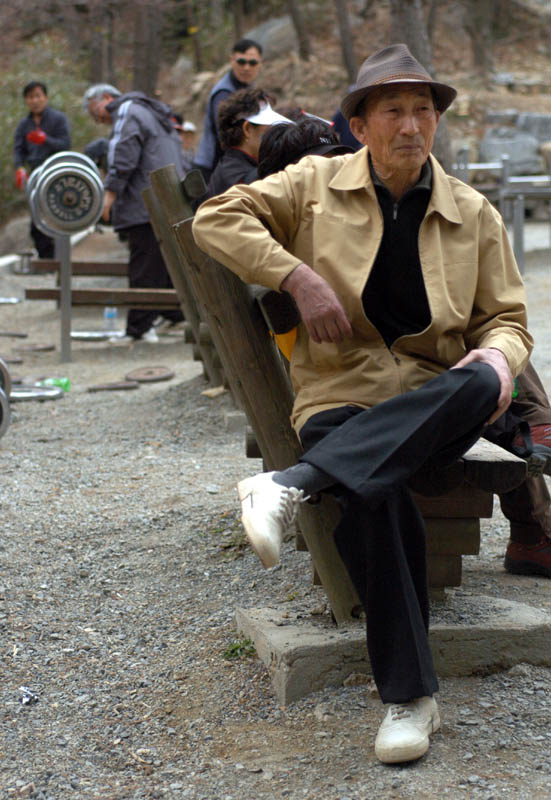
I love how the Koreans make a point of getting outside and taking advantage of the good weather. On the other hand, I go to the woods to get away from the crowds. Luckily, most of the crowds pooled at the many ‘physical parks’ hewn into the mountain side. Basically, the government sets aside an area for weather-resistant fitness equipment, including weight benches, hoola-hoops, and stretching areas. It’s very thoughtful.


Periodically, one also comes across these ‘foot massage’ paths at the physical parks. Basically, it’s a sidewalk with lots of upturned stones and logs of various sizes embedded in it. The idea is this: A person gets a foot massage as they walk this perilous footpath. The idea always makes sense to me, but I can never get up the nerve to give it a spin. The Koreans eat these things up. They’ll walk them over and over again, sometimes stopping to chat while warping their feet around a knobby concrete-embedded log.

Exhibit A:


The other cool thing to see while hiking in Korea are all the Buddhist temples. After a little while the stream took a hard turn away from the footpath and I found myself at the entrance to a small Buddhist temple called Pokoksa. There were carved stone tablets set with hundreds of tiny statues of Siddartha in various states of repose.


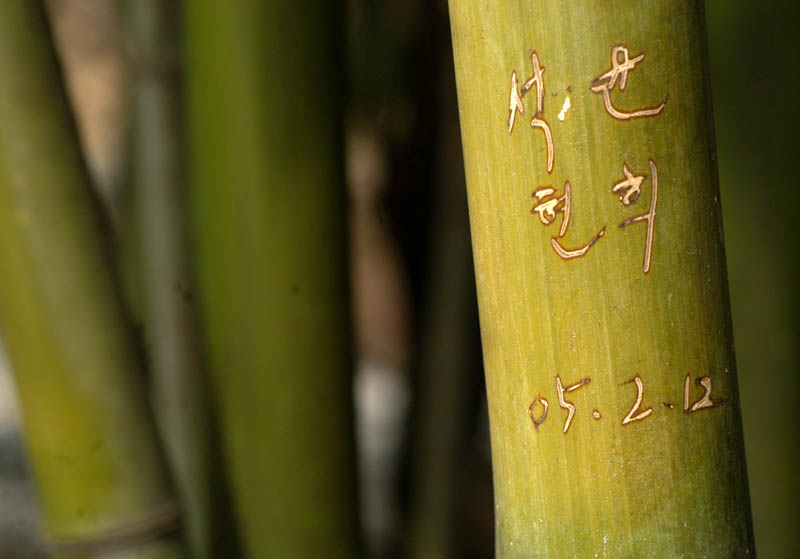
In one corner of the compound was a grove of tall, elegant bamboo.


I stopped by a pagoda overlooking a small pool ringed with statues of Buddha and watched the fish languidly swimming under a small waterfall. A few people exited the temple, chatting as they walked up the mountain, and then I was alone. A soft breeze blew through the forest. The soft rustle of the trees mixed with the gentle sound of windchimes in the temple eaves and the air was scented with the sweet tang of burning incense. The sound of my mind faded into the background.

I stared out at the forest, fondly recalling my hike along the Appalachian Trail in 2003, an uncomplicated time not long ago when every day was spent in the splendid simplicity of a backpacker’s life. I didn’t worry about my purpose or my job or where I was headed or where I had been or my family’s expectations or my own. It was a place where perfect strangers genuinely cared for and made an effort to get along with one another. All I ever had to worry about was food, water, and shelter.

In the years following that sublime journey I had to learn to live in the modern world all over again. Compared with hiking the AT, life in the modern world seemed to me needlessly complex and confusing. Money, jobs, culture, clothes, cars, sex, friends, enemies, partying, debt. Nothing ever seemed to take on as much importance or fill me with as much joy as a day hiking in the mountains of North Carolina.

I would go to parties and find myself drifting away from the music, away from the girls, away from my peers and towards an empty balcony or porch where I could drink my beer and live in the past. I could never seem to get very interested in the things that occupied my life after the Trail because they never measured up to that night camping on a high bluff in New Hampshire, or the weeks I walked with Liteshoe, or standing on top of Katahdin. Those were the last days I can recall my existence filled with meaning. I can recall almost every day I spent on the Trail, and almost every person I met there. Nowadays I can barely remember what I did yesterday. In many ways I feel that I have failed to acclimate to modern living because deep down I think ‘modern living’ is a form of collective insanity.

I sighed. I have been here for exactly six months. Half of my time in Korea is finished. The second half is beginning. What have I accomplished? What will I accomplish? It took me six months to hike the Appalachian Trail, and every day was as important and fulfilling as the collective journey. I lived life to its fullest. Whatever happens, if I can live like that again, maybe I'm doing something right. Perhaps that should be my benchmark for success.

My brain went back to work reminding me of all the things I have to do. Some people joined me at the rail and took pictures in front of the fat, smiling golden Buddha. I continued walking up the mountain. Once away from the physical parks, the crowds thinned.
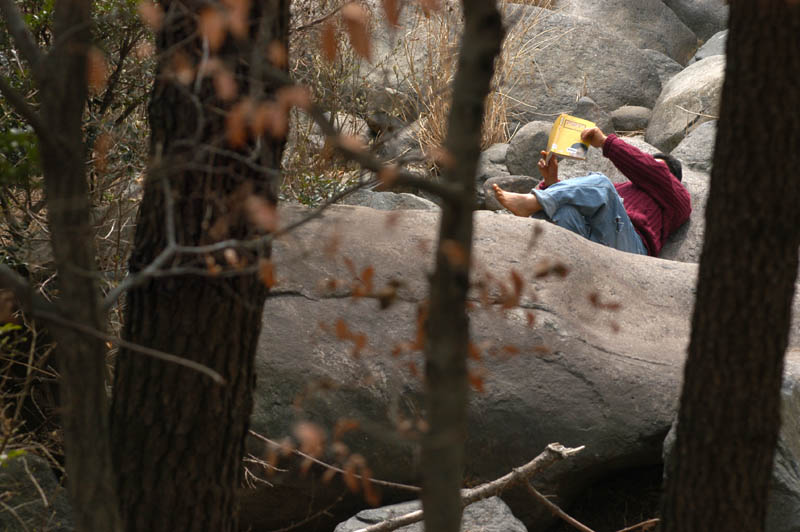


I scaled Anbu-uripong (peak) and soaked up the silence and peacfulness of the forest. The only wildlife I came across was a pack of feral cats and countless huge, blue-and-black magpies cackling in the budding trees.


As I crested Anbusan, I realized that I needed to get back home so I could get a shower before heading out to Kaeunsungdae to make another go at being a normal white male in his mid-twenties. Girls, booze, partying. Smile, Notes. Life is good.

OK, well that just about does it for...Oh, wait! I almost forgot...The Korea Files!

“A small flower shop in your hands that Antenna suggests” What other suggestions does Antenna make? --Wallet

“Emboli” ...sm. --Clothing store

“Grade AA eggs calculator.” Oh, God, what the hell? Does anyone actually sell grade AA eggs any more? --Notebook.

Also, here is the second installment of the Korean Notebook Scramble (new name). What the hell were they thinking when they wrote the following phrases in their journals?

“Second grade, I will I had a first school.”

“It was quite and looks like sad.”

“My dream is police officer and I will do hardly.”

“This year you are circular.”

“I must along him.”

Figure that crazy stuff out for fun and prizes. See ya next week. --Notes

Tuesday, March 07, 2006

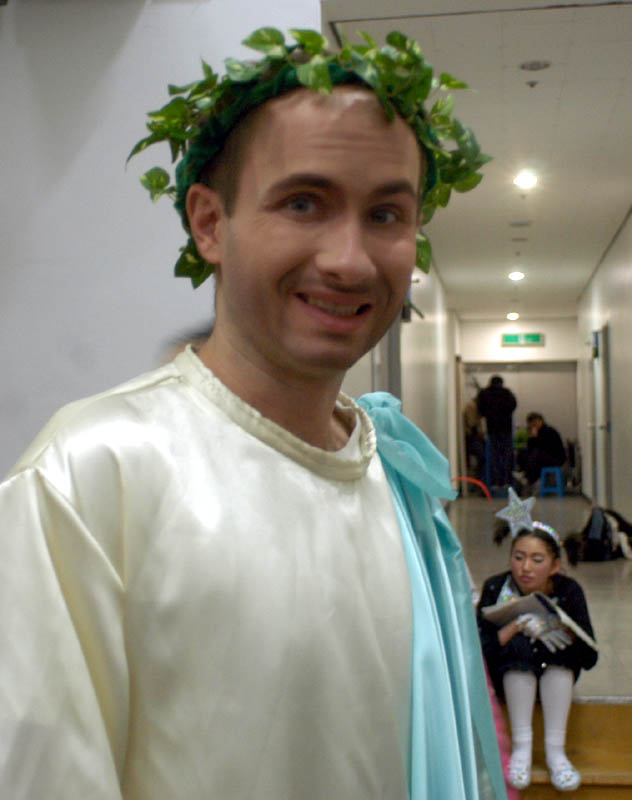
If this photo doesn't pull you into SoKoNotes, than I might as well hang up my blogging spurs now.


That's me dressed up as God for the opening (and closing) night of the ESS annual musical: The Story of Creation.

When the senior Kim Dae Min started it in the 1960s, the English Speaking Society taught the language purely by way of the script and the stage. Through acting, students developed an intimacy with the expression and intonation of the language in addition to the vocabulary and grammar. So much meaning is tied into the expression of the words. Acting, versus simple recitation, requires the speaker to communicate from these deeper levels.

According to the plexiglas sign on the third-floor hallway, ESS has put on more than thirty plays, one per year. There was a ten-year-long dry spell in the eighties when the government shut down all private English academies. I have no idea why, and google is little help. That's not the point, anyway. Quit getting me off topic! What were we talking about?

Oh yes, the play.

We began rehearsals back in February. The part of God was split between Gavin and I. The first four scenes of the eight-scene play went to me, and Gavin took up the slack. I'm not sure why Mr. Kim choose us to play the leading role, as this was an opportunity for the brightest stars in the school to shine. Perhaps Mr. Kim thought the role too heavy a burden for any of the children to bear. 'God' had lines from the first scene to the last, afterall. However, these were fourteen and fifteen-year-old students producing a play written for American third-graders. The longest stretch of dialogue was barely two sentences.

It was clear from nearly the beginning of the project that this play was to be a major production. There was more at stake than I first realized. A few weeks into rehearsals, Mr. Kim had all the teachers involved in the play watch a video of the play being performed by a rival hagwon in Seoul. From the outset, it was clear that the video was not a guide, but a benchmark to surpass. "We can do so much better than them," boasted Mrs. Nam following the video.

"We have to be better than them," added Soo-hyun later on. "They will be here to see it when we put it on."

Mr. Kim's ego was at stake. Failure would not be tolerated!

A few things struck me about the video. First of all, the children performing the play were much younger than the children performing it at ESS, closer to the script's target age. They also lip-synched the songs and they cast a student in the role of God. Of course we'd do better. Our kids are older, better trained, and 'God' would be played by two young, white American native English speakers. Who did Mr. Kim think he was fooling?

Mr. Kim brought in his daughter, Gyeong-min, to score the music. He hired a dance instructor to choreograph the songs and a director from Kyeongsung University took the reins...Well, half the reins. Mr. Kim micromanaged the play down to the smallest details. A rehearsal totaling four scenes could last three hours while Mr. Kim and the director argued and fussed over blocking, pronunciation and acting.

Gavin, the students and I did our best to stay engaged, but it was like riding a roller-coaster. A scene would get moving, everything coming together, and then Mr. Kim would throw up his hands and yell or walk up to a student and grab him or her mid-line. The play would stop, a ten minutes would go by as Mr. Kim obsessed about something, and then we'd start the scene over. Once during one of these tirades, Min-geun, a bright young woman from my 1S class playing the role of 'Star,' leaned over and confided, "Mr. Kim very scary."

Sun-jeong, the official director, was a bright, confidant, charismatic young woman; and she handled Mr. Kim with grace and patience. Whenever he didn't make it to rehearsal, the atmosphere was much more relaxed. Sun-jeong usually saved her most critical changes for after a scene was over, and was mindful of mine and Gavin's limitations. I enjoyed watching her work with the children. She was unflinching as she demonstrated how 'Moon' should walk or how 'Water' should twirl or how I would gesture with my hands as I filled the void with light in my booming, perfectly-pronounced inflection.

That's me sitting upon my heavenly throne as 'Day' sings her opening song. Kudos to Sang-min (Night) for the photo.


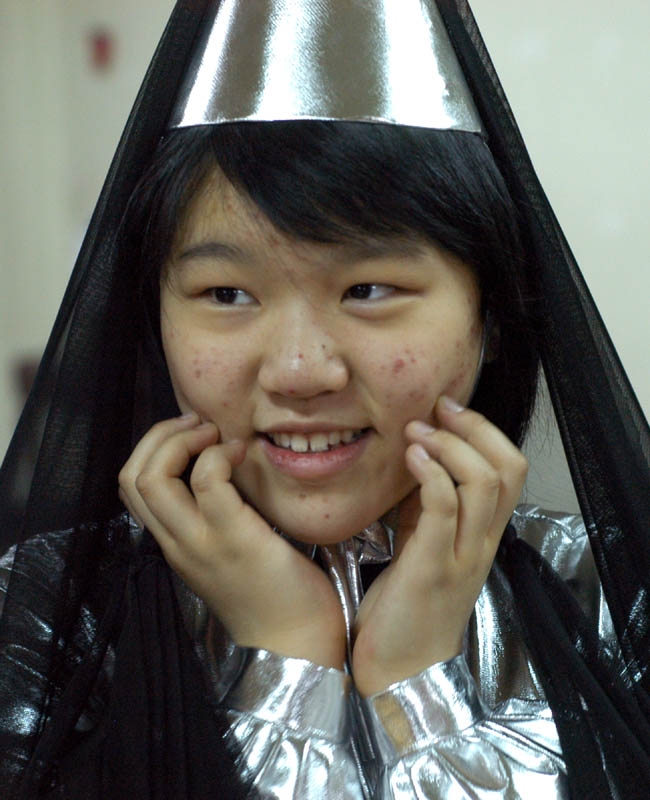
Poor 'Day' badly twisted her ankle while rehearsing her solo the day before opening night. The choreographer had her spinning in the air while singing "Let there beeeeee darknesssssss!!!" and she botched the landing. 'Day' endured both performances on Sunday, totaling sixteen acts, with her ankle tightly wrapped in gauze. This is a tight portrait of her I took during a dress rehearsal last week.


Working with the students made for joyful work. Both Gavin and I got a kick out of watching the kids laugh and enjoy themselves as they learned their lines, blocking and cues. Both of us were called on to help students with their pronunciation and expression, and this afforded us the opportunity to build a bond with many of the stuedents. Some of the students had never bothered or had never been taught how to express the meaning behind the words they were reading. Up until being handed that simple script, it just wasn't a part of their education.

The students couldn't read their line in front of an audience with a flat intonation and no regard for punctuation. Their role as actors forced them to think about where they stress words, pause, and raise the volumn of their voice. Those little dots, slashes and curvy lines nestled within the sentences suddenly took on a lot more meaning. Whenever they could, students pulled Gavin and I aside so they could practice.

"Teacher, help me," they would say and point to a highlighted line of script. "Teacher, read please." And Gavin and I would dutifully obey, demonstrating, listening and correcting them as they followed our lead. Some of them got it, and it brought a smile to my face to watch them apply what they'd learned. No one was better at this than 'Night,' Sang-min.


'Night' and 'God' share a long exchange in the third scene when 'Night' expresses dismay at having no friends with whom to share the darkness. Night is required to express complex emotions such as sadness and renewed hope. There were many dramatic pauses, slowing of delivery and body language changes that Sang-min had to learn. Some of these skills were instinctual, and the natural energy of the exchange contributed greatly to her success. Still, I was impressed by how quickly she mastered the subtlties of the duet.

There were more than a few natural-born actors in the play. Some of the students played their parts so well it seemed to me as if they were born into that role. The girl who played 'Mouse' scampered about and delivered her lines in a humble, quick-witted style.


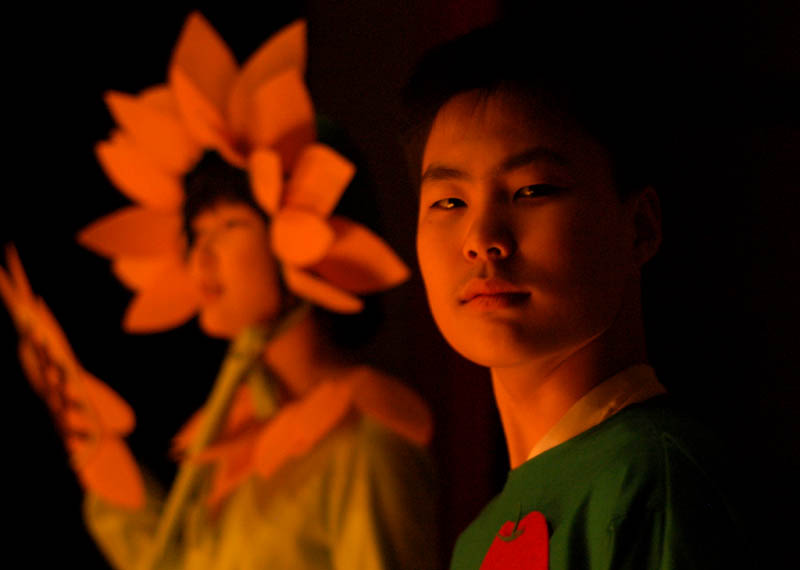
The two social pariahs in the group were cast as 'Man' and 'Woman,' which in my opinion, is quite fitting. 'Woman' was played by a short, shy girl who always appeared to be trying to disappear into her over-sized down parka. 'Man' was a lanky, disquieting boy named Jeong-won with a penchant for invading people's personal space. He spoke the line, "We are alive" in such a robotic, flat tone that it sounded like the punchline to a bad joke. I got a good shot of him adjacent 'Sunflower.'


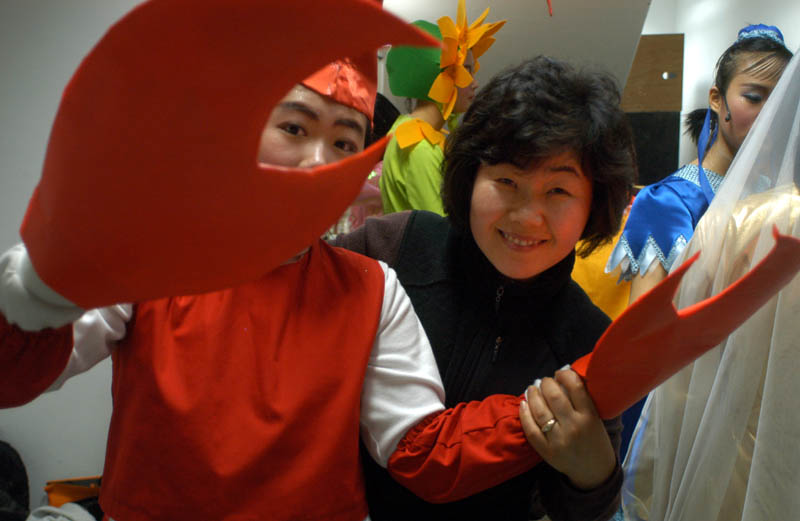
'Sunflower' was a beanpole of a girl with the biggest, warmest smile I've ever seen radiating out from her face like the yellow petals glued to her green hat. Water was lithe and joyful, leaping and dancing across the stage trailing a fluttering, snappng blue ribbon behind her. She and Land flirt a little in the second scene. First, the waters are seperated from the heavens, and 'Water' flutters around the stage for her song. Then 'Dry Land' appears.

'Dry Land' was played by Hong-gi, who I mentioned in the last update. Having only recently been introduced to English, Hong-gi was learning the way the first students at ESS learned: Through the theater. Soo-hee, Gavin, Mr. Kim and I all worked tirelessly to help Hong-gi deliver his lines with anything approaching articulation, and we met with some success. After he is created, 'Dry Land' stomps up to 'Water' and compliments her.

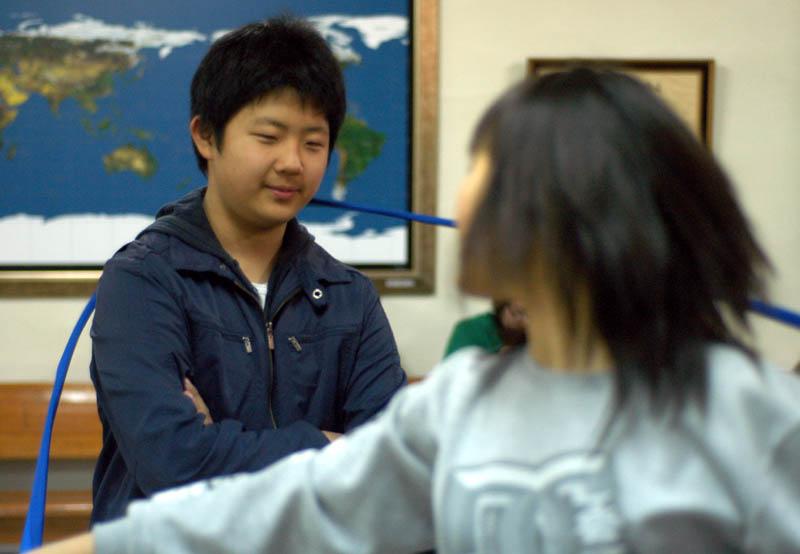
"You are so...Soooo blue!!!" He exclaims, and then 'Water' does a little dance, twirling around 'Dry Land' with her blue ribbon in hand as "La Bamba" plays. Mr. Kim was perennially disappointed by Hong-gi's flat delivery, and we rehearsed this exchange over and over and over again. The two used the repetitive interaction to get in a little old-fashioned flirting.


Hong-gi seemed particularly entranced by his partner as she twirled around him.


Here's one more shot of 'Water' at the theater waiting for her cue backstage.


We had one more rehearsal on Saturday, and then Gavin and I showed up early Sunday to get ready for the opening. Our costume was based on none other than old Rennaisance paintings of Jesus.


Gavin and I were issued identical, humiliating polyester pearl-colored nightgowns with ruffles on the collar and sleeves. They looked like what my grandmother might wear to bed. Our incessant, plaintive requests for a new costume succeeded in winning us the addition of a skyblue sash and the removal of the distasteful ruffles. The costume designers rigged my feet in silly spray-painted shoes and adorned my head in a crown of plastic ivy wrapped around pipe-cleaners. See photo at the top of this blog.

We had out makeup applied by our co-teachers. I felt honored and lucky to have the overtly narcissistic (and ridiculously gorgeous) Ms. Ha apply my makeup.


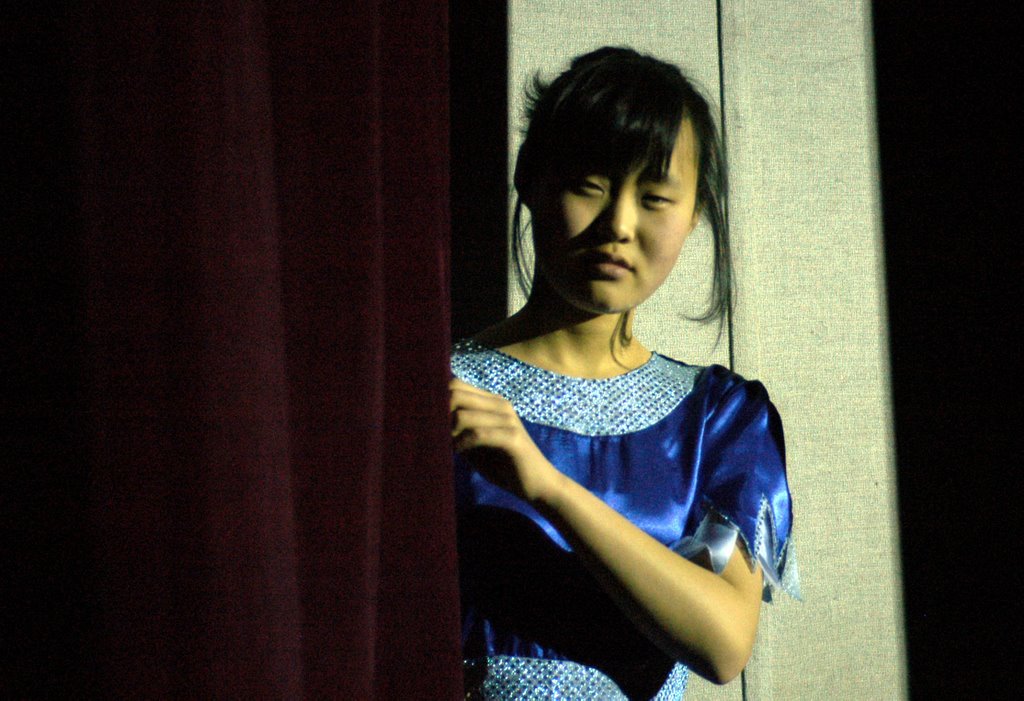
We only had two rehearsals on the stage where we were to perform the play. The lighting was a nightmare, the music miscued over and over, and some of the songs to which the children would lip-sing skipped. We needed at least two or three more rehearsals to get the timing, lights and sound squared away. The play was to go on in three hours. I braced for a disaster. Here is a photo of 'Day' poking her head out from behind a monolithic set piece to ask the director about her cue.


Here's 'Eagle' working on her lines.


At one point, I tapped one of my co-teachers, Soo-hee, on the shoulder.

"Soo-hee, do we have one more rehearsal before the first performance?" I asked in a hopeful tone. Soo-hee took the earbud from her walkie-talkie out of her ear and smiled.

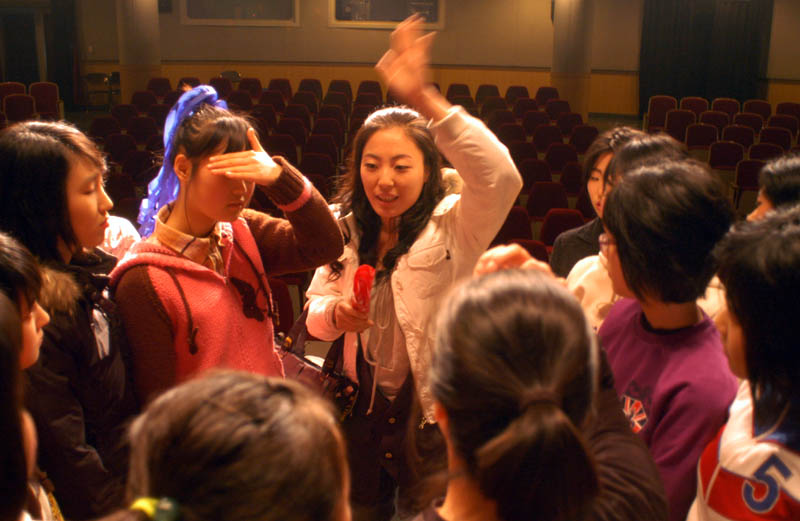
"Your rehearsal will be at 3PM," she said sheepishly, meaning our first performance. Oh, great. This photo is of the dance instructor giving some final words of advice. You can always tell when the Koreans are about to undertake something for which they are ill-prepared or the odds are against them because they pump their fists in the air and yell, "Fighting!" The story goes that they picked the phrase up from American GIs during the Korean War.


Mr. Kim had the graduated third-year students play traditional Korean drums for the audience while we prepared backstage for our debut. As I took the front of the line of actors by the curtains, the rat-a-tat-tat of the snare-drums and ching-ching-ching of the brass bells thundered in the high-ceilinged room. The music flooded my heart with joy and washed away my nervousness. Yes, I was nervous. The last time I acted in anything approaching a theatrical production was my freshman year of college. It was called the Bullshit Ballet. I was cast as a Chinese prostitute. There was booze involved. Nuff said.

Still, both performances of the play went off without much trouble. There was a smoke machine that randomly went off and filled my goofy costume with pungent white vapor. The machine went off nearly constantly during 'Water's dance, obscuring her from view and causing me to worry about her loosing track of the stage and twirling headlong into the crowd. But no such disaster materialized.


While backstage for the second half of the play, I watched Gavin's performance via a closed-circuit television. Whoever was running the video camcorder was obviously not conscience of it's settings, which were on automatic. The poor machine was trying to expose for the dark red curtains, and thus all of the brightly-lit actors were washed out and indiscernable.

During the finale, both Gavin and I walked, arms outstretched, through the plants and animals to the front of the stage for the bow. This had to be confusing. This version of the creation myth was obviously Christian in origin. Many of the Koreans watching it were Christian. Christianity is officially monotheistic. One God, not two, should have been walking towards the audience. I guess people just assumed I was Jesus.

Everyone's parents showed up for the big show. They lavished praise on Gavin and I and requested pictures with their kids.


One really sad moment happened though during the photo session following the final performance. Sang-min, the cast and I were standing on stage, holding roses in our hands. Parents crowded together like paparazzi in the first few rows of seats and aimed a phalanx of technological wizardry at us. Flashes burst from all around and the buzzing, whirring and clicking of electronic devices filled the air. I looked at all the proud parents giving thumbs-ups to their children, taking pictures, and I asked Sang-min where her parents were. Sang-min looked down at her roses and then back up at me, her face fixed as strait as she could manage.

"Yogiro opsoyo. They leave. They not here," she said wistfully and looked away.

OK, well, that was the report on the play, AKA part one of SoKoNotes. I'm not sure if I'll get anything else up this week. I'll try to get the Korean files up, but don't hold your breath. I might save everything else I wanted to show and say for next week, as there isn't much happening this week. I hope everyone is doing good. --Notes
Thursday, March 02, 2006

Just so everyone is aware, Gavin updated his blog using iWeb. It is truly one of the best-looking, easiest-to-use blogs in Korea, as well as a great source for photos, observations and Konglish. Check it out. You'll have to cut-and-paste the URL into your browser window because I haven't gotten around to figuring out how to make something clickable. --Notes
http://web.mac.com/gavinaverill1/iWeb/MULA/MULA/MULA.html

Friday, February 24, 2006


There, that reeled you in.

Hello and welcome to *cough* another invigorating installment of SoKoNotes! Please pardon the coughing, that's just my virus putting in it's two-cents. Turns out the high-fever and bouts of uncontrollable shivering were just the first two courses in a two-week long banquet of misery. Now I've moved on to the main course: Lungs stuffed with a gooey yellow phlem topped with a green mucus gravy. Yum!

For the past two or three years I only got sick once or twice a year, and it was hardly ever serious. It has been two months now and I cannot remember the last time I went more than five days without my sinuses getting infected and shutting down (which makes pronouncing N's and M's rather difficult). I've suffered from bouts of unexplainable nausea, diarrhea, fever, headaches, viral infections and weird rashes on my legs and back I suspect reflect the hardness of our water supply. After weeks and weeks of low-level infirmity, one starts to seek answers for the mysterious crap oozing from one's orifaces.

The internet is of little help. A google search brings up a number of websites dedicated to helping the armchair physician diagnose his ailment. Plug in your symptoms and hit 'enter' and then brace yourself for the horrifying list of possible maladies. To type in the words 'fever, sinus infection and runny nose' is to come face to face with a list of everything from the common cold to terminal blood cancer. Such a system only serves to kill off any optimism while at the same time feeding the anxious doubts whispering fearfully in the back of one's mind.

For example, starting last Monday (and this is quite humiliating, actually), for a couple of days I noticed a slight burning sensation whenever I took a piss. My immediate instinct yelled 'bladder infection,' and that made a lot of sense. With my immune system preoccupied with repelling the viral assault on my sinus cavity, I'm sure the policing of the normal one-celled riff-raff that call my body home, such as the bacteria in my bladder, came to a screeching halt. And while the master is away...

Logic and experience told me a bladder infection would clear up in a matter of days. Later, my mother (a former teacher) informed me that bladder infections are quite common among teachers (who can't simply leave class to go pee whenever they like). Still, those whispering doubts in the back of my head needled me: What if it's not a bladder infection. What if it's something worse, something that could seriously damage your, your...You know...I had to check it out. I sat down at my computer and decided to give the diagnstic websites another at-bat. I pitched the words 'burning' and 'urination' and hit 'enter.'

Chlamydia, the computer spat back out. You have VD. I starred dumbfounded at the webpage, slowly shaking my head. No, no, that couldn't be, I thought. That just isn't correct. I can't have VD! There has got to be another answer! There has to be something else wrong with me! For Chrissake, I haven't been laid in seven months!

There were other key, and much more severe, symptoms listed under 'chlamydia' that I didn't exhibit (and which I won't list here for the sake of your appetite). Furthermore, the computer also brought up 'urinary tract infection' further down the list.

After many quarts of water, countless vitamin C tablets and twenty-four hours of debilitating anxiety, my urinary tract returned to its normal, happy, non-burning state. So really all that I've discovered is that diagnostic websites are good for little more than freaking people out enough to go see a flesh-and-blood doctor.

OK, enough about my bladder already. Lets move on. I've decided to start a new section on SoKoNotes. Once or twice a week Mrs. Nam asks Gavin and I to check over the students' english journals. We edit for grammar, spelling and word choice. Most of the students write about the simple events in their pleasant, simple lives: Birthdays, holidays, Sundays, the first day back in school, movies, you name it. Most of the time, their grammar is attrocious, bordering on schizophrenic. I have known students to change verb tenses two or three times in a paragraph, or insert random punctuation (or forget about punctuation entirely). Details such as articles (a, an, the) and pronoun agreement (He/his) are rarely given any thought. Many a composition leaves my desk covered in so much red ink that it literally looks like it has been butchered.

Many of the students try out new phrases they've learned. Sometimes it works and sometimes it doesn't, or sometimes they can't quite remember a phrase, but they remember the Korean translation. Re-tooling the translation back into English never quite works out, or they get it right but screw up the grammar, and it can be a challenge figuring out what the student is trying to say. So, I thought I'd elicit some help from the readers of SoKoNotes.

I proudly present to you the newest section in the blog that continues to be a thorn in your English teacher's side: The Weekly Konglish Conundrum!

Yeah, I'll come up with a better title later. For now, sit back and wrap your mind around this new wackiness.

"I run at the nose."

"I have a very long tail to tell."

"My favorite somewhere is my home."

"I thought many kinds of something."

"I'm afraid to use the knife and fire, so I won't be able to clock."

"After lunch we packed to live."

Was that fun? Use the comment button and write in with your responses. What do you think they were trying to say? For those of you who don't feel like using your noodle tonight, here's the plain ole' Korean Files.

"Come enjoy the rich taste of world's best designer." (We've been fattening him up on fashion show buffet tables for months) --Shopping bag

"Anomoly-opening collection from Innovation designer of the word." (You said it) --Same stupid bag.

"Think wilt though let it slip useless away?" (Old English. As if normal English weren't hard enough) --Notebook

The streets of Nampo-dong have started to take on something like familiarity. When I first arrived here, such a thing would not have seemed possible to me. Every street corner seemed to have an identical assortment of ugly, hulking buildings playing host to a maddeningly homogenous assortment of PC Bongs, restaurants, cellphone stores and clothing outlets all festooned in neon signs. Finding a landmark in this mess was like trying to remember a wave in a stormy sea.

Six months of wandering those streets and allyways have turned the mysterious into the mundane. Strange, when I think of landmarks, I don't just picture buildings, but now people as well. Human landmarks. Oh, so you need to find the movie theater? OK, go down this alley past the sunglasses vendors. When you hit the main road, you should hear "Living the Vida Loca" blaring from a coffee shop across the street. Cross the street there and follow the brick alleyway to your first intersection by the wristwatch carts. You'll know you're going the right way by the strong smell of sewage. When the smell dissapates, turn right and walk a couple of hundred yards. When you pass the old fortune teller by the Coke billboard, you're almost there. Keep going strait past the dokpokki stands, take a left at the PIFF statue and you've made it.

People tend to be more distinct than the buildings they inhabit.


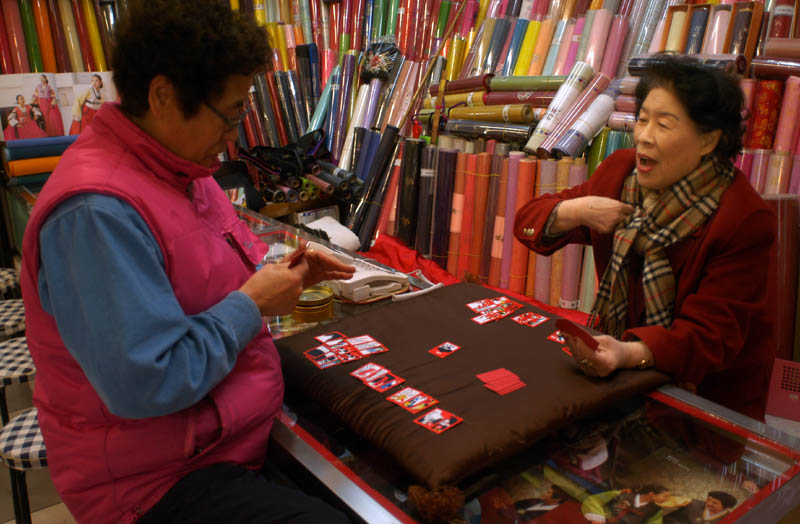
I wandered into a Hanbok shop and found these two saleswomen doing their level best to earn a living.


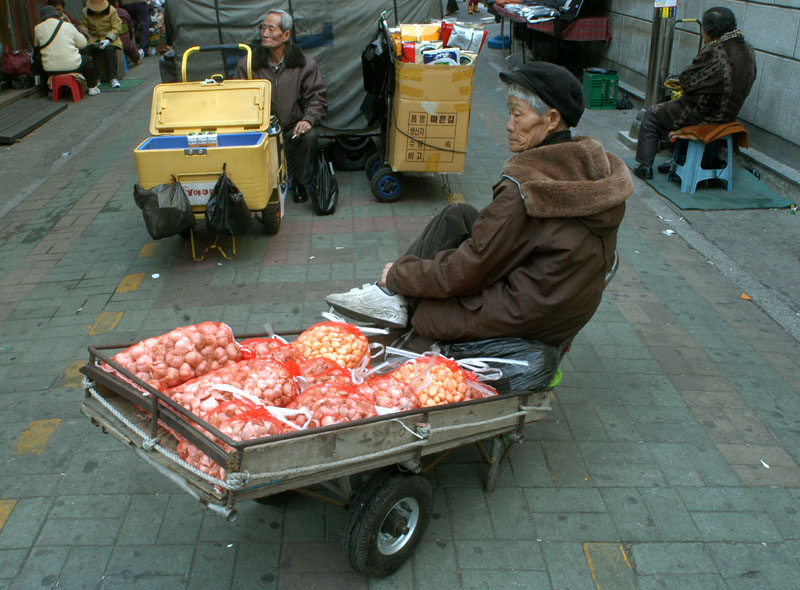
Some landmarks pick up and move periodically. Take this garlic salesman, for example. I see him, or people like him, everywhere. They wire a car battery to a boombox, strap it all to their cart, and wheel it around the market blaring their sales pitch. I buy fruit from them just to get them to turn the damn thing off for a minute.


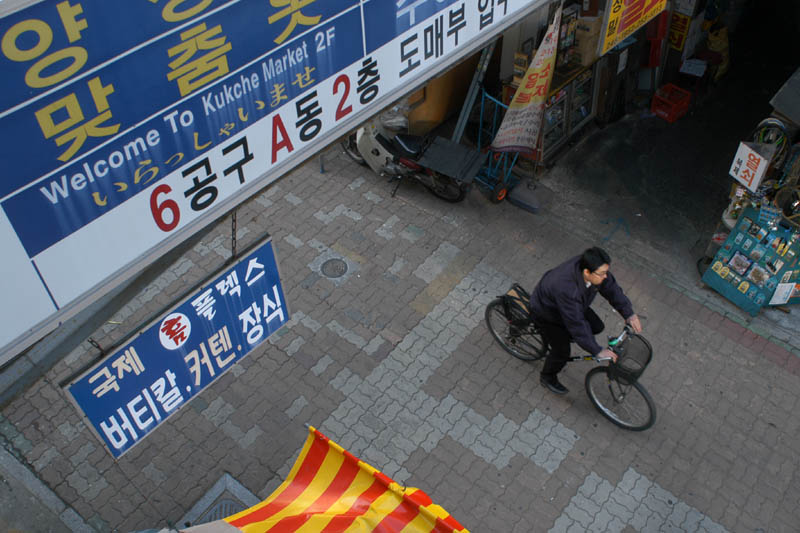
I really enjoy the Gukje Market. With all of it's nooks and crannies, I feel like a little kid again, playing hide-and-go seek in my friend Wes' big old house. I found a little bridge from the Hanbok shop up onto the rooftop of the building across the alley Thursday, and took advantage of my birds eye view.


The weather has gone haywire. Whereas for most of November and December and even part of January we had nothing but day after day of cold, dry air and clear blue skies, now the weather has returned to being its normal unpredictable self. Wednesday morning my computer's weather widget said it would be cold and sunny. I stepped outside to dark clouds and a light drizzle. Point. Focus. *Ker-plunk*


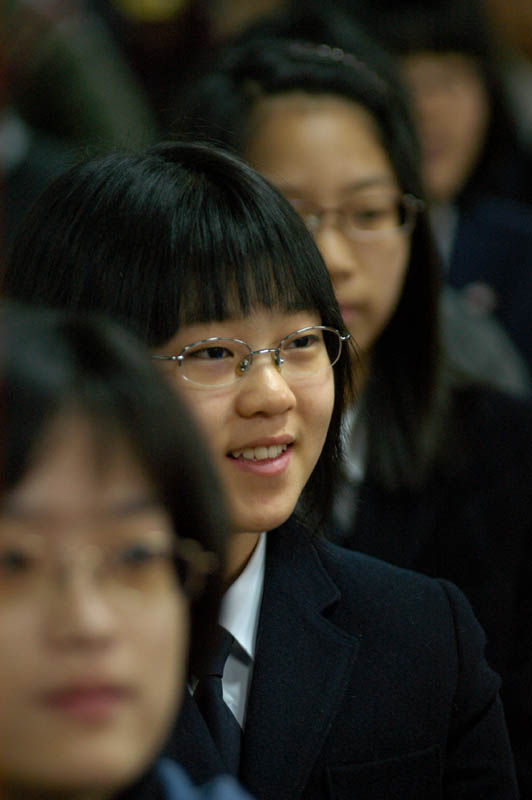
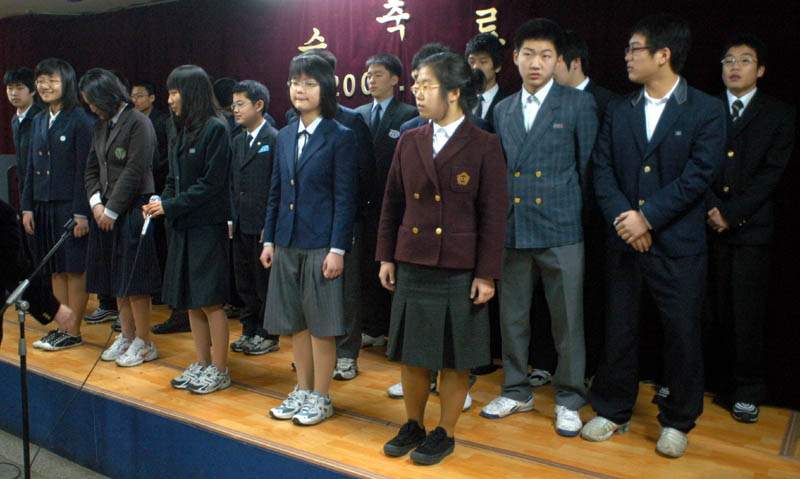
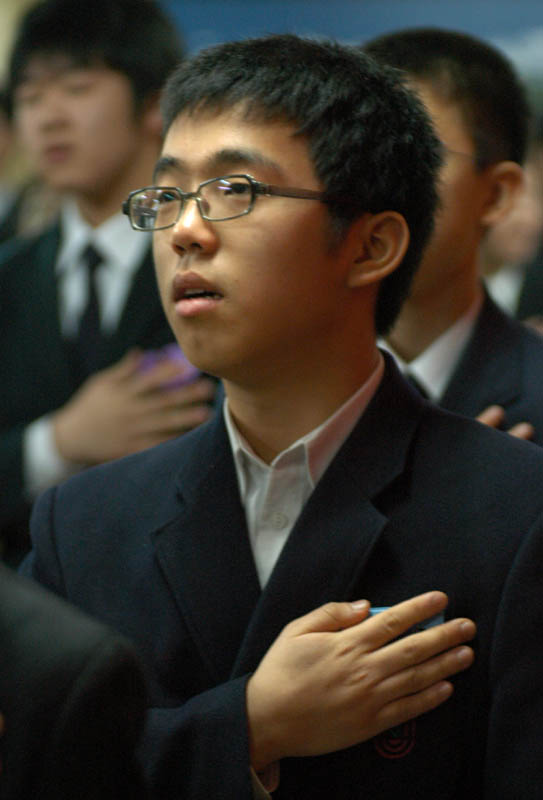
ESS graduated the third-year middle school students on Friday. The ceremony was very long, with the students filing in to applause from the other Best Jr. students. It is my observation that the bond between students crosses ages and classes. I've seen older students talking with younger students and I've seen kids from beginner or lower classes shooting the shit with advanced students. Many of the first-year middle school students - the 1E's - were visably proud of and happy for the seniors as they calmly lined up on stage. Take Bit-na, for example


Then the 3Es proceeded to sing a long set of songs to the anticlimatic sounds of a Casio keyboard. There is nothing that drains a song of it's substance quite like cheesy accompaniment. Still, it was neat to watch and listen to them sing.


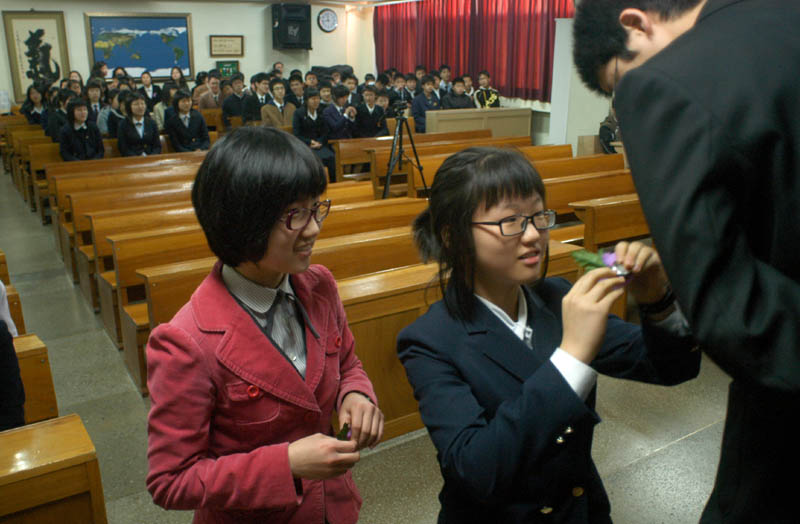
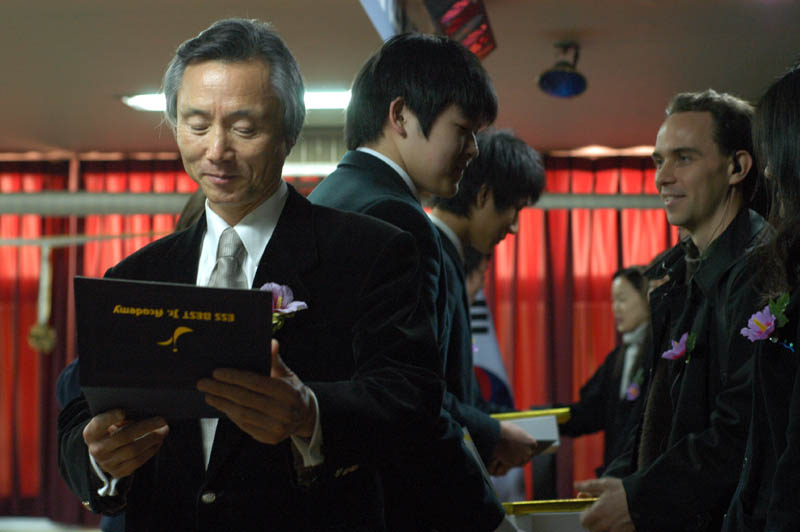
Afterwards, students from the rising class, the 2Es, came up and pinned plastic flowers to the graduates.


Part one of the Korean National Anthem was played.


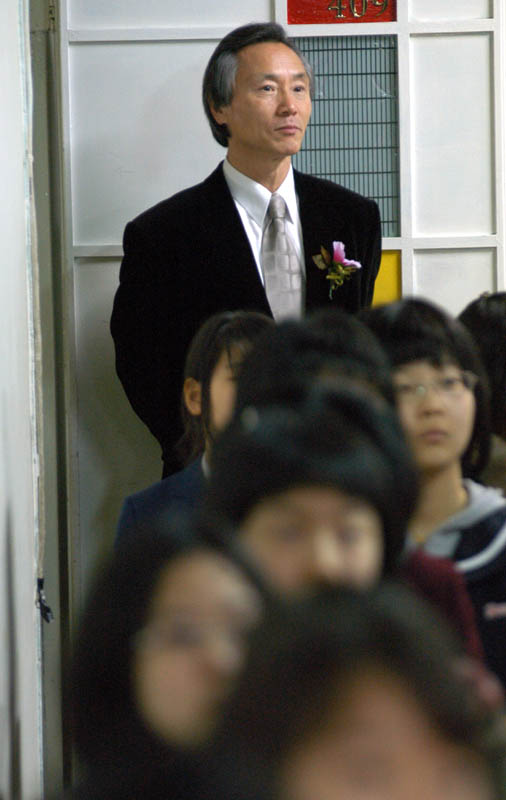
Mr. Kim watched these proceedings from the back of the room.


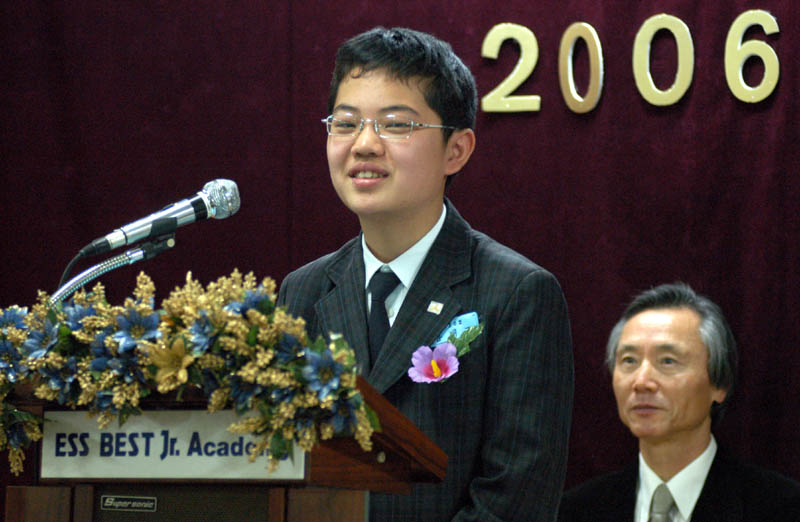
Afterward, he came up and gave a speech and handed out diplomas. As each student approached the podium, Myeong-hee announced their visions for the future. Many of the students had very humble life plans. Two or three future police officers, an elementary school teacher or two and even an aspiring flight attendant crossed the stage and received their handsome burgandy diploma.


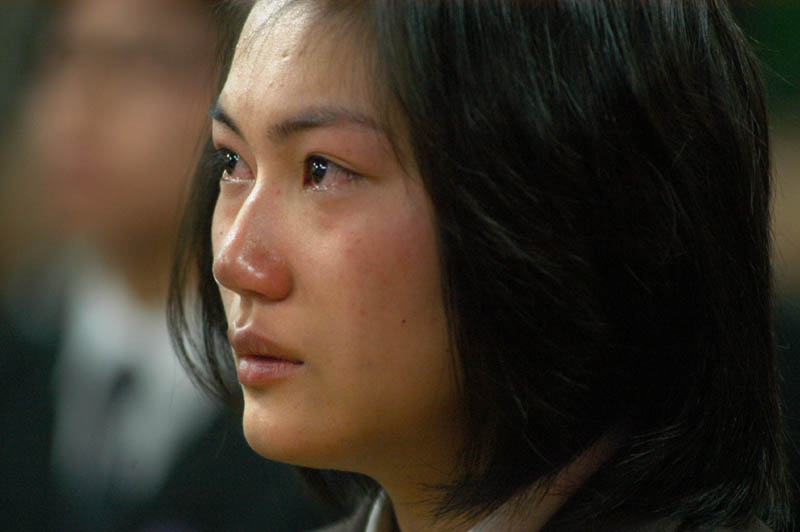
For some, it was a very emotional moment. This is a shot of one of Gavin's favorite students from 3E2, Do-yeon, who was teary-eyed for most of the program.


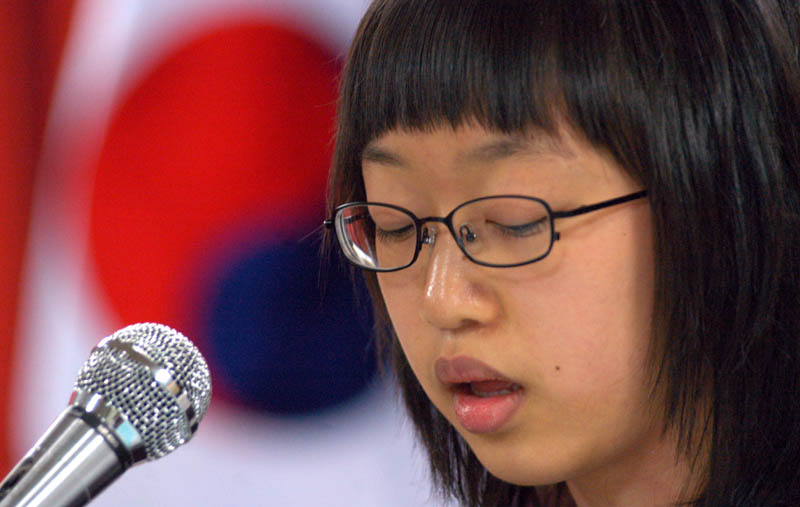
Next, Ah-jin, the sharpest knife in the 2E2 drawer, gave a speech to the departing seniors.


And then every 3E graduate gave a speech.


It's weird when someone cracks a joke that sends the entire room to laughing, but you don't get it at all because you don't speak the language.


It was good to see the 3Es graduate. They'll enter high school in March and begin the final leg of the marathon that is education in Korea. This weekend also saw the end of my Saturday classes. Apparently, there weren't enough 3E students interested in the Saturday classes to justify them anymore. That's fine with me, as I'm looking forward to having my Saturdays back in full. Still, it saddens me in some way. But I'm not going to go into that now, as I am tired. The good news is that I can breath through both nostrils without the aid of ephedrine, my stomach is in neutral, and my bladder is...Oh, sorry, I promised not to talk about that. With any luck, I'll have something more to write about than my poor health next week. Peace. --Notes