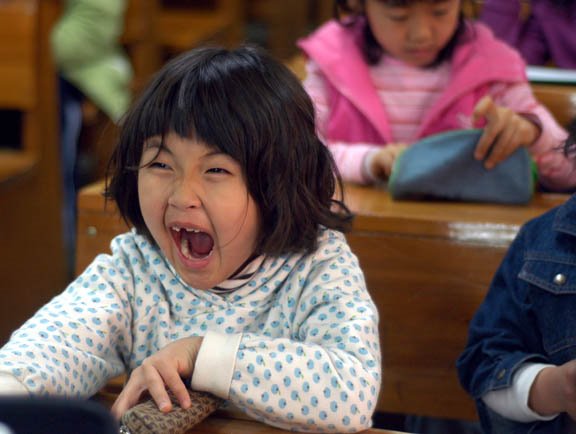
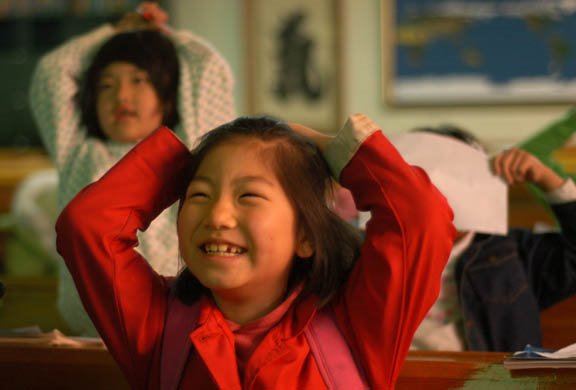
Tuesday, May 09, 2006

I think it's funny how I live in a foreign country 12,000 miles from home and yet the best photo I made this week was in the McDonalds down the street from ESS.


Light. It's a strange, miraculous phenomena. Stranger still is light's uncanny analogy to a sound or water wave. Energy travels in waves, no matter what medium it might be traveling through. I tried explaining this to my Special Class last Monday, and too my great surprise, they got it. We talked about pigments, reflection, refraction and even the visible spectrum.

Wait a minute, you're thinking. How do you explain the foundations of wave theory to a group of thirteen-year-old Koreans using their second language? Are you crazy?

Bare something in mind. These are not typical ESS students. They're Special.

When I first saw the "S.C." on my assignment sheet lo these many months ago, my immediate thought was that I had just been handed a group of mentally retarded children. While I was in public school, 'Special Class' was bureaucratic doublespeak for the children who were mentally handicapped. They had their own classroom, their own teacher, their own lunch period, and my only exposure to them came after school while waiting for my ride or at Friday night football games. They sat with their teacher in their wheelchairs at the top of the handicapped access ramp at Decatur High stadium and took in the game.

However, at ESS Best Jr. Academy, 'Special Class' refers to children who have lived abroad in English-speaking countries for an extended period of time. Naturally, they would be far, far ahead of the other children in the academy, and many of them are indeed great English speakers. Soon "Doo boo" Jeong. Ju "Chun je" Young. Ji "Wiz" Sun. These are all great English speakers in comparison to the bulk of students at ESS. This does not mean they are smarter than all the other kids at ESS. In all honesty, I consider the children of Advanced Three to be my brightest students. But the students of Special Class have something no one else can boast: Immersion in an English-speaking culture.

By enrolling their children in Special Class, the parents of these wayfaring youngsters hope to maintain their child's strong conversational and comprehension skills. Indeed, three times a week the six children in Special Class receive a full hour-and-a-half native speaker smackdown from Mr. Jones and Mr. Averill and Mr. Northcott. That's a whole lot of English!

However, the curriculum for the class has usually been cobbled together from texts selected on a lark. For most of the first four months I taught Special Class, I had no curriculum. I taught from the hip, so to speak. We built parachutes, read about the Japanese whaling industry and played games. The student's high level of English comprehension made teaching a little easier, and they could wrap their minds around advanced material that was better suited to their interests and age bracket.

Around the end of February, Hye-ran decided it was high time the native speakers adhere to a curriculum. She took us to the English bookstore and we selected texts in the areas of social studies, science, conversation and grammar. She made us write up a syllabus for the month of March and she handed copies to the students. It was a lot more work than I had ever had to do for Special Class, and I grumbled and griped the whole time. I liked the class partly because it allowed me the opportunity to try new things and be spontaneous.

Hye-ran quit her job in April to pursue other interests, leaving the task of managing Special Class to Soo-hyun, who was (and still is) relatively new to the organization. Though it probably has nothing to do with her, I haven't had to make another syllabus since then. The school's interest in Special Class waxes and wanes with the vaguely predictable behavior of the stock market, and my instinct tells me that the movements are cued to the quality and size of the class itself.

One of the problems facing Soecial Class is that some of the children don't actually speak English as well as advertised. This isn't nessiarily anyone's fault, but rather the result of a slipshod admission process levered by the school's bottom line.

One day, a month or so after arriving last fall, Gavin was pressed into a hasty interview of two potential students for admission to Special Class. Gavin was given only a few minutes to prepare and even less time to actually conduct the interview. The students, who were very nervous and scared of embarrassing themselves and their parents, were unresponsive, and Gavin had a hard time sizing up their English-speaking capabilities.

The two applicants were twin girls: Eun-hee and Eun-jeong. They had studied in an English academy while living in China, and they were reputed to be excellent English speakers. For the first month, neither Eun-hee nor Eun-jeong said a thing. In my class, they sat in the front row and stared at me like I was the living incarnation from a fairytale and they flatout refused to answer any of my questions. Gavin's experience was even more perplexing. One of the girls looked "like she was going to cry at any minute," he reported.

More students entered Special Class under the radar partially due to the stunted, frankly extemporaneous, nature of the interview process. Gavin theorized that the students probably prepared answers in advance of the interview. The questions we asked were very straitforward and highly predictable. What's your name, how old are you, where did you study English, etc. Someone with an English phrase book and an hour to kill could probably come armed to impress.

My own response to this tactic was to ask the children to read from what I thought would be a difficult text, but this proved an easily surmountable obstacle. English and Hangul are both phonetic alphabets, and thus reading comes easy to strangers of either language. My technique only proved how well they could pronounce English. It said nothing about their level of comprehension.

Gavin and I tried retooling our interview questions so that we could better gauge the student's ability to form original thoughts in English. In the case of one my newest students, Ye-ji, this proved devestatingly effective.

While walking down the hallway with her parents, I put Ye-ji at ease by asking the easy, predictable questions I'm sure she expected. This made her smile, and her practiced, casual replies visibly pleased her parents who were following behind us. Ye-ji had spent two years in New Zealand with her mother, specifically to learn English I was told, and her father (some variety of businessman) was fluent in English. The language was obviously an important ingredient in their lives.

During the interview, I left the phrasebook behind and played hardball. So you're thirteen years old? What did you do on your last birthday party? How did you like New Zealand? Where did you live? Were the people nice to you? What is the difference between Korean school and the academy in New Zealand? I varied the difficulty of my questions, trying to gauge Ye-ji's ability to digest, comprehend and then react to the inquiries.

Over the course of the five-minutes I had been allotted for the interview, all of the wattage drained from Ye-ji's smile, and her actual level of conversational ability was set in stark contrast to her reported background. Though I could detect a high level of comprehension in her eyes, the responses to my questions were far from that of a near-native speaker. Her voice couldn't keep up with her ears. You might say that she heard more than she could speak. My report to Soo-hyun was not positive, and I have to admit that I did not recommend Ye-ji for admission to Special Class.

The following Monday Ye-ji was sitting behind Ju-yeong when I walked into room 307, a fat green science book on her desk and a confused, timid look in her eyes. Money speaks louder than English in ESS Best Jr. Academy, apparently.

Throughout my short history with Special Class most marginal speakers, such as Ye-ji, get weeded out after a month or two as their true level of English becomes grossly apparent. As I mentioned before, the size and chemistry of the class has varied according to this odd pattern. Throughout March Hye-ran repeatedly inquired of Gavin and I about the twins as well as other new additions to Special Class. In all truth, some of these new students were stellar English speakers. Others obviously didn't live up to expectations, and were eventually dismissed by Hye-ran or yanked out of ESS by their parents. From the beginning of March to the present the class size dropped from its high of eleven in March to its current roster of six children.

Ye-ji is still in the game, as are the Twins, who are now a much more vocal ingredient. I have nicknamed them Hee and Jeong (as both of their 'first' names are Eun), and I am slowly getting to know them better. Through Hye-ran, Gavin discovered that the Chinese academy where the twins studied actually discouraged the highly interactive, free-speaking style of learning that Gavin and I encourage. They didn't speak up in class because such behavior was punished in China. Once they began to notice how the American and Austrailian-educated students around them were raising their hands and responding to the teacher, I imagine the Twins felt safer. Now they are two of my best students.

I can only hope the same for Ye-ji, who is still in the '"dormant" stage. I like her. I detect a great deal of intelligence and thoughtfulness in her eyes, and I hope she gets rid of the butterflies in her stomach and emerges from her cocoon before Soo-hyun or her folks get fed up and punches her ticket out of ESS. Either way, Special Class will remain a wild card in my weekly rounds.

Buddha celebrated a birthday Friday. He turned 2550 years old. I'd say he's a 'young' 2550. He sure has a lot of thoughtful followers.


The temple next to ESS (which actually owns our building) was alive with people eating bibimbop and worshipping. There were many statues of Buddha, one of which people would pour what looked like oil over. A monk was chanting the whole time I was there, a strange, ancient sound.

Gavin and I had Friday off due to the Sukatanshinil holiday. We got an early start and climbed over Bongnaesan into the local temple, filled with lanterns hung with prayers, to see what this "Buddhist Christmas" was all about.


The temple on Bongnaesan had a giant stone pagoda covered in carvings. People bowed before them before making their way into the temple's main hall.


A couple of ajummas welcomed people into the temple. They were dressed in beautiful hanbok and were very friendly.


There was lots of bowing.


The following week came and went with little fanfare.

Someone asked me last week why my nickname is Notes, and I bet there are some readers of my blog who wonder the same thing. Let me preface this by going backwards in time.

Ever since I joined the photography staff at the Chattanooga Times Free Press as an intern in the dawn of my career, I have carried a notepad. Besides being a critical tool in gathering information for the photos I took, I found the notepad an equally good medium to cover the ongoing story of my life as well.

Thumb through any of those old, sweat-stained notepads and in and among the scribbled names of people I photographed on assignment you will find scraps of poetry and prose, grocery lists, story ideas, reactions to events in my life, financial notes and various to-do lists. There is a box at my parents' house filled with these old notepads. I am literally writing my autobiography one tiny notebook at a time.

Of course, when I started hiking the Appalachian Trail in March of 2003, I had a little black, spiral-bound notepad tucked into a pocket within easy reach. Over the course of that six-month journey, I ran through some two dozen such notepads, mailing them back to The Chattanooga Times Free Press when every last page was filled with scribblings from interviews, photo credits, and observations. The newspaper condensed the information into a ten-part series that ran every third Sunday or so from March till October.

Almost everyone who hikes the Appalachian Trail picks up a nickname, or in Trail parlance, a "Trailname." I hiked with people with names like Space Monkey, Liteshoe, Itchyfoot, AWOL, Commander-in-Chief, Tang and Stringbean. To this day, I cannot recall, or in some cases never learned, many of their given names. If I saw Space Monkey tomorrow on the way to work, that would be the name I would put to his face. That would be the name I would yell across the busy streets of Nampo-dong. Space Monkey.

I should also add that most trailnames are coined by other hikers, and they reflect some defining aspect of the individual being named. Stringbean, for example, was ludicrously thin. Itchyfoot would wake up every morning at the crack of dawn. Tang was fond of drinking, well, you guessed it: Tang.

Some people were often the beneficiaries of horribly unfortunate trailnames. One young man, upon being discovered cooling off his hiking-chaffed crotch in a creek upstream from a campsite was instantly and irreversibly christened "Ball Washer" by his comrades. I myself narrowly avoided garnering the odious trailname "Bad Joke."

A Canadian hiker got fed up with my daily stream of poorly-crafted witticisms and slyly proposed the name over dinner in a shelter in North Carolina. A few people grumbled their ascent, citing a damning number of horrificly bad jokes I had told that day, and it was only after a prolonged filibuster that I managed to at least table the idea.

The next morning I think I cracked another awful play on words, something about bugs and breakfast cereal, and after everyone had stopped groaning, the Canadian took the opportunity to reexamine the "Bad Joke" idea from the previous night. If memory serves, the joke had indeed been a real stinker, and I probably deserved the moniker.

I realized where the conversation was leading, and I protested mightily.

"Well, you need a trail name," she pointed out with a hint of sarcasm. "Do have a better idea?"

I didn't. I had been thinking about it for weeks, and nothing seemed to fit. Ever since I first interviewed someone at Springer Mountain, people had been trying to pin me with various names pertaining to journalism. I tried on Cronkite, Shutterbug and Sleuth, but found them all lacking. I wasn't anything like the iconic news anchor (in fact, I maintain a healthy disrespect for television in general and televised news in particular), Shutterbug seemed to imply a low degree of skill with a camera, and Sleuth didn't fit because I was in no way an investigative reporter.

"How about 'Notes," the Canadian's hiking partner suggested. "Every time I see him, he's always writing in that tiny notebook." She pointed to a pouch on my waist strap where I kept the notepad.

There was a sort of contemplative silence as the four or five hikers gathered under the lean-to chewed on the suggestion. Personally, the name "Notes" wasn't perfect, but it was a damn sight better than "Cronkite" or "Bad Joke."

"Hey, I like that name," I cheerfully chimed in, breaking the silence. People began to nod. The Canadian girl cocked a disapproving eyebrow at me as she realized I had dodged a much-deserved bullet. She continued to call me "Bad Joke" for a few days thereafter, even though Notes had become my generally accepted trailname. Only after I promised to stop telling them around her did she declare a ceasefire.

The 'Notes' name grew on me as I hiked, and the pile of notepads at the Times Free Press grew and grew. Yellow ones, long ones, plastic ones, waterproof ones, sweatstained, bloodstained, foodstained notebooks filled a tiny box on a desk in Chattanooga. By the time I returned home and began searching for a job, notebooks found a permanent residence in my back right pocket.

I have owned all brands and builds of notebooks. Spiral bound, glue bound, sidebound, topbound, cardboard-backed, plastic-backed, waterproof, numbered, college-ruled, unruled: I've owned them all, and I am constantly on the lookout for better, sturdier notebooks.

My current notebooks of choice are the Pb Memory Tae Won Special Note series of notepads found on art street in Nampo-dong. They are everything I love in a notebook: Seventy-five cent five-by-three inch metal-spiral top-bound college-ruled 80-page beauties with easy-to-see-in-the-dark orange (or sky blue) covers made of a sturdy cardboard stock. I love em.' I can't think of a better notepad to slip into my back right pocket every morning.

The best part of the Tae Won Special Note, though, is its cover, on which is written the following:

"Loving is knowing how to live,
Living is knowing how to love."

Really, is there any notepad out there that can compare to the Tae Won Special Note? When I get around to packing up and leaving this place, you can bet I'll have a bundle of these beauties tucked away somewhere in my luggage.

Photographically, its been a good week. I made this from from my busstop in Nampo-dong. Evening was coming on, and the fluorescent lights of the busstop billboard across the street had just switched on.


A Non-Governmental Organization specializing in building parks came to Nampo-dong to drum up support for their latest project: A (hold on, let me check my Tae Won Special Note) Central-park style development on Doon-chi-do island north of the river. I guess no one bothered to tell them that Central Park is so-named because, well, it's in the 'center' of the city, not twenty miles away on some deserted riverbank.

The NGO covered Gwangbokdong in sod and trees to simulate the park's design. Personally, I found the grass-covered space they had created in Nampo-dong to advertise the proposed park a MUCH better idea than the park itself! Normally, Gwangbokdong is filled with cars and scooters. I hate cars in general, and I really hate cars here in Korea where very few people actually obey the traffic laws. I prefer grass and trees to cars and concrete any day.


Ditch your cars. Ride a bus. Do it for the next generation.


So many people go out of their way to make life easier on their children. It's really very thoughtful. Gavin also pointed out that you very rarely hear babies crying or screaming in Korea. They are extremely quiet and peaceful, as a general rule. I would be too if mom and dad were doing all of the walking for me.


Gavin turned 30 on Saturday. We celebrated by hiking back up to the temple on Bongnaesan and going out to Kaeungsung that night. I paid for dinner at Outback Steakhouse, which was the highlight of the evening. My first steak in eight months. I cannot describe to you the taste, as I might break down and cry.


The light is fantastic these days right around six in the afternoon.


Last weekend I took an extended hike through Jagalchi fish market. All I have to say is, damn, the Koreans eat some ugly fish. If you want a healthy dose of culture shock, there is no better place to have your prescription filled than Jagalchi. From the ajummas skinning eels alive to the octopi reaching out to grab you as you walk by a stall, Jagalchi can serve up a bizarre experience. I really can't wait for my sister to arrive in July so I can freak her out with a tour of Jagalchi.


Continuing my study of the homeless of Busan.


Phew! Well, that about wraps it up for SoKoNotes. I'm actually thinking of tackling the Herculean task of writing the much-anticipated food-edition of SoKoNotes. Food has been an unexpected bonus, in terms of quality and variety, and there is a lot to say. There are a lot of photos to tone, too. Sheesh. Anyway, I hope you enjoyed this week's update. Peace. --Notes

Thursday, May 04, 2006

Time, such a precious thing. For some of us time is money, literally.


Alright, bad jokes aside, welcome back to SoKoNotes. Photographically speaking, it's been a big week and I have lots of photos to share.

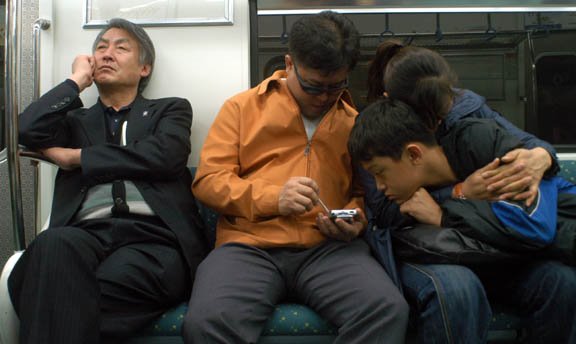
People, people everywhere. The subways are always packed on Saturday afternoons. Shoppers, kids just let out of school, and couples walking hand-in-hand fill the stations. Periodically one sees a flash of brown skin or blond hair as a foreigner walks by, and the Russians are easy to spot because they are invariably a solid foot taller than everyone else. The whole mess of people surges and shifts as individuals travel in a thousand directions at once.

The focal point for most of these people is Seomyeon Station, the beating heart of Busan.


I always board the train at Nampo-dong, and by the time it reaches Seomyeon station, the subway car is like a sardine can. People get out of their seats and pack even tighter as the train pulls up to the platform. An equally huge crowd waiting to board the train flashes past the windows like the ranks of an opposing army; however, the pressure to get off the train usually outweighs the pressure to get on. The doors fly open and the passengers who want off the train surge past the passengers who want on the train. I usually catch a few unintentional kidney shots and my heels get battered up pretty bad as this transaction takes place. The sensation is akin to being moved by a strong river current.

I actually cited Seomyeon station as an analogy during Special class last Wednesday while discussing the random movement of molecules in a balloon. We have been focusing on matter and energy the last few weeks, and so I decided we should build air-powered rockets as a fun way to conclude the unit.

I bought clown balloons, straws, and colored paper and made an example rocket dubbed the ‘Ms. Huh’ by Ms. Ha. The students all built similar contraptions, but with varying degrees of decoration and balloon sizes.


One of our Korean teachers, Sook-hyun, is going to depart from ESS in a month. In celebration of her successful tenure at ESS, we took her to dinner at the usual Sumgyupsal restaurant. The teachers pulled all the stops. The table filled with food and drink. Mr. Yi ordered four bottles of soju and everyone (except Gavin and I) went to town. Even Soo-hee and Na-ri, rare drinkers both, had a shot or two. Gavin and I drank Makalli and beer, arguing that we should save the ethanol for cars considering how expensive gas is these days.


After dinner, we all went to a Norae-bong. I sang a couple of songs, Wonderwall and Bohemian Rhapsody, but no one was terribly interested in hearing English tunes, and that was just fine with Gavin and I, actually. Korean pop songs were the main dish, and just about everyone took a turn with the mic.

Eun-hee displayed a masterful command of the music, and as she sang, the other teachers clapped or kept time with tambourines. Every now and then, Mr. Yi, our company Chief Operating Officer, would stand to great fanfare and artfully sing solo, drawing even more applause and cheering from the teachers.


It was a really good time, and Gavin and I both had fun, though we were exhausted from a long day's work.

Nature is cranking up the thermostat these days, and the temperature hangs around a very pleasant 70 to 75 degrees. The days are getting longer and the angle of the sun at its zenith is getting steeper and steeper, creating hard, ultra-crisp highlights in the middle of the day.


I’ve stopped using my motorcycle to go to work, even though the good weather is awfully inviting. The bus, though much less fun and convenient, certainly presents more photo ops.


The possibility of being permanently paralyzed in a motorcycle accident looms over my head whenever I put on my helmet and crank up my steed. A lifetime of someone else wiping my ass is not worth fifteen minutes of convenience. Still, I can’t quite bring myself to sell the bike, as it opens up a lot more of Korea to exploration. Just this past weekend I packed a bag and rode to Gyeong-ju to see the famous Bulgeoksa temple.

I seriously underestimated the distance - which I pegged at fifty kilometers - and ended up driving 100 kilometers. The scenery was nothing to write home about. Actually, it felt a lot like driving through North Georgia.

Highway 35, which follows the valley floor between twin mountain ranges and parallels the interstate, is a strait shot from Busan to Gyeongju. Every few kilometers a small collection of gas stations, convenience stores and other road trip staples would pop up on the horizon, all festooned in big, garish billboards. I stopped periodically to stretch my legs and let the long, terrifying lines of speeding cement trucks get ahead of me.

Finally, I arrived in Gyeongju, which was deep in the thralls of spring. Fields spanning many square kilometers opened up before me filled with brilliant yellow flowers. People by the dozens parked their cars and frolicked in the flora.


It was impossible to escape the crowds.


If it hadn’t been for the motorcycle, my trip to Bulgeoksa from Gyeongju would have entailed an hour-long ride in a sweltering, packed bus. As I was parking my bike, I watched those sweaty, annoyed tourists pour out of those hot, cramped buses onto the hot concrete for the long walk up to the temple.

I started my walk cool and refreshed. Naturally, a small town comprised mostly of expensive hotels, restaurants and trinket shops had sprung up around the famous temple, and my route to the temple’s entrance forced me to walk this gauntlet of yelling, pushy shopkeepers.

‘Eat here, we have good food,’ one woman shouted at me. Gwen channayo, I responded. That’s OK. Even this basic command of Hangulmal, which most foreigners probably don’t exhibit, drew a faint gasp from the ajumma and she didn’t pester me any further as I continued up the hill.

I walked past a handful of overpriced-trinket shops. The trinket of choice seemed to be the classic round oriental umbrella. The vendors sold them in a variety of explosively loud colors, and I saw many Korean women with one over their shoulder.


Across a parking lot and up a flight of stairs and I was in the Bulgeoksa complex. Red brick paths lined in shin-high, wrought-iron decorative fencing wound away from me in all directions through a large grove of trees covered in new Spring leaves. The wind accompanied me along the path until it terminated in a road winding up towards the main gate.

Across the road the trees were still covered in pink flowers. People picnicked in the grass as tourists casually walked the street lined with dozens of hotdog and trinket vendors.


I paid four thousand for a ticket and proceeded inside the gate towards the main temple. A beautiful stone bridge with three arches crossed a shallow pond fed by a waterfall at one end. Carefree yellow, orange and white goi the size of medium-sized dogs swam languidly in and out of the shadows cast by the bridge, halfheartedly hunting for handouts from tourists crossing the the bridge above.


Once at the main temple, I ran into scores of people. The temple itself was in the process of being decorated for Buddha’s Birthday celebration to commence May 5th. Brightly-colored lanterns hung from electrical cords stretched from one end of the ancient structure to the other, breaking up the muted browns, grays and greens of the temple with their vibrant colors.

Buddhism has been a part of life in Gyeong-ju since Mahayana Buddhism was imported from China over the course of the 7th century. The center of Buddhist life in Gyeong-ju lies on Mount Namsan north of the city. The Buddhist monuments that have been excavated near or on Mount Namsan to the present include the ruins of 122 temples, 53 stone statues, 64 pagodas, and sixteen stone lanterns. Excavations have also revealed the remains of the pre-Buddhist natural and animistic cults of the region.

Some of Korea’s finest examples of Silla-era Buddhist engravings can be found on Mount Namsan; however, the biggest jewel in Gyeong-ju’s crown is Bugoksa Temple at the northern end of the mountain, where I stood. According to the temple’s own records, the current temple was built under King Gyeongdeok in 751 A.D. King Gyeongdeok’s prime minister wanted the temple built in order to calm the spirits of his ancestors.

Bulgeoksa took twenty-three years to complete. Thirty-three stairs lead into the temple, equivalent to the 33 steps to enlightenment. The most unusual feature of Bulguksa is the twin 8.2-meter stone pagodas. The first, Seokgatap, is over 13 centuries old. It’s twin, Dabotap, is 10.4 meters high and dedicated to the ‘many treasures’ described by Buddha in the Lotus Sutra


I soon tired of the crowds at the site, and after a few more stops at sites around Bulgeoksa, I mounted my bicycle to leave. On the way out of town, I passed a vacation resort, probably the home base for many of the people I had seen earlier in the day. A large river drainage culvert had been converted into a ‘Kart Track,’ where resort-goers could purchase an ATV and bring their computer games to life. There was only one problem. When you crash in the real world, there are real repercussions.

I was photographing this mother and her two daughters enjoying themselves when they rounded a corner too fast and lost control of the ATV. Overcome with its own inertia, the vehicle rode up on two wheels and haphazardly exited the turn. It slammed into the curb and the little girl in the middle tumbled off.

The ATV ran over and crushed her leg into two pieces, and she began to scream, a sound I will never forget. The woman, who was visibly dazed by the accident, fumbled around her screaming child, unsure of what was wrong. Another man and myself rushed over and heaved the ATV, woman and all, off of the girl.


The girl scream louder and louder, whimpering between bursts. Her leg was crushed, the bone sticking through a gaping wound just above her ankle. Blood gushed down her leg as her father lifted her onto the back of the very vehicle that had run her over and rushed her to the hospital.

I was shaken by the accident. Earlier in the day I had also accidentally dropped my 800 dollar 80-200 f2.8 zoom lens, which would run 120 dollars to fix. The crowds, heat and duration of my travels had worn me down. It was time to go home.

The trip home, like the trip there, was perilous. Two hours on a motorcycle is hell enough, but two hours on a motorcycle in a land where traffic ‘laws’ are like some sort of national joke is pushing one’s luck.

People here tend to do all of their driving at the last minute. While on the four-lane highway on the outskirts of Busan, I watched a cab driver cut across five lanes of busy traffic - no turn signal or any warning whatsoever - in the space of fifty yards and then run the stoplight just ahead of oncoming traffic.

Was I surprised? No, not at all. Such behavior is commonplace, even among the buses and especially the motorcycle drivers. But as I said before, is the freedom of personal transportation worth a lifetime of paralysis? Probably not, and by the time I reached my apartment, I had pretty much convinced myself to put the bike up for sale. Now I’m not so sure, but probably another harrowing ride in the city will change my mind.

That’s all for now from SoKoNotes. I hope you enjoyed it. See you next week after Buddha’s birthday. Peace. --Notes

Sunday, April 23, 2006

I went to Haeundae over the weekend. Cold, windy, good light. I thought I'd start with photos this entry. They don't much relate to the topics I write on, so I might as well put em' out front. This first photo is of three school boys at the beach in Haeundae. I liked the shapes and lines of the clouds.


On Sunday I went back to Amnam to hike and get some quiet time. People fished along the dock, turning the concrete red where they were gutting and skinning their catch alive.


The way was steep back to the parking lot.


I saw this mother and her baby at the bus stop. That's the building next to my building in the middle-foreground.


A makeup shop dealing in mostly Western brands.


High my short ‘workplace environment’ wishlist is smaller classes. When I first met her, Kristen told me that classes at her hagwon rarely consisted of more than ten children. She said that some of her classes only have a handful of students. Julie, too, told a similar story about YBM, where she worked for the first six months of her now-ended year in Korea.

I only have two classes with less than eight children, and my average class size runs between fifteen and twenty-two pupils. The large size can be a blessing and a curse on both me and the children. On one hand, a large group of kids brings a lot of positive energy into a classroom. Find a game or activity that catches their eye and the childrens’ momentum can stretch it into thirty minutes or more. The competition heats up as children compete, their hands shooting into the air.

‘Mr. Jones! Mr. Jones! Junchisa! Junch--prepo--Preposition! Preposition!’

During these explosions of hands and English phrases, I can’t help but notice the children who are not raising their hands and yelling their heads off. Some look bored, many are flat-out shy and others simply can’t be bothered. I glance at them, sitting quietly in their seat, a maelstrom of English swirling around them, and I worry that they aren’t getting enough ‘air time.’ I lack the sophistication and experience to actually figure out what’s wrong, so I simply confront many of these children during class, which I now think might not be wise.

First, I float an easy question. The smartest children roll their eyes and reach for the sky, but I ignore their plaintive calls and point to the mute child, who’s eyes register something like shock. The class goes silent, as if perplexed by their teacher’s odd definance of the laws of natural selection. The air is heavy with anticipation. The momentum I had built up balances on a knife’s edge.

Usually the victim shakes his head vigorously or crosses his arms in the shape of an ‘x’ in front of his face, pleading with his eyes for me to take my question elsewhere. No, Mr. Jones, don’t call on me, I don’t know, I don’t want to answer, please leave me alone. Sometimes the student will indicate one of the outspoken children and say, ‘pass.’ My shoulders slump and I appeal to the student to give it his best shot. I sometimes guaruntee a point. Still no dice. The child shakes his head, looking around nervously or pointing to someone else.

The pupils on the other team know a dropped ball when they see one. They lunge out of their seat and start yelling, vieing for the unwon point. Screwed out of the point by Mr. Jones’ inconvenient sense of justice, the defending team begins an ear-splitting retort. The smartest children stand and mount a passionate defense for their right to answer the question dropped by their teammate, who is now cowering in shame.

‘TEACHER, NOOOOOO! OUR point! Pass! Pass! He pass it to me!’

I let the cacophony roll over me and I try to mask my frustration. I stare at the student, wondering what could be wrong. Now truth be told, the above anecdote is the compilation of a number of different experiences and not the recollection of a single event. With each child, the story is a little different.

Some of these ‘silent partners’ are, in fact, the brightest or nearly the brightest children in the class, and they can absolutely floor me with their answers. I think of them as English class ‘sleeper cells.’ These children are highly intelligent, good students, and they usually aren’t shy or bored, but rather, they are simply turned off by my style of teaching, which is crafted around a large class size. They aren’t large-group learners.

My sister also had difficulties as a child with learning in large groups, and for a couple of years she attended a private school with smaller class sizes. Besides her normal studies, the school also taught her skills for learning in the large-group scenarios common to most American public schools. After graduating, she enrolled in the Atlanta Public School system and never looked back.

Currently, she is on track to graduate from Georgia Tech in May - one of the premier technology schools in the United States - with a double major in biology and bio-chemistry and a minor in Japanese.

I can’t send these children to an elite private academy in North Fulton county unless I start selling heroin or I rob a bank, but a smaller class size would go a long way towards providing a comfortable learning environment for these children.

Last week many of the children attended day-long or even week-long field trips with their public schools, and thus many of my students were absent. 6A, a massive 22-child class I instruct three times a week, was cut in half. The first thing I did was move the shy, quiet or overwhelmed students into the empty seats closest to the blackboard and confined the miscreants to chairs within the girl’s team, as per some sage advice from Gavin.

Now that they were sitting close to the blackboard, swimming in a much smaller ‘pond,’ a few of the shy students and ‘sleeper cells’ woke up and willingly participated in class. They raised their hands, opened their mouths, and English poured forth. Not all of the students had such a miraculous transformation, but when the field-trips end and 6A regains all of its former strength, I hope to see some of these new hands in the air. I promise I will call on them first.

Sixty minutes is a long time to ask a score of eight-year-old children to sit in hard wooden benches in a darkened room. One would need a massive amount of stimulation, such as a feature-length animated movie, to pull it off. It would be suicidal to teach them about the future tense with stock pictures and chanting. Still, Soo-hyun and I tried just that last Friday.

After fifteen minutes the children began to loose interest. The youngest among them shifted nervously. Other started kicking backpacks or doodling on their handouts. Another ten minutes and the fidgeting had reached a crecendo. The classroom buzzed and hummed like a hot powerline searching for a ground.

A few minutes later that energy started to leak. The children started searching for more stimulation. They chatted or played rock-scissors-paper or played hide-and-go-seek with their neighbors under their desks. Others turned off like unattended computers, leaning on their neighbors like drunkards, eyes closed, a peaceful, future-tense induced slumber written on their faces.

The last few weeks Soo-hyun had some truly inspired lessons planned. We had great success with singing and dancing numbers such as ‘The Hooky-Pokey’ and ‘I’m A Little Teapot’ and teaching about insects. Jumping from creepy spiders to ‘My mom will make sandwiches and pack a thermos,’ was not a leap the students apparently cared to make.

Entire blocks of children were in la-la land, completely disengaged from the material. Even high-octane Jeong-yoon appeared bored, her head on her desk, staring up at the screen with a look of resignation painted on her face. Only a few students clung to the lesson. By minute forty the class was well on its way to getting out of hand.

The first to crack was Jeong-han, the boy whose parents recently divorced. Jeong-han is something of a mess. His mood swings rapidly from joy and compliance to anger and defiance, which is usually dominant. He obviously doesn’t give a lick for English class, and spends the majority of his time yelling his head off, running up and down the aisles, or generally doing whatever it takes to be the center of attention.

As the situation worsened in the auditorium Friday, the mounting chaotic energy fed Jeong-hans own inner mayhem and he did little to control it. He repeatedly left his chair to go talk to other students or hide behind the red stage curtain, which would draw Soo-hyun or myself away from what we were doing in order to Jeong-han back into his seat. After twenty minutes of class I had positioned myself directly in front of Jeong-han, who responded to this police action by staging a private riot, hitting me, pulling on my clothes or attempting to climb over the desk.

At one point I was distracted trying to teach two students from 1-2B and Jeong-han made a break for it. He managed to get on stage, where he plopped down in a green chair, center stage, the blinding LCD projector revealing him for all to see. Here I am. Look at me. His classmates found this the height of comedy, and they pointed at Jeong-han and laughed. Jeong-han wore a wide, nefarious grin. Soo-hyun quickly removed him.

A few more outbursts landed poor Jeong-han finally in the seat directly in front of Soo-hyun, though his proximity to the authority figure did little to curb his bad behavior. The fidgeting resumed, his arm his the laptop computer hooked to the LCD projector and it began to fall. Soo-hyun lunged in time to catch the two-thousand dollar machine, but the mouse clattered to the floor. Everything stopped.

The accident got everyone's attention. Soo-hyun's face was screwed up into a look of anger and frustration built mainly from fifty minutes of teaching an unwilling and apethetic class about the future tense, and this was the last straw. The sudden silence dwarfed Jeong-han like a sheer cliff face might dwarf a climber, but it did not cowe him. Jeong-han's grin lost little of its wattage even as Soo-hyun read him the riot act.

There, Jeong-han, there is the attention you desire, I thought to myself. Probably not the attention you need, but you don't really care, do you? You are hurt and probably overwhelmed with feelings of humiliation, anger, and betrayal. Your parents, the bedrock of your existance, has betrayed you. Your world has been yanked out from beneath you and you're pissed.

On Jeong-han's face was a look of mock shame as Soo-hyun finished reprimanding him. The smile and the fidgetig returned the second she diverted her attention. Jeong-han apparently felt no shame or guilt for disturbing the class and nearly destroying an expensive machine. His anger with the world murdered those feelings and his insatiable need for attention quickly buried them. Inwardly, I felt a great deal of sympathy for the boy who, ten minutes earlier, had been trying to stab me with a pencil. I probably won't be seeing much more of him.

And now for the "Korean Files," which has been combined with the "What were they thinking?" section.

"My class went see a musical and it was Jiggle and Hide." Notebook entry.

"I learn 15 different subjects, Korean, Math, English, Music, Computer, Morals, Jugglery and Tyrannical Government."

"Fairlysm Wonderful for the people."

"Fairly Korea" Both from a sticker stuck to a vendng machine.

Well, that wraps up SoKoNotes for April 23rd, 2006. I hope you all enjoyed it. The cherry blossoms have fallen and the road to Nampo-dong is trimmed in pleasing green foliage. The temperature is perfect for getting outside. I'll see you all again next week. Goodnight. --Notes
Tuesday, April 18, 2006

AHHHHHH!!! SPIDERS!!!


During the auditorium classes we taught about insects last week. Nothing drew a bigger response than the photos of the spider, centipede and cockroach. You could hear the classes yelling their heads off all the way in the teacher's lounge.

For the first (and probably only) time in SoKoNotes history, I want you to stop what you are doing and redirect your browser somewhere else...To my brand new website (you can always come back). Click the following link:
Stephen Jones Photography

Click on the "Explore the Site" link, sit back, relax and take a tour of the Appalachian Trail or experience picturesque Hattiesburg, Mississippi. Weird word, 'picturesque.' Weird place, Hattiesburg. I have spent the last three months building the pages from scratch using a program called Adobe GoLive. I had a lot of help from Gavin, who taught me how to operate the program. He also showed me the main strength of GoLive: The ability to seamlessly integrate Photoshop files using SmartObjects. Photoshop is a program I am much more familiar with, and it made laying my pages out much easier. I also had a "For Dummies" book on GoLive courtesy of my parents, and it came in handy when the time came to upload my site to the server. A marvelous book. My deepest thanks to my parents and Gavin.

Now back to the blog.

I think it's funny how some children grow faster than others. In some of my classes, particularly my fifth and sixth graders, there is a student or students who are measurably larger than their peers. The children in these classes are between eleven and thirteen, at the threshold of puberty, and the ole' mother nature has decided it's time they become adults.

Take Ho-jeong, for example. I taught her for two months last semester as a fifth-grader. At twelve years old, she was not the oldest child in the group, but Ho-jeong stood a solid foot taller than the second-tallest child in 5A. When I first took the class, I thought for a second that perhaps Ho-jeong was a middle-school student who got her classroom mixed up. When the children all stood up every day to greet me, Ho-jeong looked like Gulliver among the Lilliputians. When she walked down the halls with her friends, one could have easily mistaken her for their "Ohni," older sister.

What really threw me was Ho-jeong's behavior. My natural inclination towards Ho-jeong was to treat her like one of the older children, and I unconsciencely expected more from her than her classmates. For one thing, she was the smartest student in the class. Her hand would rocket into the air after every question, her eyes bulging, a plaintive look on her face.

"Mr. Jones! Mr. Jones! I know it! I know the answer! Verb! VERRRB!"

I assumed she was equally mature. This turned out to be wrong-headed. Make no mistake, Ho-jeong was the sharpest knife in the drawer, and her genetic code was way ahead of the curve, but psychologically speaking she was still a child. She would play with the other children before class, towering over even the boys as they drew goofy faces, monsters and princesses in the chalk dusk adhered to the blackboard. Only Ho-jeong could draw high up on the blackboard where the other children couldn't reach. She would laugh as they jumped up and tried to erase her doodles.

There are other tall fifth and sixth-graders in my other classes. Seong-leong of my current 6A class , who is all of twelve years old himself, is as tall and almost as broad at the chest as I am. Ah-hyun of Advanced 4-1 is taller than Ho-jeong; however, Ah-hyun possesses a much more reserved personality.

The opposite can be true, too. I have children in my upper-level middle-school classes that could easily blend into a lower classes. The smallest of these late-bloomers tend to act out more than their fully-developed peers, as if trying to make up for their small size with the volume of their voice.

If I had to pick a favorite age group, I would not hesitate to pick the sixth-graders. They are still young enough to possess a great deal of enthusiasm for learning and they have the cognitive complexity to engage in some of my most fun, creative activities. If I had to pick a second favorite group of students, I'd pick the youngest students. Pound-for-pound, no other group of children exhibits more energy, vitality and honest enthusiasm than a pack of first and second-graders. This is Jeong-yoon, a child truly like no other.


The raucous, joyful sound of Jeong-yoon's laughter filters into the teacher's lounge all the way from the third floor around 2PM every Monday, Tuesday and Wednesday, heralding my first class of the day. Gavin, Dave or I have only to step into the same room as Jeong-yoon and she begins gushing with laughter. Her English ability is tops, too. When we started the new semester, Jeong-yoon took the new boys under her wing, guiding them through the auditorium class on Friday.

Some nights as we walk to dinner, particularly after a good day, Gavin will remark in his deep, no-bullshit tone, "I really like our kids."

Me too.

What's so funny to me is how before I came to Korea children were, in many respects, a mystery. In some ways, my job as a newspaper photographer well-prepared me for interacting with children, as many of my assignments centered around gathering images of cute children doing cute things so people who are suckers for anything cute would buy the paper.

My sporadic contact with children in Hattiesburg couldn't prepare me for the benefits of those interactions. I had no idea that teaching could be so rewarding. Nothing makes me feel as great as the honest 'hello' and a smile from a passing pupil. The act of teaching alone forces one to build a relationship with the children so one can understand what and how they need to learn. This simple act of caring for another person is healing in of itself, a balm for the wounds inflicted by life in the real world. Teaching has helped me to grow and mature, face fears and solve problems.

* * *

The ESS staff went on a 'picnic' last weekend. I don't know many picnics that start at 6AM, last all day, and involve driving by bus all the way to the other side of the country. Most of my picnics involve a local park, a cloth, a bottle of wine and some food.

This was a balls-out road trip.

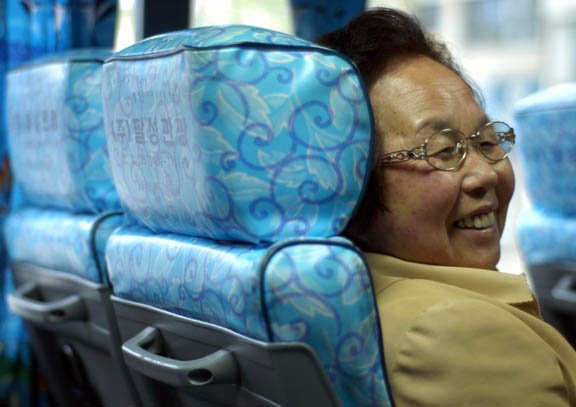
Mr. Kim rented a big orange tour bus. Just as I expected, somebody neglected to install an aircraft-style lavatory in the rear (a la most of the tour buses I have encountered in the United States). In preparation for just such a lapse in judgment, and still carrying the scars from the embarrassing pissing episode on the bus to Gyeong-ju during last fall's Chuseok holiday, I left my water bottle at home.

Most of the teachers were there, casually dressed, which is something of a shock when one is used to strait lines and high-heels all the time. Soo-hyun wore light blue jeans with a tear in them. Soo-hee cut the glare with a pink baseball cap. Even the normally exquisitly-dressed, ultra-professional Ms. Ha sported jeans, a t-shirt and a big smile. One of my favorite ESS personalities, Bok-shim, was there too.

Bok-shim is a stout, good-natured ajumma no taller than my shoulder with a confidant, pugnacious swagger and a gentle wit. Often times she can be found in the third-floor lobby chatting up the receptionists and scolding the children, a mop in her left hand and her right hand stuck in her jacket like Napoleon Bonaparte. She always wears a little bling: A watch or a ring encrusted with gold and jewels, though it's her warm smile and friendly nature that makes Bok-shim really stand out.

On Saturday she strutted onto the bus with a giant purple gem around her finger and the frames of her glasses so ornate they looked like they had been made in Rivendell.


The bus shuddered to life as the driver dropped it into gear and off we went to the provence of Hye-nam, the hometown of Na-ri and a five hour journey to the opposite side of the Korean peninsula. Gavin and I quickly fell asleep to the soothing clucking of the Korean women chatting a few seats up.

The first place our bus visited was, ironically, a rest stop. Having had deprived myself of water in anticipation of a torturously long journey, I looked on from the bus as my better-hydrated companions disembarked and relieved themselves. At the onset of the trip Mrs. Kim had provided a grocery bag filled with goodies like candy, cookies and fruit to all in attendance. I snacked on "tok," cinnamon-honey sandwiches and wasabi-encrusted peas while waiting for the bus to get moving again.

Food was really the highlight of the day, but more on that later.

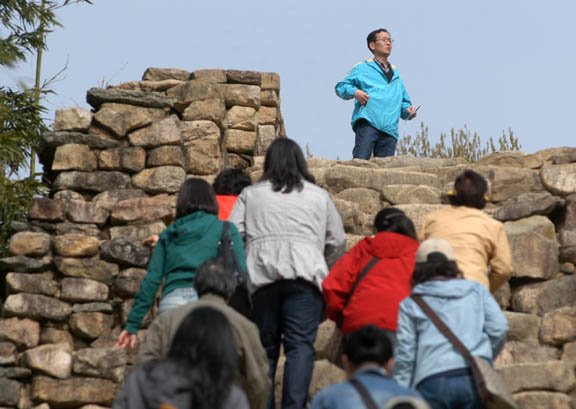
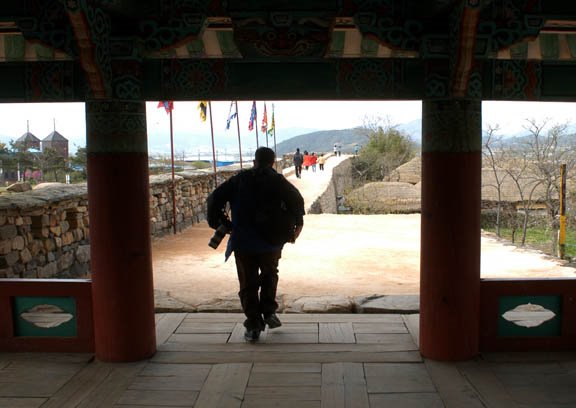
Our second stop was a traditional Korean village in the style of the 14-1500s, carefully preserved by the Korean government, perhaps to remind people of their history and heritage. A thick (my eyes put it at ten feet) stone wall fifteen feet high encircled the entire town, and it was upon this battlement that we began our tour.


The high wall gave us a splendid view of the town within. Uncomplicated thatch-huts and tiny farm plots dotted with chickens dominated the scene. Tourists in brightly-colored parkas and nylon sweatsuits walked among the soft earthen-toned structures, taking photos and pointing. In their vivid clothing, they looked to me like blooming flowers in a pile of hay.

Some of the huts were occupied, and some of the plots were alive with spring crops. People live here still, apparently. I could see their laundry drying on lines strung up between huts, and some of them were out and about, tending to their business.


The farmer had old, bloodshot eyes and a face that said nothing. I felt sort of odd as I walked on the wall high above him, like I was invading his home. I wondered if in five-hundred years this village will still be here, or if maybe there will be another "traditional Korean village" made to look like Dongsamjugong: A skyscraper full of villagers, a quickie mart and a PC Bong.

At one end of the wall was a hill, and the wall rose abruptly to its summit. Mr. Yi took the lead up this stoney embankment.


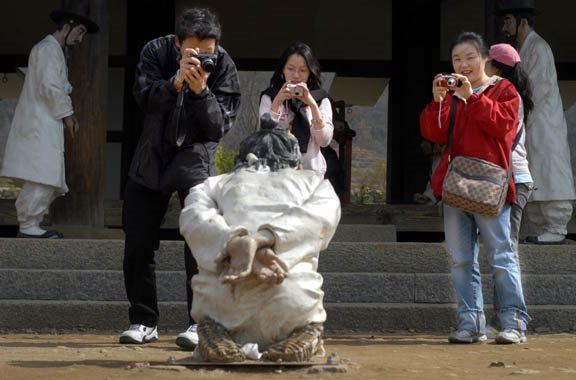
After touring the museum, we came to the ancient village police hall. Within were a few plastic "prisoners" and their "accusers." They were in cheesy, dramatic poses of agony or penitence. The Korean staff chuckled and took photos of the permanently apologetic criminal.


Our next stop was at the home of a famous Korean scholar named Gosun Yun Sun-do, reputed to be "one of the greatest writers in Korean history," according to the plaque at the entrance to his ancient ancestral home. Gosun, who lived from 1587 to 1671, got in a lot of trouble for pointing out the corruption of the oppressive Korean government officials in power. he was exiled, twice, and pardoned, twice. During his exile(s), he wrote poems about his "mountain fastness" in Hye-nam. I likened him to a Korean Thoreau, although Henry exiled himself versus getting the boot from corrupt government officials a la Yun Sun-do.

A giant, five-hundred year old tree stood in the courtyard of his home, the only living thing to have shared it's existence with the outspoken poet. The teachers took pictures. Mr. Kim's son Byeong-su played with a dog. I practiced reading Hangul, drawing quite a few "oooohs" and "ahhhhs" and encouragement from the staff. Afterwards, it was time for lunch.

The only highlight from lunch was the Makalli. I was frankly surprised when the waitress brought out the brown earthen bowl filled with milky-white, 25% alcohol-conent rice liquor. Drinking with my boss was not on the agenda, and Gavin and I were reticent to sacrifice any inhibition. We drank a bowl or two. The Korean teachers seemed even more apprehensive, and many didn't finish the drinks.

After lunch we went to a huge Buddhist temple.


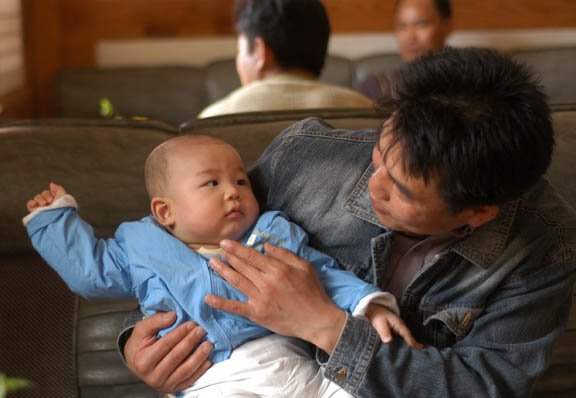
The problem with bus tours is that one never gets enough time to properly explore such sites. Dozens of structures, courtyards and pagodas were there to be explored, but we only had thirty minutes or so before we had to return to the bus. On the way back I stopped at a trinket shop to see if they had any flashing-Buddha keychains (many temples do) and I came across this man and his son in some nice window light. It must be odd, cosmically speaking, when a tourist photographs another tourist in a trinket shop.
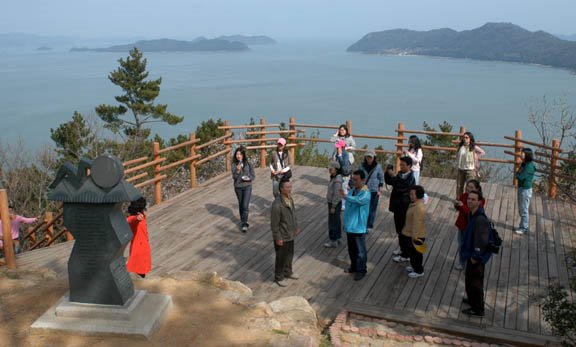
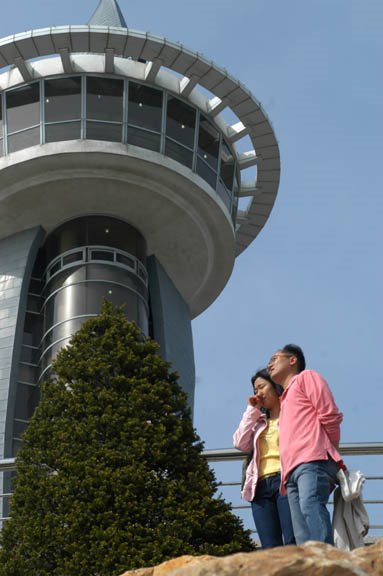


After a long ride, the bus took us to our final destination: Tangkeut, The End of Korea. Unless you put on a bathing suit or jumped in a boat, you could not go any further south on the peninsula than here, and the people of Hye-nam were proud of this. They even erected a sleek metal tower at the site's summit so you could look out over the sea.


We took photos from a platform overlooking the tiny islands surrounding Tangkeut.


As we walked down to take a piss, Na-ri told me that there had been a curse on the men's bathroom at Tangkeut. It was rumored that people who pissed within died soon thereafter. As I took my place among all the dead men at the urinals, I wondered how I would meet my untimely demise. My first thought was the motorcycle. No, I thought, too predictable. Cursed lavatories probably lead to mysterious, suburban-myth style deaths like being crushed by a falling fast-food sign or choking on an octopus tentacle.

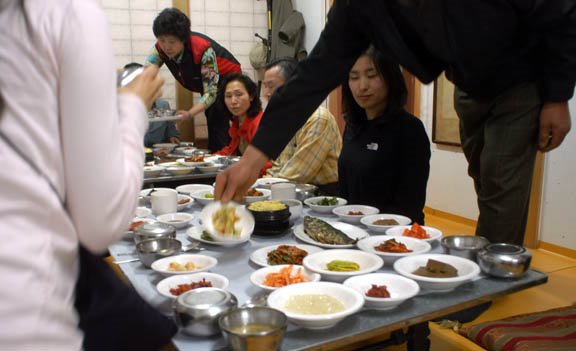
Following this climax in our journey, Mr. Kim treated us all to dinner at a traditional Korean restaurant specializing in a marinated, bar-b-qued beef called Galbi.

"The people of Hye-nam are famous for their cooking," said Mr. Kim.

The meal ranks high on my "greatest life dining experiences." Tables covered in white dishes filled with a cornucopia of Korean food were set at our feet. Fish, beef, vegetables drenched in ginger, kimchi, spicy crabs and the truly fantastic Galbi made it's way into my mouth. It was an amazing meal.


The bus-driver got us home in record time, according to Mr. Yi. I spent the entirety of the return journey snuggled up with my iPod and a book. We disembarked at 10:30. Na-ri's father gave each staff member a five-kilo box of sweet yams to take home, and it took all my remaining strength to lug the box of starch 100 yards to the taxi stand.

Like I said before, bus tours suck because one doesn't have the time to properly explore the amazing places where the bus stops. To my mind, the best part of the trip wasn't the stops or even the amazing food, it was getting to know my fellow teachers outside of work.

Within ESS, the Korean teachers are friendly, but focused on the task at hand. My communication with them is usually limited to talking about classes and helping them understand or pronounce difficult English idioms, phrases and words. They wear pressed suits, black slacks and meticulously manage their makeup. When I come back from a series of classes, I am covered in chalk dust as if I just got attacked with a chalk-grenade and the Korean teachers still look like the partners in a major Korean law firm.

On the bus, at the stops, and in the restaurants, it was like I was hanging out with the Korean teacher's alter-egos. Like I said earlier, the ladies wore jeans, t-shirts and tennis shoes. They giggled like little girls, held hands and joked with Gavin and I. They cut up at the restaurants and enjoyed themselves, and I enjoyed being a part of their group. I felt less like a stranger in a strange land. This was one of the experiences I was looking for when I came to Korea.

Well, that's all I have for you this time. Here are a few more photos from the week.


Gavin and I spent Sunday in Haeundae. This was taken at the APEC island.


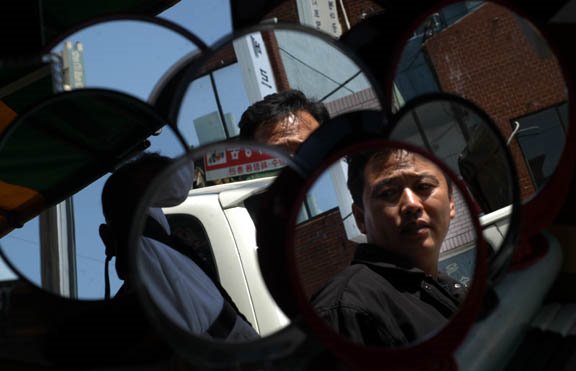
A mirror salesman in Nampo-dong.


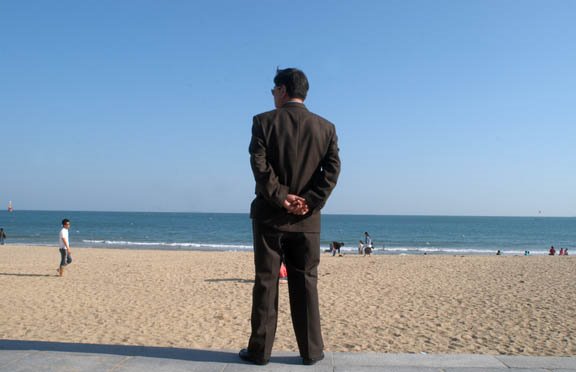
Old guy on the boardwalk in Haeundae.


No Korean Files this week, as I am building case for the next update. I hope everyone is doing well, and please take the time to check out my website. The URL again is as follows:

www.notesjones.com