Alright. Here goes.
One of the great missions in my life is trying to understand the forces that pull me in one way or another. On the ground, the forces are so huge they seem invisible. Then something happens that causes me to look back at my past that I see them, like a man cresting a bare mountain peak only to turn around and look over the great range he crossed under the cover of trees. Everything makes sense.
"There is the that bog that dragged me down. There is the campsite where I met a friend. There is the road where I went into the city. There is the mountain I worked so hard to climb, and there is the beautiful waterfall I saw near the top."
The good, the bad, the unexplainable; it’s all laid out so well when you just turn around and look. It all just fits.
I turn around a lot these days. I forget sometimes that the past is made up of the present, and that it slips eventually into the future. Time marches on like the strokes of a paint brush, each day a coat of fresh pigment, drying and becoming the fading past in the blink of an eye.
The strokes seem random and outrageous until you hold them away from you. Then the content materializes. The colors compliment one another. The pattern unfolds and both fascinates and terrifies you all at once in it's completeness.
What is difficult is understanding where the artist is going with the work, what it will finally look like when it is finished, and more ominously 'when' will it be finished. The forces of creativity and the concept of the future are one, and they can be totally frustrating or liberating depending on your faith in the artist.
That’s what it takes to live in the present: Faith, a belief in the future. That’s why I wasn’t frightened by my decision in the summer of 2005 to drop everything and fly to a distant corner of the earth, to live in a strange land, in a strange job, with strange people speaking a strange language. I had faith. That was why I wasn't afraid to walk 2,176 miles through hungry-bear-infested woods.
I believed in the creative power of doing something different. I closed my eyes as I applied the paint to my canvas and trusted that the stroke would compliment the others that came before it, and it did. Korea was a beautiful stroke, a learning experience, a place where I grew in a positve way. It was hard, really hard, at times, but I stuck with it because I knew deep inside that I was on the right path.
When I returned back in October, I jumped into starting my business. I felt like that was the logical next step in my life. I'm a good photographer. There is lots of demand for photography in Atlanta. Everything has been going alright, but at the same time, things haven't. I find that I keep looking back, like a man who thinks he might be lost. I spend hours reading this blog, smiling, laughing, crying, wondering why I can't put it down and I can't add to it.
I work on my business, but there is no force behind my work. Like a loaf of bread with no yeast, I work and work and work and the bread doesn't rise. I don't seem to have my heart in the work, and my mind is always full of doubt. I am a person who, once his heart is behind something, becomes unstoppable, irresistable, consumed by the task at hand. When it comes to the photography business, I feel consumed only by doubt.
I'd like to share a story with you from 2003 when I was hiking the Appalachian Trail. I think it will illustrate how I feel right now.
The Appalachian Trail is managed by thirteen or so 'trail clubs,' with thousands of volunteers who maintain it year after year. It moves my heart to think about all of those people giving their time, money and sweat to maintain a simple footpath. This spring I plan on joining their ranks, but that's not where I'm going with this. Every year those clubs decide that a certain section of trail has had too much traffic and the trail needs to be re-routed for a few years so the old section can 'heal.'
Some of these re-routes were so new that they hadn't made it into the maps (mine were four years old) or guidebooks. The old, well-worn and muddy rut of the old trail would wind off in one direction and the new path with it's blinding white blazes and freshly cleared underbrush would stretch off in the other. There was usually a sign indicating that the trail had been re-routed. Sometimes, due to weather, forgetfulness or vandals, the aforementioned sign would go missing and many a hiker would simply cruise right on past the intersection and keep following the old rut.
I did this a lot, sign or no sign. Lost in thought and not paying attention, I'd innocently follow my happy feet down a former section of trail. Sometimes I'd have no idea that I had taken the unofficial route until it re-connected with the new trail sometime later. I'd come to an intersection (not expecting one), look dumbly at my map, scratch my head, realize what I did, shrug, and keep walking.
One time, I gave myself an awful scare. To doubly make sure no one followed the old trail, the trail crews would paint over the south-facing blazes with dark brown enamel. North-bound hikers would see that there were no white blazes and thus take the new route. However, many of these trail crews would neglect to paint over the North-facing blazes, thinking there was no way a northbound hiker would miss the sign indicating the detour.
One time (I think I was in Virginia) I was walking along and noticed there were no white blazes on the trees. Confused, I looked behind me, and lo! There were white blazes! I thought I was on the right path and I kept walking, but the lack of blazes on the south side of the trees bothered me. Was I going the right way? Did I miss something? Maybe the blazes were old and faded. If indeed I am on the right path, why are there no blazes? It took me almost a mile of walking in confusion before I realized the ruse innocently played on me by the trail maintainers. I hustled back to the intersection, cursing.
That feeling of not going the right way, of looking for signs of affirmation and seeing none, that's the feeling that's been eating me since late December.
I believe that every human is endowed with 'blazes,' internal truths that guide them through life. Angels, the Soul, God, whatever you want to call it, I believe they are part of every person on this planet. Some people listen to them, others ignore them. I believe that when you listen to them, success and happiness follow; and when you ignore or repress them, misery, doubt and failure become your companions (read "The Alchemist" by Paulo Coelho).
So what has kept me going if all this time I've felt that I've been walking in the wrong direction? What have been the North-facing blazes that have confused and misguided me? Well, for starters, I am a talented photographer, and when I was in Korea, I felt that I should give that a chance to grow and blossom once I got back to Atlanta. I felt that I couldn't be anything else. My parents were going to support me with housing and a car. I thought that was to be my career, my life path. I was stubborn, and that has paid dividends of uncertainty. This dogged adherence to a former dream has kept me asleep to reality.
I've tried fighting it. I bought $9000 in equipment in an effort to force myself to keep going, which has now ended up simply making me feel trapped. I justified my misery by banking on my future. "Don't worry, Stephen. You'll get rich and then you'll have all the time in the world to do what you really want," I tell myself. There is something really insidious about that statement, if you think about it.
So what do I want to do?
The greatest thing about realizing that you may be walking down the wrong path is that the right path is usually very close at hand. In my case, it was in my face every day I breathed the Korean air: teaching.
Make no mistake, teaching in Korea was hard. I lived in a dump. I had few friends. In the classroom, I got no supplies save a chalk board, thirty screaming children who didn't speak English six to eight times a day, and daily xenophobic torment from my superiors. Still, something about it felt right. The days when I came to school and did a great job, I got an equally great reward: A feeling that I was doing something worthy and additive to the common good. And when I left at the end of my contract, the children proved those feelings contained a modicum of truth with their letters, flowers and tears.
My roommate and I would laugh and talk for hours about our students, our successes and our failures. We still do.
Teaching appealled to me in many ways. It harnessed my creativity, my caring nature and my love of people. For these same reasons, photojournalism appeals to me. Even writing about it now, I am energized and excited. I look forward to my chess classes every week, and I am beginning to get a handle on the discipline issues that plagued me in Korea (speaking the same language helps a lot).
This morning I had another existential conniption and got really depressed. I consider these little depressing fits something of an alarm ringing in my head, like the guy on the Titanic yelling, "Iceburg right ahead!" Could I just be a lazy asshole who doesn't want to put in the work needed to start a business? No, that's not me. When my heart is behind something, I'm like a juggernaut. Nothing stands in my way. Aspects of my personality appear that I didn't know existed. I become excited, resolute, unflappable.
Booking a swim meet just doesn't ellicit these feelings. The thought of harrassing another editor for a morsel of an assignment doesn't, either. Barnstorming bridal shops is not me at all. I am beginning to realize that I may be the photographer, but I'm not the businessman. In this market, you can't have one without the other.
But every week, my uncle Steve's secretary tells me that, "As much as we'd like to give another coach the chance to teach at Mt. Carmel, the parent coordinator says she wants Stephen Jones and no one else."
If that isn't a south-facing blaze, than I don't know what is.
--Notes
Friday, February 16, 2007

Sunday, December 24, 2006
Merry Christmas from Atlanta!
There were only two reasons to come home, and being with my family over the holidays was reason number two. Reason one, of course, was Stephen Jones Photography.
Last week my family bought a Christmas Tree. However, there was no room in the living room for it, so my parents put it on the coffee table. Where once a lamp, coasters and a few magazines rested, there sprouted a tree reaching a foot or two higher in the air than nature intended. Dad and I clothed it in lights, Sara and her boyfriend came over and we all decorated it with ornaments from the dusty boxes mom brought downstairs from Sara's closet.
Ornaments are like personal artifacts. Not all of them have stories, but many of them are from different times in my life. Sara found ornaments with pictures of us as children, ornaments we made in grade school, ornaments from Happy Meals, ornaments my grandmother once hung on Christmas trees when she was a girl and she and her mother were living alone in Kansas City, estranged from her violent father.
Even the generic ornaments my parents bought from Ace hardware over the years, the balls and butterflies with their brass hooks, told a story. There were ornaments from the seventies when my parents were first dating, ornaments from eighties and nineties when Sara and I were kids, and brand-new ornaments bought just this year that one day will be from this period in our lives.
We drank eggnog and brandy and listened to the London Philharmonic play Vaughn Williams' emotional orchestral arrangments of ancient English folksongs. We talked. We laughed. We were a family. I found myself satisfied for once with my decision to come home.
I've thought long and hard about going back to Korea. Starting a business is hard, but that isn't the reason. I am not a stranger to hard work. In fact, the difficult part of starting a business is finding time to put your feet up and relax. No, I seriously consider going back to Korea because life was so damn easy there.
I can already hear you saying, "But wait! You bitched a lot about Korea." And you'd be right. I did. It was. But not like this.
Teaching was hard, living in Korea tried my patience, but I loved it because it was different. I felt like every day was an opportunity to explore, to learn. Even though my days had a pattern, there was always the chance for something totally mind-blowing to occur. Learning the language and navigating the culture presented challenge enough to keep my mind occupied. Not only that, I had a steady, relatively good paycheck, a challenging job, and lots of spare time. I have none of those things here, especially the spare time. Also, there is something about Atlanta that changes everything. The magic of 'new' is gone.
My waking hours are framed by an emotion resembling remorse. I am starting out on a new path, but it feels old. The excitement of Korea and the Appalachian Trail is absent. My surroundings are so familiar, and with familiarity comes dullness, the unspoken curse of memory.
For the last few years, I have lived away from home. College, Chattanooga, The Trail, Hattiesburg, Korea. Long has it been since I woke to the sound of my parents making breakfast. Strange are sounds that never change. In the space of my absence I have grown a lot, and arrived home far from where I left. But little has changed in those years. The owls still live in the trees towering over my house where it slowly ages in the wooded cove of a midtown neighborhood. My dad still labors every weekend to keep it standing. Some friends have moved away. Others stayed, married, had kids. I see them and remember, and when we speak, one or both of us carries the burden of meaningless memory, recognition without bond, things done or undone that don't matter anymore but still seem to cling to us like a faded tattoo barely visible under our sleeve. We're adults talking to memories of childhood.
The 'oldness' of Atlanta acts as a weight, a burden weighing me down. It is the weight of birth. Everything about me was born in this city, starting with my physical being in the fall of 1979. Within a ten-mile radius from my house is my first day at school, my first friend, my first kiss, my first experiment with drugs, my first broken arm, my first broken heart. If experience is the brick and morter of personality, Atlanta is where I was built, and when you return to the place of your construction, you cannot help but feel the rough hands of the creator upon your soul.
There were plenty of times that creator screwed up. All of my issues, my personality problems, they were all born here, too. Some of them were with me when I was born. Others were the result of experience, and sometimes during my travels throughout the city, I come across these personal epitaphs. There's the corner by Mary Linn Elementary where John Arnold used to beat me up after school, and that's the park where I broke up with a girlfriend I was close to. Here is the school where I spent a year with no friends. All of these experiences left marks on my soul, scars that itch faintly as I drive by.
Anywhere else in the world, I still carried this luggage, but they were easier to ignore. Living in and around Atlanta is to live a lot closer to who I am, the good and the bad. Viewing those old tapes in the cold light of adulthood makes things worse. My shortcomings suddenly take on form and reason. Some of them I feel like I can resolve. Others look to me like boulders stuck in a mountain side. Big. Immobile. Perhaps part of the mountain itself. I must learn to live with them or get around them. This is who you are, because this is who you were.
One thing Atlanta can't do is tell me who I will be, though it has become clear that whoever that person is, he will be shaped by who he was. There is no avoiding it. How I change is entirely dependant upon how I handle the issues and history that Atlanta has held up to my face. Starting Stephen Jones Photography is only part of what is starting in Atlanta. Stephen Jones himself is starting, too. Who he will be is not immediately apparent. Against the fading portrait of my youth I must craft a new work of art.
Some things and some people will fade away. Others will come into the foreground. Interests and passions will be stoked, habits formed, clothes bought and hangouts established. I will catch a break and my business will thrive. Or it won't and I'll find something else to do. It doesn't matter. Over time, the person inside will make it's habitat outside. It takes years. I must be careful about which parts of my past may become part of my future.
The only thing that is new about Atlanta, the only magic that awaits me is within myself. I will bring to this city a person it has never known, and that person will grow and thrive and build a new life. I do not have to be ruled by my past, but in order to move beyond it I must face it and come to terms with it.
I large measure, this is what Christmas is all about: Rebirth. To me, the principle lesson of Christ's birth is that what has happened is trumped by what is and what will be. To live in wholly in the present is an act of confession. To focus on the future is to forgive.
Sometimes I feel like the message of Christmas is lost on most Americans, most of whom mistakenly celebrate it a week later at New Years. Decorating the Christmas Tree with my family has reminded me of the good experiences in my life that live side by side with the bad. I am reminded that life is a mix of good and bad experiences, a series of questions against which we are all tested, and those of us who can smile at it all have passed with flying colors.
Peace
--Notes
There were only two reasons to come home, and being with my family over the holidays was reason number two. Reason one, of course, was Stephen Jones Photography.
Last week my family bought a Christmas Tree. However, there was no room in the living room for it, so my parents put it on the coffee table. Where once a lamp, coasters and a few magazines rested, there sprouted a tree reaching a foot or two higher in the air than nature intended. Dad and I clothed it in lights, Sara and her boyfriend came over and we all decorated it with ornaments from the dusty boxes mom brought downstairs from Sara's closet.
Ornaments are like personal artifacts. Not all of them have stories, but many of them are from different times in my life. Sara found ornaments with pictures of us as children, ornaments we made in grade school, ornaments from Happy Meals, ornaments my grandmother once hung on Christmas trees when she was a girl and she and her mother were living alone in Kansas City, estranged from her violent father.
Even the generic ornaments my parents bought from Ace hardware over the years, the balls and butterflies with their brass hooks, told a story. There were ornaments from the seventies when my parents were first dating, ornaments from eighties and nineties when Sara and I were kids, and brand-new ornaments bought just this year that one day will be from this period in our lives.
We drank eggnog and brandy and listened to the London Philharmonic play Vaughn Williams' emotional orchestral arrangments of ancient English folksongs. We talked. We laughed. We were a family. I found myself satisfied for once with my decision to come home.
I've thought long and hard about going back to Korea. Starting a business is hard, but that isn't the reason. I am not a stranger to hard work. In fact, the difficult part of starting a business is finding time to put your feet up and relax. No, I seriously consider going back to Korea because life was so damn easy there.
I can already hear you saying, "But wait! You bitched a lot about Korea." And you'd be right. I did. It was. But not like this.
Teaching was hard, living in Korea tried my patience, but I loved it because it was different. I felt like every day was an opportunity to explore, to learn. Even though my days had a pattern, there was always the chance for something totally mind-blowing to occur. Learning the language and navigating the culture presented challenge enough to keep my mind occupied. Not only that, I had a steady, relatively good paycheck, a challenging job, and lots of spare time. I have none of those things here, especially the spare time. Also, there is something about Atlanta that changes everything. The magic of 'new' is gone.
My waking hours are framed by an emotion resembling remorse. I am starting out on a new path, but it feels old. The excitement of Korea and the Appalachian Trail is absent. My surroundings are so familiar, and with familiarity comes dullness, the unspoken curse of memory.
For the last few years, I have lived away from home. College, Chattanooga, The Trail, Hattiesburg, Korea. Long has it been since I woke to the sound of my parents making breakfast. Strange are sounds that never change. In the space of my absence I have grown a lot, and arrived home far from where I left. But little has changed in those years. The owls still live in the trees towering over my house where it slowly ages in the wooded cove of a midtown neighborhood. My dad still labors every weekend to keep it standing. Some friends have moved away. Others stayed, married, had kids. I see them and remember, and when we speak, one or both of us carries the burden of meaningless memory, recognition without bond, things done or undone that don't matter anymore but still seem to cling to us like a faded tattoo barely visible under our sleeve. We're adults talking to memories of childhood.
The 'oldness' of Atlanta acts as a weight, a burden weighing me down. It is the weight of birth. Everything about me was born in this city, starting with my physical being in the fall of 1979. Within a ten-mile radius from my house is my first day at school, my first friend, my first kiss, my first experiment with drugs, my first broken arm, my first broken heart. If experience is the brick and morter of personality, Atlanta is where I was built, and when you return to the place of your construction, you cannot help but feel the rough hands of the creator upon your soul.
There were plenty of times that creator screwed up. All of my issues, my personality problems, they were all born here, too. Some of them were with me when I was born. Others were the result of experience, and sometimes during my travels throughout the city, I come across these personal epitaphs. There's the corner by Mary Linn Elementary where John Arnold used to beat me up after school, and that's the park where I broke up with a girlfriend I was close to. Here is the school where I spent a year with no friends. All of these experiences left marks on my soul, scars that itch faintly as I drive by.
Anywhere else in the world, I still carried this luggage, but they were easier to ignore. Living in and around Atlanta is to live a lot closer to who I am, the good and the bad. Viewing those old tapes in the cold light of adulthood makes things worse. My shortcomings suddenly take on form and reason. Some of them I feel like I can resolve. Others look to me like boulders stuck in a mountain side. Big. Immobile. Perhaps part of the mountain itself. I must learn to live with them or get around them. This is who you are, because this is who you were.
One thing Atlanta can't do is tell me who I will be, though it has become clear that whoever that person is, he will be shaped by who he was. There is no avoiding it. How I change is entirely dependant upon how I handle the issues and history that Atlanta has held up to my face. Starting Stephen Jones Photography is only part of what is starting in Atlanta. Stephen Jones himself is starting, too. Who he will be is not immediately apparent. Against the fading portrait of my youth I must craft a new work of art.
Some things and some people will fade away. Others will come into the foreground. Interests and passions will be stoked, habits formed, clothes bought and hangouts established. I will catch a break and my business will thrive. Or it won't and I'll find something else to do. It doesn't matter. Over time, the person inside will make it's habitat outside. It takes years. I must be careful about which parts of my past may become part of my future.
The only thing that is new about Atlanta, the only magic that awaits me is within myself. I will bring to this city a person it has never known, and that person will grow and thrive and build a new life. I do not have to be ruled by my past, but in order to move beyond it I must face it and come to terms with it.
I large measure, this is what Christmas is all about: Rebirth. To me, the principle lesson of Christ's birth is that what has happened is trumped by what is and what will be. To live in wholly in the present is an act of confession. To focus on the future is to forgive.
Sometimes I feel like the message of Christmas is lost on most Americans, most of whom mistakenly celebrate it a week later at New Years. Decorating the Christmas Tree with my family has reminded me of the good experiences in my life that live side by side with the bad. I am reminded that life is a mix of good and bad experiences, a series of questions against which we are all tested, and those of us who can smile at it all have passed with flying colors.
Peace
--Notes
Monday, October 09, 2006
OK, I'm going to try. I've sat down at my computer. Photoshop is off. So is GoLive. I've made time and space to sit down and update Sokonotes.
When I returned from Argentina, I was swallowed up by my ambition. For those of you who don't know, the primary reason for returning to the States was to start a photography business, and as you will remember, I went to Korea specifically to raise capital for that venture. I'm not positive that I have enough money, but I'm here and it's going to happen.
Heck, I've already incorporated. if anyone needs a photographer, just call Stephen Jones Photography Inc. The number is on my website, www.notesjones.com.
Starting a business, any business, is an uphill climb. I really had no idea what that climb would be like. I sort of dove into the venture the same way I approached a big mountain on the Appalachian Trai: Well, as the White Blazes go, so go I...
God, I wish it were that easy. If only someone could tell me how to climb this mountain. But when starting a business, everything is left up to you, including the destination. There are no trails, no blazes, and for some people, no summit. Sometimes my parents, who run a business of their own, half-jokingly lament that they will work until they die. They'll be climbing forever.
I don't want to climb forever, and I've discovered that the key to summiting the climb is deciding where the top will be far in advance.
Like any climb on the trail, the hard work of starting a business is good work, rewarding in so much as it feels like I am finally in control over my life. I don't feel like I am mindlessly spinning my wheels for someone else. As a free-lance photographer, I set my own prices, I decide how much work to do and I keep my copyright. Oh, and I can say 'no.'
Saying 'no' feels good, almost as good as saying 'yes.' When I say 'yes,' I get paid. When I say 'no' I feel like I am setting my own course. I don't have to take every dumb assignment some desk jockey thinks up while wolfing down donuts. But if I want to take that dumb assignment, and that desk jockey wants it down bad enough, I can set my own price, and that price is damn high!
So far, I haven't taken any dumb assignments. Being your own boss has it's advantages. It has it's disadvantages, too. I don't get overtime. In fact, I don't get paid at all. I haven't cut myself a check in two months, but I work all the time. How long has it been since last I updated?
I am a ruthless self-employer. Whenever I try to sit down and relax, there is a little voice in the back of my head admonishing me. Shouldn't you be using this time to work on your website? Prepare mailers? Call clients? Keep up with your books? Deal with that printing error? Even now, sitting at my computer writing this blog, it distracts me. Is writing this blog really nessisary? Does anyone really read it, anyway?
But it isn't about that. It's about taking time for myself.
When you don't take time for yourself, when you don't relax, your days begin to run together. Eat, sleep, wake, shower, shave, work, run, teach, tone, print, call, drive, eat, sleep, wake, shower, don't shave, work, run, breakfast, and on and on and on and on until one day you wake up and it's Friday. How is it Friday? Do I have plans? Oh, I have that football game for the Gwinnett Daily Post. Shit.
Better cancel that date.
Some weeks the only time I had to myself was the seven or eight hours I slept. What is funny is that I do a lot of catching up in my sleep. I've had dreams where I am hiking, going out with friends, even watching movies. I've had dreams where I've sat by the Chatooga and fished for trout, dreams where I am drinking a beer with Gavin, dreams where I've been at a concert with Wes.
Luckily, I've realized that if I do take time for myself, I am a better photographer for it. It's hard, but it has to happen. No one can live a life so unbalanced for so long without going mad. So I make a few hours available every night to watch TV with my folks, or go to Trivia Night with my sister, or high Stone Mountain with Jennifer. I am also going to try and make room for blogging. Look for update, however irregular, every few weeks. I'll include photos from the assignments I've taken.
Oh, and I plan on finishing the blog on Argentina. Just let me finish this website first, which I need to go work on now...
Peace.
--Notes
NOTE: This is part two of a multipart series on my trip to Argentina. If you missed part one, scroll down and read it.
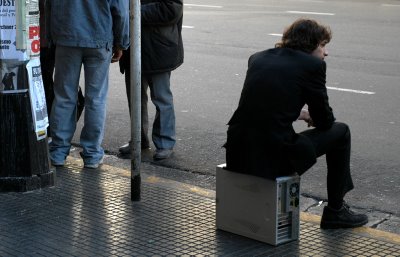
I loved the Argentinean people. They were vibrant, beautiful, full of life, and awfully creative. See? They finally found a good use for the PC tower! (I'm an Apple user, for all of you who don't know)
After I finished touring the photographic exhibits at the end of Florida Street, I found myself at the crux of a daunting situation in a foreign country. Tengo hambre. I'm hungry.
My (sort of useless) Spanish phrase book (because Argentineans don't speak Castilian Spanish) in hand, I walked down the stairs to the basement of the building where there was a food court selling everything from steaks and sandwiches to Chinese food. There is nothing as interesting to a traveler as the food he or she encounters. It is one of the first things people ask me about Argentina or Korea.
Lunch was to be my first meal in Argentina. I wondered if the plump, pimply girl behind the cash register felt any pressure as I haphazardly ordered a submarine sandwich filled with something called "Lomo" that wasn't in my Castilian phrase book. Was she worried about how I might react to Argentinean food? She had me pinned as a Shankee from the second I opened my mouth.
"Olah, me gustaria, uh, uhhhhhh, pee-dir lo-mo, uh..." I stumbled.
She smiled patiently and finished my sentence for me in perfect English.
"..Italiano. Do you want fries and a cola?" Sure. Boy, that was too easy. Korea was so much more fun.
Wait, back up. Shankee? What's a Shankee?
"Shankee" is the word Argentinean people pin to ignorant American jackasses like me. Actually, it is little more than the word "Yankee" pronounced in the Argentinean Spanish accent, which slides Y's and LL's into an "Sh" sound. "Llamo" sounds like "shamo," "yo" sounds like "sho," and "Yankee" sounds like "Shankee." I resent that nickname. I'm a Boston fan!
After a long wait, I got my lomo submarine. Lomo is nothing more than beef tenderloin, and it goes well on French bread with mayo and tomatoes. They served me a coke with no ice and a plate of salty, rubbery fries. Typical mall food court fare, I thought as I mindlessly consumed the mastication-resistant fries. I rode the sugar buzz all the way home, where my blood glucose levels crashed and I fell into a fast-food fostered sleep on Faith and Bernardo's mafia-made couch.
Mafia-made couch? I guess I didn't mention that the mafia runs Argentina, or so it seems. A day didn't go by that someone didn't mention the mafia and/or how they are closely related to the government, a sort of Argentinean Department of Nefarious Deeds. People said, and I believed them, that they were closely tied to the police through bribes and blackmail.

All sort of inconveniences, infrastructure problems, monetary issues and even the couch I was sleeping on were the result of some super secret anarchic ultracapitalist subculture existing just under the surface of a seemingly lawful society. Sounded like home to me.
Oh, and the couch. It had, uh, character.
Faith and Bernardo, who recognized the awful state of their couch, insisted I sleep on a spare mattress, which was a million times more comfortable than the lumpy brown couch. Actually, I hadn't complained about the couch. After six month on the Appalachian Trail, I can sleep in any weather, anywhere, on anything, and if it just happens to be soft, well! The couch was soft. Lumpy, yes, but soft. I slept well on both couch and mattress.
The story about the couch went like this. Faith and Bernardo went to a futon store, found a mattress they liked, and asked for it to be delivered. Upon delivery, not a solid Japanese futon but a loose brown corduroy bag filled with shredded foam was heaved into their apartment along with the convertible bed/couch frame that came with it. My friends complained and demanded the correct mattress be delivered pronto, but it all came to naught, and they knew who was to blame.
The Mafia! (cue dastardly music/evil laughter).

As you can tell, I took the whole matter much too lightly. People made it sound like the mafia was this omnipotent force, everpresent, never sleeping, waiting behind every tree to leap out and nab your purse. Luckily, I don't carry a purse.
People would point out something backwards or ridiculous about Buenos Aires, speculate in the form of a question as to the nefarious rationale behind the seemingly irrational phenomena indicated, and then let the obvious answer hang in the air like a fart. Mafia. Had to be. Bastards. I found it all amusing, and tried to encourage Faith and Bernardo to see it the same way. They didn't, and with good reason.
In December of 2004 a fire ripped through the Cromagnon night club where hundreds of people had gathered to hear the rock group, Los Callejeros. Someone had wired the doors shut to prevent people who hadn't paid from entering the concert, and 194 people died in the resulting fire trap, including several small children. Fingers were pointed, the owner was arrested, and investigations were dutifully conducted.
The investigations found the government's fire inspection unit badly managed and corrupt, the fire department and emergency response teams underequiped and poorly trained, and the owner of Cromagnon to be unreasonably oblivious to the obvious fire hazards in his club. The mayor lost his job over the matter, but it was small consolation to the residents of Buenos Aires, who all knew who was really behind the disaster. Mafia.
Monday night Faith and Bernardo took me to club called The Konex to hear a percussion group called "Time Bomb" do their thing. I hadn't yet heard about Cromagnon at this time. Bernardo's college friend Martin drove Faith, Bernardo, and another friend, Diana, to The Konex along with me in his old blue Renault stick shift.
This is a picture of Martin, who everyone calls by his nickname, Tincho. He graduated from film school with Bernardo, and uses his tremendous talent to a number of artist ends. He is a virtuosic painter and his films exhibit a masterful command of timing, light, and photography.
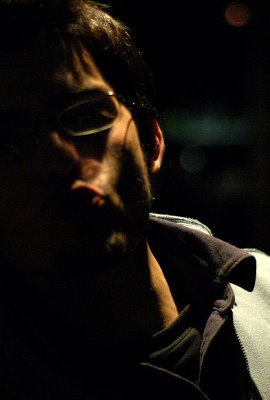
And this is Diana, a lovely entrepreneur from the same neighborhood Faith and Bernardo live in. During the economic crisis in the late 1990s, she lost her job working as a designer with an internet company, and started her own business helping independent designers of all breeds network and sell their products online. She is also an amazing photographer, who proved to me over the course of two weeks that it is the photographer who makes the image, not the camera. Don't worry, I'll explain later.

OK, where were we? Oh yes, the KONEX. This is also a reference to my previous thread on the mafia. Ah-hm.
Martin parked down the street from The KONEX, and I was the first one out of the car. A gruff, middle-aged man with a stocky build and a polypro windbreaker walked up to me and started speaking fast in Spanish. He had a serious look on his face, and I wondered if he was mafia. He certainly looked the part. The only words I understood were "car" and "to pay." Martin and Bernardo quickly took over for me, as the man was starting to get exasperated, as answer to his questions was a slow, "un momento. Habla despacio por favor." One minute. Please speak slower.
"Mafia," Faith said in a whisper as Bernardo and Martin dealt with the man. They had to pay him a small fee for his "protection" against thieves. A couple of pesos and no harm would come to Martin's car. How funny, I thought. A human parking meter!
All the money actually bought was protection from the man himself. When we returned to the car later on, he was gone. There was nothing in the car worth stealing, as someone had already ripped off Martin's stereo long ago, and Tincho had been shrewd enough not to replace it. An American living abroad (from my home city of Atlanta) named Sarah and her friend joined us.
The concert itself was a treat. We entered what had been a factory that had been converted into a cavernous music venue with giant red neon letters spelling the word KONEX laid out diagonally in front of the windows. It looked like a set from the first Batman movie. I would have photos, but Faith and Bernardo urged me not to take a camera, as it would result in a more personal meeting with members of the mafia.
The band, Time Bomb, was a collection of music students, focused mainly on percussion, headed by their charismatic professor. They practiced at The Konex, and then afterwards put their skill and talent to work for whoever could spare seven pesos (two bucks). It was an absolutely astounding show.
Ten to twelve musicians sat in a circle around their master, a dazzling array of percussion instruments laid out at their feet. As we walked into the room, they were working on a simple but catchy phrase with their drums. Their professor, the conductor, stood at the top of the circle with two small hand drums on stands by his side, his black wingtip shoes keeping time on the floor. He was a thick, jovial man dressed in dark clothing with thick black hair and a pirate-like mustache.
He swayed like a martial artist to the increasingly complex rhythm, watching and communicating with each musician with a series of homegrown, unique and delightful hand gestures customized to change the meter, instruments, styles or even which musicians were emphasized.
Over the course of three hours, the conductor and his students filled The KONEX with a thunderous, emotionally charged sound made from scratch. They brought in new instruments, different styles, mixed them in unbelievable ways and toyed with the sound like the wind plays with a falling leaf. Everyone was dancing, clapping and swaying to the sumptuous beat. Everything and everyone, down to the crowd itself, became an instrument in the hands of the conductor.
At one point, the conductor set the audience to clapping in time for him, and upon that human pulse he brought a symphonic masterpiece to life, sending the crowd into wild cheers. It is said that friendship is one soul in two bodies. By the time Time Bomb was through, everyone standing in the KONEX were friends. The cadence united us and released us as each melody changed, built and resolved itself over and over again. I realized how much color and creativity was to be found in Buenos Aires, and the whole night I pined for my camera. As we drove home, I ached to go explore.
Over the next two weeks, I got my wish.
The next day, Faith took me downtown, where she works as a mortgage saleswoman (another benefit of being bilingual), and knowing my love of the outdoors, pointed me towards the Parque y Zona de Reserva Ecologica Costanera Sur. This massive stretch of managed land spans dozens of city blocks, bordered by downtown Buenos Aires on the western flank and the Rio de La Plata to the east.
The route Faith chose took me down the long series of dikes that lined the main avenue downtown. In the first dike, sailboats rested.

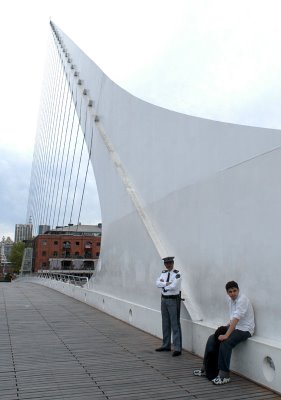
The area by the dikes is another trendy location slowly being turned into a haven for tourists. Called Puerto Madero, it made for pleasant sightseeing. To my right were buildings housing upscale restaurants and pricey lofts. To my right was what looked like a train station converted into similar monuments to Western comforts and decadence. An artful bridge pictured on the cover of my city guide spanned the dikes. Called the Woman Bridge, it was designed by celebrated Spanish architect Santiago Calatrava Valls. Wes, these photos are all for you, my friend.


Rowers silently glided past me as I stopped at a small cafe for lunch. I had a lot more luck this time. I ordered a chicken sandwich on pita bread and a cup of espresso. Cost to me: $4, and Faith told me later I got ripped off.

At the end of the dikes, the road turned into the ecological preserve. In the turn of the century, it was a popular destination for bathers, and had docks along the ponds for such purposes. Nowadays you'd have to be absolutely bonkers to try swimming in the Rio de La Plata or any pond fed by its polluted, neglected waters. Unlike the Koreans, the Argentineans don't have a particularly close relationship to the sealife living side-by-side with them.
"Our backs are to the river," Bernardo pointed out about the city's design.
I walked a broad sand path towards the river, bikers, joggers and school children my companions. Behind me, the skyline of Buenos Aires rose above the razorgrass and pine trees.


People rested and took in the open space, a necessity in a city the size of Buenos Aires.

Others looked for a place to escape and be together.

At four thirty, I met Faith after work and followed her to her next job: Teaching English in the Palermo district. But you will have to wait till the next update for those stories and photos. Also, I'll get into the joy of using Spanish and Rashashana with Bernardo's family. Jeez, I'm only two days into my trip. Don't worry, there won't be 14 updates on Argentina, but these first few days really stand out. I guess that's true anywhere you go. It's all about travel. So till next time...Peace. --Notes
I loved the Argentinean people. They were vibrant, beautiful, full of life, and awfully creative. See? They finally found a good use for the PC tower! (I'm an Apple user, for all of you who don't know)
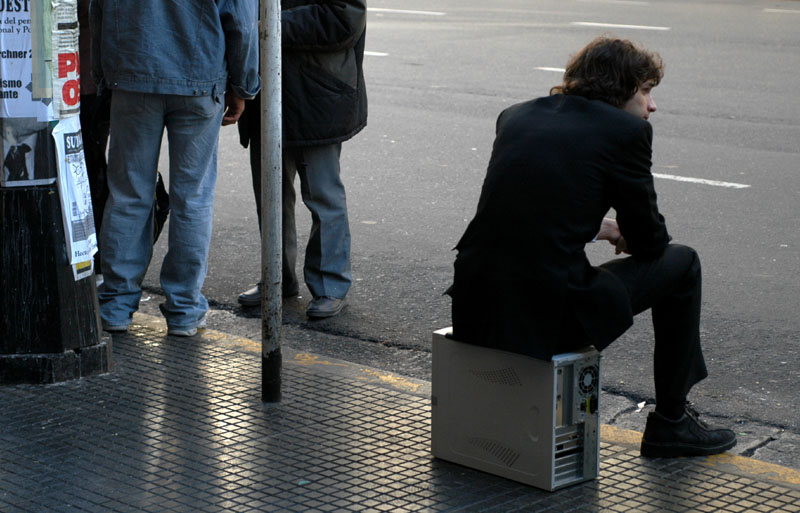
After I finished touring the photographic exhibits at the end of Florida Street, I found myself at the crux of a daunting situation in a foreign country. Tengo hambre. I'm hungry.
My (sort of useless) Spanish phrase book (because Argentineans don't speak Castilian Spanish) in hand, I walked down the stairs to the basement of the building where there was a food court selling everything from steaks and sandwiches to Chinese food. There is nothing as interesting to a traveler as the food he or she encounters. It is one of the first things people ask me about Argentina or Korea.
Lunch was to be my first meal in Argentina. I wondered if the plump, pimply girl behind the cash register felt any pressure as I haphazardly ordered a submarine sandwich filled with something called "Lomo" that wasn't in my Castilian phrase book. Was she worried about how I might react to Argentinean food? She had me pinned as a Shankee from the second I opened my mouth.
"Olah, me gustaria, uh, uhhhhhh, pee-dir lo-mo, uh..." I stumbled.
She smiled patiently and finished my sentence for me in perfect English.
"..Italiano. Do you want fries and a cola?" Sure. Boy, that was too easy. Korea was so much more fun.
Wait, back up. Shankee? What's a Shankee?
"Shankee" is the word Argentinean people pin to ignorant American jackasses like me. Actually, it is little more than the word "Yankee" pronounced in the Argentinean Spanish accent, which slides Y's and LL's into an "Sh" sound. "Llamo" sounds like "shamo," "yo" sounds like "sho," and "Yankee" sounds like "Shankee." I resent that nickname. I'm a Boston fan!
After a long wait, I got my lomo submarine. Lomo is nothing more than beef tenderloin, and it goes well on French bread with mayo and tomatoes. They served me a coke with no ice and a plate of salty, rubbery fries. Typical mall food court fare, I thought as I mindlessly consumed the mastication-resistant fries. I rode the sugar buzz all the way home, where my blood glucose levels crashed and I fell into a fast-food fostered sleep on Faith and Bernardo's mafia-made couch.
Mafia-made couch? I guess I didn't mention that the mafia runs Argentina, or so it seems. A day didn't go by that someone didn't mention the mafia and/or how they are closely related to the government, a sort of Argentinean Department of Nefarious Deeds. People said, and I believed them, that they were closely tied to the police through bribes and blackmail.

All sort of inconveniences, infrastructure problems, monetary issues and even the couch I was sleeping on were the result of some super secret anarchic ultracapitalist subculture existing just under the surface of a seemingly lawful society. Sounded like home to me.
Oh, and the couch. It had, uh, character.
Faith and Bernardo, who recognized the awful state of their couch, insisted I sleep on a spare mattress, which was a million times more comfortable than the lumpy brown couch. Actually, I hadn't complained about the couch. After six month on the Appalachian Trail, I can sleep in any weather, anywhere, on anything, and if it just happens to be soft, well! The couch was soft. Lumpy, yes, but soft. I slept well on both couch and mattress.
The story about the couch went like this. Faith and Bernardo went to a futon store, found a mattress they liked, and asked for it to be delivered. Upon delivery, not a solid Japanese futon but a loose brown corduroy bag filled with shredded foam was heaved into their apartment along with the convertible bed/couch frame that came with it. My friends complained and demanded the correct mattress be delivered pronto, but it all came to naught, and they knew who was to blame.
The Mafia! (cue dastardly music/evil laughter).

As you can tell, I took the whole matter much too lightly. People made it sound like the mafia was this omnipotent force, everpresent, never sleeping, waiting behind every tree to leap out and nab your purse. Luckily, I don't carry a purse.
People would point out something backwards or ridiculous about Buenos Aires, speculate in the form of a question as to the nefarious rationale behind the seemingly irrational phenomena indicated, and then let the obvious answer hang in the air like a fart. Mafia. Had to be. Bastards. I found it all amusing, and tried to encourage Faith and Bernardo to see it the same way. They didn't, and with good reason.
In December of 2004 a fire ripped through the Cromagnon night club where hundreds of people had gathered to hear the rock group, Los Callejeros. Someone had wired the doors shut to prevent people who hadn't paid from entering the concert, and 194 people died in the resulting fire trap, including several small children. Fingers were pointed, the owner was arrested, and investigations were dutifully conducted.
The investigations found the government's fire inspection unit badly managed and corrupt, the fire department and emergency response teams underequiped and poorly trained, and the owner of Cromagnon to be unreasonably oblivious to the obvious fire hazards in his club. The mayor lost his job over the matter, but it was small consolation to the residents of Buenos Aires, who all knew who was really behind the disaster. Mafia.
Monday night Faith and Bernardo took me to club called The Konex to hear a percussion group called "Time Bomb" do their thing. I hadn't yet heard about Cromagnon at this time. Bernardo's college friend Martin drove Faith, Bernardo, and another friend, Diana, to The Konex along with me in his old blue Renault stick shift.
This is a picture of Martin, who everyone calls by his nickname, Tincho. He graduated from film school with Bernardo, and uses his tremendous talent to a number of artist ends. He is a virtuosic painter and his films exhibit a masterful command of timing, light, and photography.
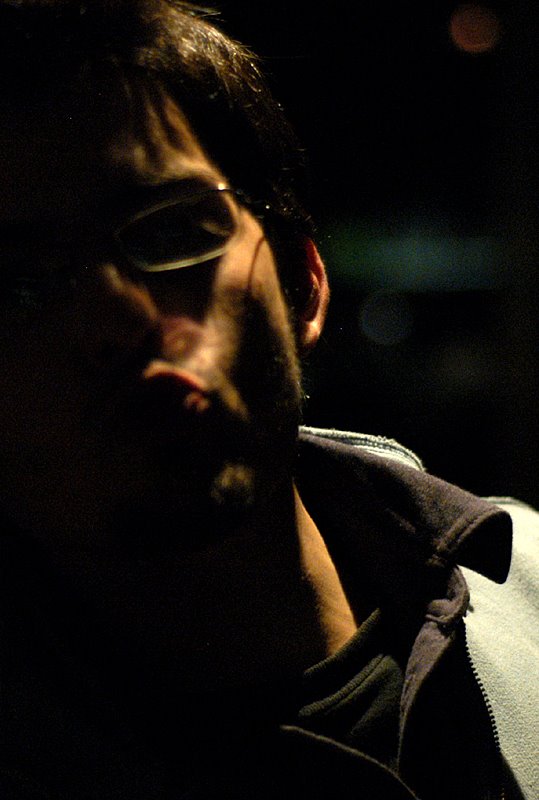
And this is Diana, a lovely entrepreneur from the same neighborhood Faith and Bernardo live in. During the economic crisis in the late 1990s, she lost her job working as a designer with an internet company, and started her own business helping independent designers of all breeds network and sell their products online. She is also an amazing photographer, who proved to me over the course of two weeks that it is the photographer who makes the image, not the camera. Don't worry, I'll explain later.

OK, where were we? Oh yes, the KONEX. This is also a reference to my previous thread on the mafia. Ah-hm.
Martin parked down the street from The KONEX, and I was the first one out of the car. A gruff, middle-aged man with a stocky build and a polypro windbreaker walked up to me and started speaking fast in Spanish. He had a serious look on his face, and I wondered if he was mafia. He certainly looked the part. The only words I understood were "car" and "to pay." Martin and Bernardo quickly took over for me, as the man was starting to get exasperated, as answer to his questions was a slow, "un momento. Habla despacio por favor." One minute. Please speak slower.
"Mafia," Faith said in a whisper as Bernardo and Martin dealt with the man. They had to pay him a small fee for his "protection" against thieves. A couple of pesos and no harm would come to Martin's car. How funny, I thought. A human parking meter!
All the money actually bought was protection from the man himself. When we returned to the car later on, he was gone. There was nothing in the car worth stealing, as someone had already ripped off Martin's stereo long ago, and Tincho had been shrewd enough not to replace it. An American living abroad (from my home city of Atlanta) named Sarah and her friend joined us.
The concert itself was a treat. We entered what had been a factory that had been converted into a cavernous music venue with giant red neon letters spelling the word KONEX laid out diagonally in front of the windows. It looked like a set from the first Batman movie. I would have photos, but Faith and Bernardo urged me not to take a camera, as it would result in a more personal meeting with members of the mafia.
The band, Time Bomb, was a collection of music students, focused mainly on percussion, headed by their charismatic professor. They practiced at The Konex, and then afterwards put their skill and talent to work for whoever could spare seven pesos (two bucks). It was an absolutely astounding show.
Ten to twelve musicians sat in a circle around their master, a dazzling array of percussion instruments laid out at their feet. As we walked into the room, they were working on a simple but catchy phrase with their drums. Their professor, the conductor, stood at the top of the circle with two small hand drums on stands by his side, his black wingtip shoes keeping time on the floor. He was a thick, jovial man dressed in dark clothing with thick black hair and a pirate-like mustache.
He swayed like a martial artist to the increasingly complex rhythm, watching and communicating with each musician with a series of homegrown, unique and delightful hand gestures customized to change the meter, instruments, styles or even which musicians were emphasized.
Over the course of three hours, the conductor and his students filled The KONEX with a thunderous, emotionally charged sound made from scratch. They brought in new instruments, different styles, mixed them in unbelievable ways and toyed with the sound like the wind plays with a falling leaf. Everyone was dancing, clapping and swaying to the sumptuous beat. Everything and everyone, down to the crowd itself, became an instrument in the hands of the conductor.
At one point, the conductor set the audience to clapping in time for him, and upon that human pulse he brought a symphonic masterpiece to life, sending the crowd into wild cheers. It is said that friendship is one soul in two bodies. By the time Time Bomb was through, everyone standing in the KONEX were friends. The cadence united us and released us as each melody changed, built and resolved itself over and over again. I realized how much color and creativity was to be found in Buenos Aires, and the whole night I pined for my camera. As we drove home, I ached to go explore.
Over the next two weeks, I got my wish.
The next day, Faith took me downtown, where she works as a mortgage saleswoman (another benefit of being bilingual), and knowing my love of the outdoors, pointed me towards the Parque y Zona de Reserva Ecologica Costanera Sur. This massive stretch of managed land spans dozens of city blocks, bordered by downtown Buenos Aires on the western flank and the Rio de La Plata to the east.
The route Faith chose took me down the long series of dikes that lined the main avenue downtown. In the first dike, sailboats rested.
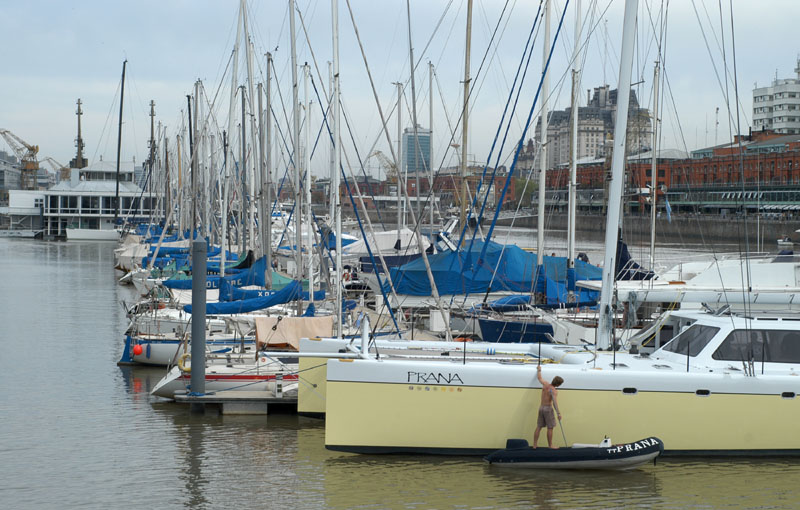
The area by the dikes is another trendy location slowly being turned into a haven for tourists. Called Puerto Madero, it made for pleasant sightseeing. To my right were buildings housing upscale restaurants and pricey lofts. To my right was what looked like a train station converted into similar monuments to Western comforts and decadence. An artful bridge pictured on the cover of my city guide spanned the dikes. Called the Woman Bridge, it was designed by celebrated Spanish architect Santiago Calatrava Valls. Wes, these photos are all for you, my friend.
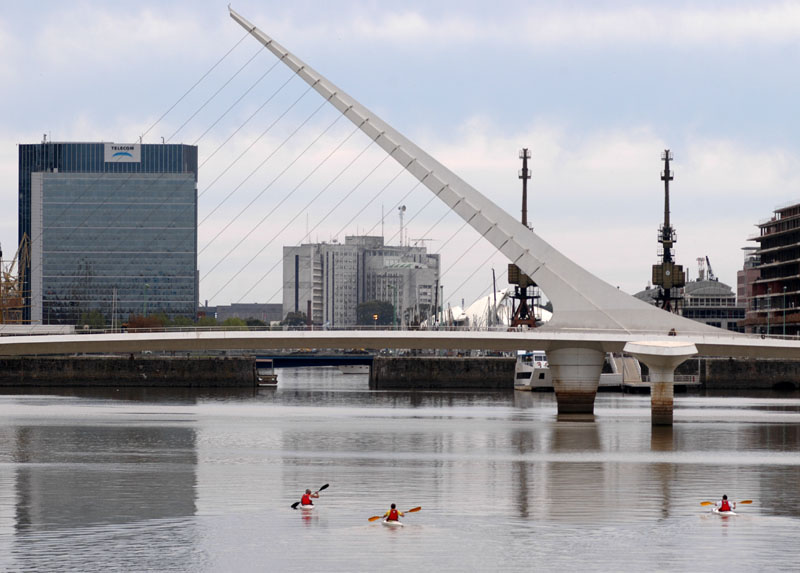

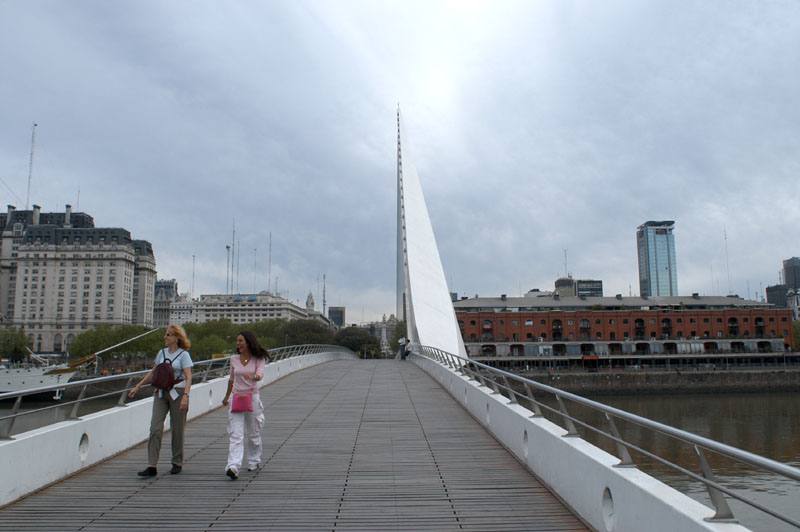
Rowers silently glided past me as I stopped at a small cafe for lunch. I had a lot more luck this time. I ordered a chicken sandwich on pita bread and a cup of espresso. Cost to me: $4, and Faith told me later I got ripped off.
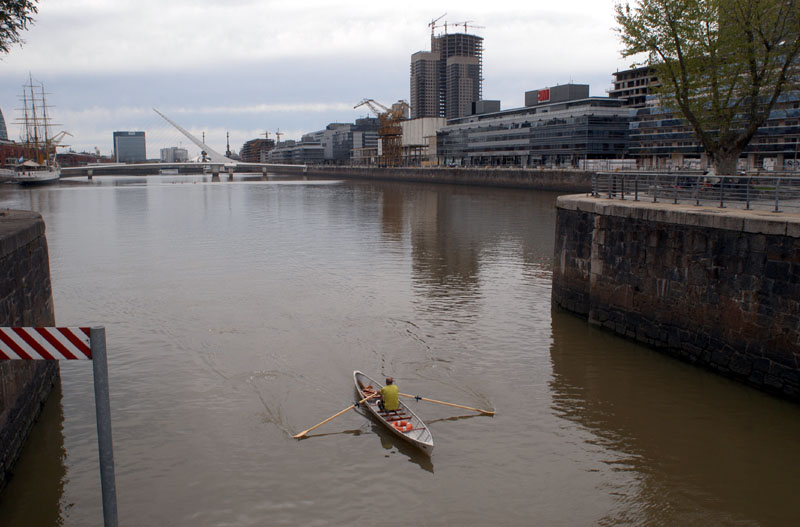
At the end of the dikes, the road turned into the ecological preserve. In the turn of the century, it was a popular destination for bathers, and had docks along the ponds for such purposes. Nowadays you'd have to be absolutely bonkers to try swimming in the Rio de La Plata or any pond fed by its polluted, neglected waters. Unlike the Koreans, the Argentineans don't have a particularly close relationship to the sealife living side-by-side with them.
"Our backs are to the river," Bernardo pointed out about the city's design.
I walked a broad sand path towards the river, bikers, joggers and school children my companions. Behind me, the skyline of Buenos Aires rose above the razorgrass and pine trees.
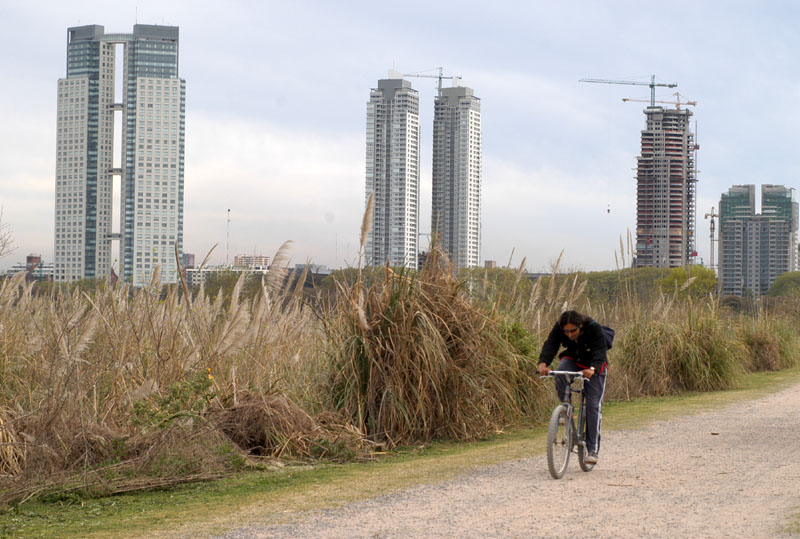
People rested and took in the open space, a necessity in a city the size of Buenos Aires.
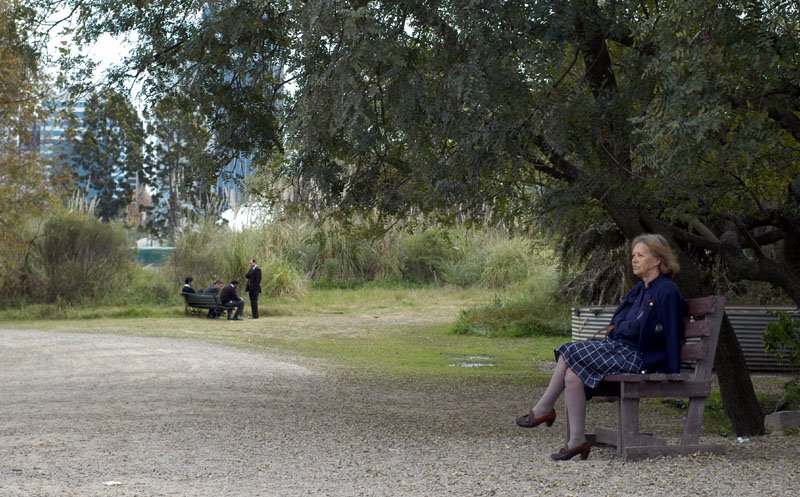
Others looked for a place to escape and be together.
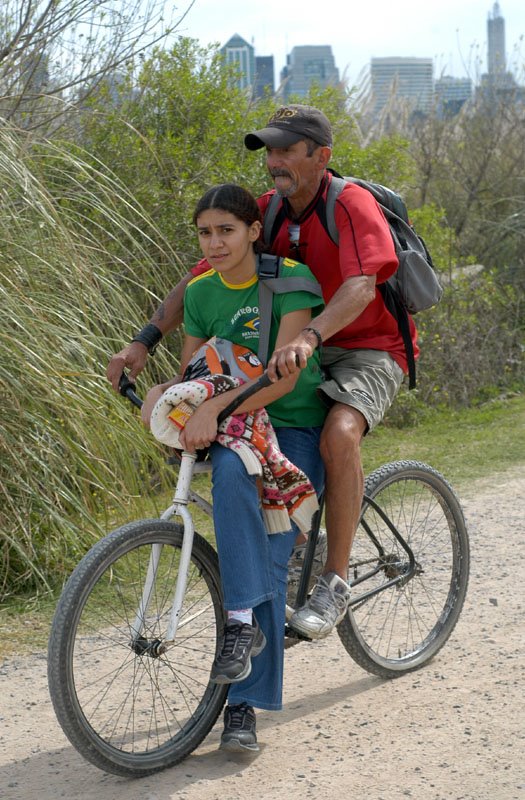
At four thirty, I met Faith after work and followed her to her next job: Teaching English in the Palermo district. But you will have to wait till the next update for those stories and photos. Also, I'll get into the joy of using Spanish and Rashashana with Bernardo's family. Jeez, I'm only two days into my trip. Don't worry, there won't be 14 updates on Argentina, but these first few days really stand out. I guess that's true anywhere you go. It's all about travel. So till next time...Peace. --Notes
Subscribe to:
Posts (Atom)