Tuesday, April 18, 2006

AHHHHHH!!! SPIDERS!!!


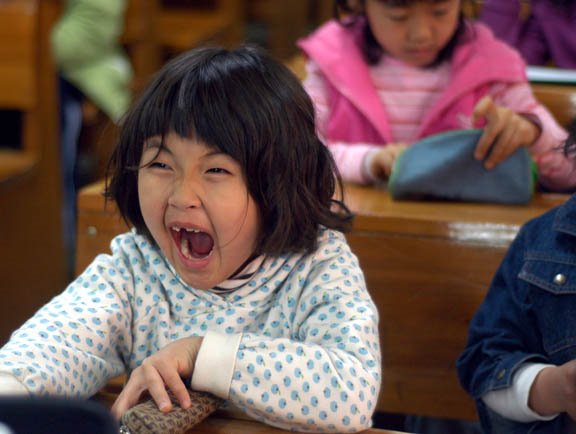
During the auditorium classes we taught about insects last week. Nothing drew a bigger response than the photos of the spider, centipede and cockroach. You could hear the classes yelling their heads off all the way in the teacher's lounge.

For the first (and probably only) time in SoKoNotes history, I want you to stop what you are doing and redirect your browser somewhere else...To my brand new website (you can always come back). Click the following link:

Stephen Jones Photography

Click on the "Explore the Site" link, sit back, relax and take a tour of the Appalachian Trail or experience picturesque Hattiesburg, Mississippi. Weird word, 'picturesque.' Weird place, Hattiesburg. I have spent the last three months building the pages from scratch using a program called Adobe GoLive. I had a lot of help from Gavin, who taught me how to operate the program. He also showed me the main strength of GoLive: The ability to seamlessly integrate Photoshop files using SmartObjects. Photoshop is a program I am much more familiar with, and it made laying my pages out much easier. I also had a "For Dummies" book on GoLive courtesy of my parents, and it came in handy when the time came to upload my site to the server. A marvelous book. My deepest thanks to my parents and Gavin.

Now back to the blog.

I think it's funny how some children grow faster than others. In some of my classes, particularly my fifth and sixth graders, there is a student or students who are measurably larger than their peers. The children in these classes are between eleven and thirteen, at the threshold of puberty, and the ole' mother nature has decided it's time they become adults.

Take Ho-jeong, for example. I taught her for two months last semester as a fifth-grader. At twelve years old, she was not the oldest child in the group, but Ho-jeong stood a solid foot taller than the second-tallest child in 5A. When I first took the class, I thought for a second that perhaps Ho-jeong was a middle-school student who got her classroom mixed up. When the children all stood up every day to greet me, Ho-jeong looked like Gulliver among the Lilliputians. When she walked down the halls with her friends, one could have easily mistaken her for their "Ohni," older sister.

What really threw me was Ho-jeong's behavior. My natural inclination towards Ho-jeong was to treat her like one of the older children, and I unconsciencely expected more from her than her classmates. For one thing, she was the smartest student in the class. Her hand would rocket into the air after every question, her eyes bulging, a plaintive look on her face.

"Mr. Jones! Mr. Jones! I know it! I know the answer! Verb! VERRRB!"

I assumed she was equally mature. This turned out to be wrong-headed. Make no mistake, Ho-jeong was the sharpest knife in the drawer, and her genetic code was way ahead of the curve, but psychologically speaking she was still a child. She would play with the other children before class, towering over even the boys as they drew goofy faces, monsters and princesses in the chalk dusk adhered to the blackboard. Only Ho-jeong could draw high up on the blackboard where the other children couldn't reach. She would laugh as they jumped up and tried to erase her doodles.

There are other tall fifth and sixth-graders in my other classes. Seong-leong of my current 6A class , who is all of twelve years old himself, is as tall and almost as broad at the chest as I am. Ah-hyun of Advanced 4-1 is taller than Ho-jeong; however, Ah-hyun possesses a much more reserved personality.

The opposite can be true, too. I have children in my upper-level middle-school classes that could easily blend into a lower classes. The smallest of these late-bloomers tend to act out more than their fully-developed peers, as if trying to make up for their small size with the volume of their voice.

If I had to pick a favorite age group, I would not hesitate to pick the sixth-graders. They are still young enough to possess a great deal of enthusiasm for learning and they have the cognitive complexity to engage in some of my most fun, creative activities. If I had to pick a second favorite group of students, I'd pick the youngest students. Pound-for-pound, no other group of children exhibits more energy, vitality and honest enthusiasm than a pack of first and second-graders. This is Jeong-yoon, a child truly like no other.
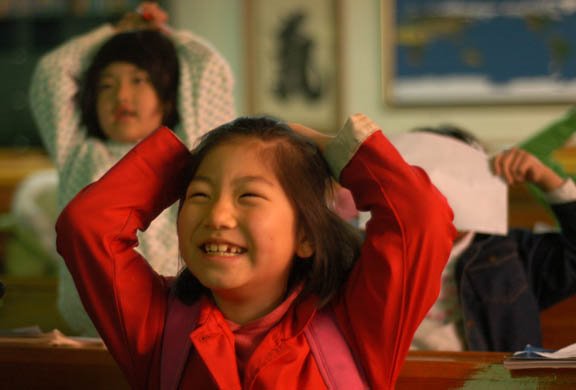


The raucous, joyful sound of Jeong-yoon's laughter filters into the teacher's lounge all the way from the third floor around 2PM every Monday, Tuesday and Wednesday, heralding my first class of the day. Gavin, Dave or I have only to step into the same room as Jeong-yoon and she begins gushing with laughter. Her English ability is tops, too. When we started the new semester, Jeong-yoon took the new boys under her wing, guiding them through the auditorium class on Friday.

Some nights as we walk to dinner, particularly after a good day, Gavin will remark in his deep, no-bullshit tone, "I really like our kids."

Me too.

What's so funny to me is how before I came to Korea children were, in many respects, a mystery. In some ways, my job as a newspaper photographer well-prepared me for interacting with children, as many of my assignments centered around gathering images of cute children doing cute things so people who are suckers for anything cute would buy the paper.

My sporadic contact with children in Hattiesburg couldn't prepare me for the benefits of those interactions. I had no idea that teaching could be so rewarding. Nothing makes me feel as great as the honest 'hello' and a smile from a passing pupil. The act of teaching alone forces one to build a relationship with the children so one can understand what and how they need to learn. This simple act of caring for another person is healing in of itself, a balm for the wounds inflicted by life in the real world. Teaching has helped me to grow and mature, face fears and solve problems.

* * *

The ESS staff went on a 'picnic' last weekend. I don't know many picnics that start at 6AM, last all day, and involve driving by bus all the way to the other side of the country. Most of my picnics involve a local park, a cloth, a bottle of wine and some food.

This was a balls-out road trip.

Mr. Kim rented a big orange tour bus. Just as I expected, somebody neglected to install an aircraft-style lavatory in the rear (a la most of the tour buses I have encountered in the United States). In preparation for just such a lapse in judgment, and still carrying the scars from the embarrassing pissing episode on the bus to Gyeong-ju during last fall's Chuseok holiday, I left my water bottle at home.

Most of the teachers were there, casually dressed, which is something of a shock when one is used to strait lines and high-heels all the time. Soo-hyun wore light blue jeans with a tear in them. Soo-hee cut the glare with a pink baseball cap. Even the normally exquisitly-dressed, ultra-professional Ms. Ha sported jeans, a t-shirt and a big smile. One of my favorite ESS personalities, Bok-shim, was there too.

Bok-shim is a stout, good-natured ajumma no taller than my shoulder with a confidant, pugnacious swagger and a gentle wit. Often times she can be found in the third-floor lobby chatting up the receptionists and scolding the children, a mop in her left hand and her right hand stuck in her jacket like Napoleon Bonaparte. She always wears a little bling: A watch or a ring encrusted with gold and jewels, though it's her warm smile and friendly nature that makes Bok-shim really stand out.

On Saturday she strutted onto the bus with a giant purple gem around her finger and the frames of her glasses so ornate they looked like they had been made in Rivendell.
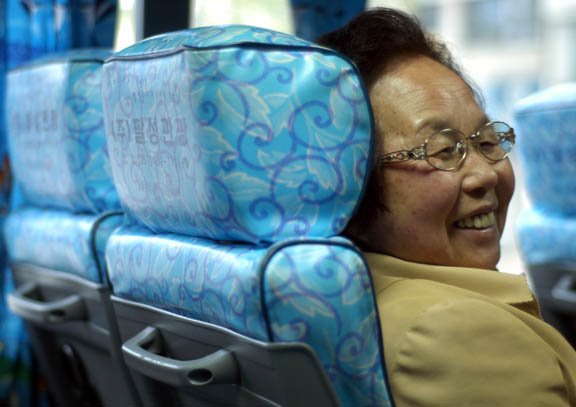


The bus shuddered to life as the driver dropped it into gear and off we went to the provence of Hye-nam, the hometown of Na-ri and a five hour journey to the opposite side of the Korean peninsula. Gavin and I quickly fell asleep to the soothing clucking of the Korean women chatting a few seats up.

The first place our bus visited was, ironically, a rest stop. Having had deprived myself of water in anticipation of a torturously long journey, I looked on from the bus as my better-hydrated companions disembarked and relieved themselves. At the onset of the trip Mrs. Kim had provided a grocery bag filled with goodies like candy, cookies and fruit to all in attendance. I snacked on "tok," cinnamon-honey sandwiches and wasabi-encrusted peas while waiting for the bus to get moving again.

Food was really the highlight of the day, but more on that later.

Our second stop was a traditional Korean village in the style of the 14-1500s, carefully preserved by the Korean government, perhaps to remind people of their history and heritage. A thick (my eyes put it at ten feet) stone wall fifteen feet high encircled the entire town, and it was upon this battlement that we began our tour.
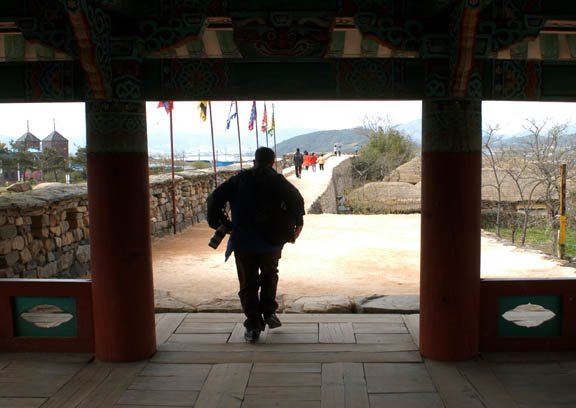


The high wall gave us a splendid view of the town within. Uncomplicated thatch-huts and tiny farm plots dotted with chickens dominated the scene. Tourists in brightly-colored parkas and nylon sweatsuits walked among the soft earthen-toned structures, taking photos and pointing. In their vivid clothing, they looked to me like blooming flowers in a pile of hay.

Some of the huts were occupied, and some of the plots were alive with spring crops. People live here still, apparently. I could see their laundry drying on lines strung up between huts, and some of them were out and about, tending to their business.


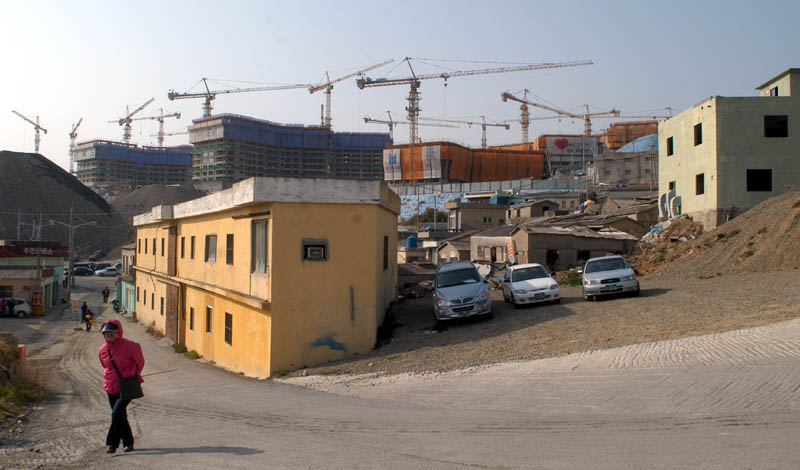
The farmer had old, bloodshot eyes and a face that said nothing. I felt sort of odd as I walked on the wall high above him, like I was invading his home. I wondered if in five-hundred years this village will still be here, or if maybe there will be another "traditional Korean village" made to look like Dongsamjugong: A skyscraper full of villagers, a quickie mart and a PC Bong.

At one end of the wall was a hill, and the wall rose abruptly to its summit. Mr. Yi took the lead up this stoney embankment.
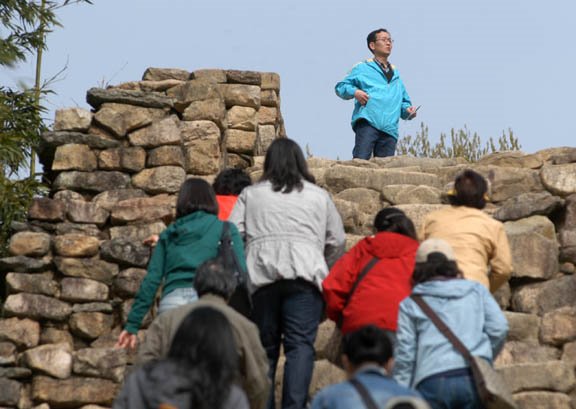


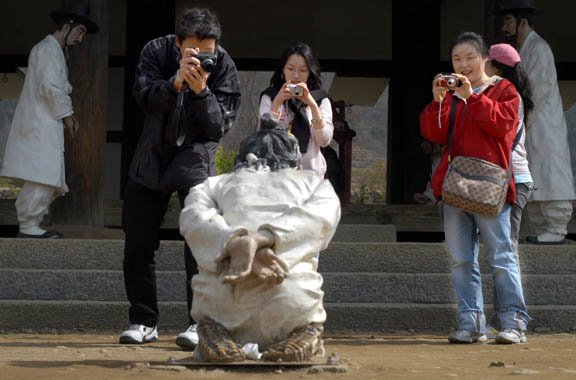
After touring the museum, we came to the ancient village police hall. Within were a few plastic "prisoners" and their "accusers." They were in cheesy, dramatic poses of agony or penitence. The Korean staff chuckled and took photos of the permanently apologetic criminal.


Our next stop was at the home of a famous Korean scholar named Gosun Yun Sun-do, reputed to be "one of the greatest writers in Korean history," according to the plaque at the entrance to his ancient ancestral home. Gosun, who lived from 1587 to 1671, got in a lot of trouble for pointing out the corruption of the oppressive Korean government officials in power. he was exiled, twice, and pardoned, twice. During his exile(s), he wrote poems about his "mountain fastness" in Hye-nam. I likened him to a Korean Thoreau, although Henry exiled himself versus getting the boot from corrupt government officials a la Yun Sun-do.

A giant, five-hundred year old tree stood in the courtyard of his home, the only living thing to have shared it's existence with the outspoken poet. The teachers took pictures. Mr. Kim's son Byeong-su played with a dog. I practiced reading Hangul, drawing quite a few "oooohs" and "ahhhhs" and encouragement from the staff. Afterwards, it was time for lunch.

The only highlight from lunch was the Makalli. I was frankly surprised when the waitress brought out the brown earthen bowl filled with milky-white, 25% alcohol-conent rice liquor. Drinking with my boss was not on the agenda, and Gavin and I were reticent to sacrifice any inhibition. We drank a bowl or two. The Korean teachers seemed even more apprehensive, and many didn't finish the drinks.

After lunch we went to a huge Buddhist temple.
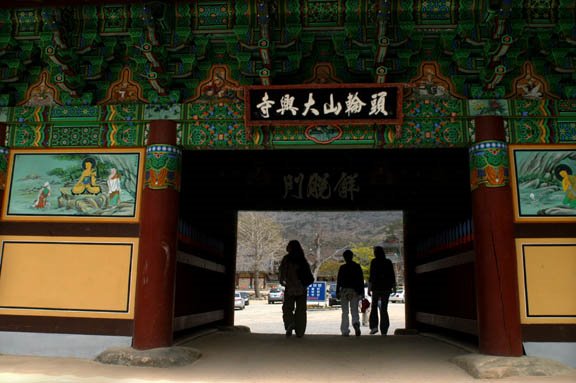


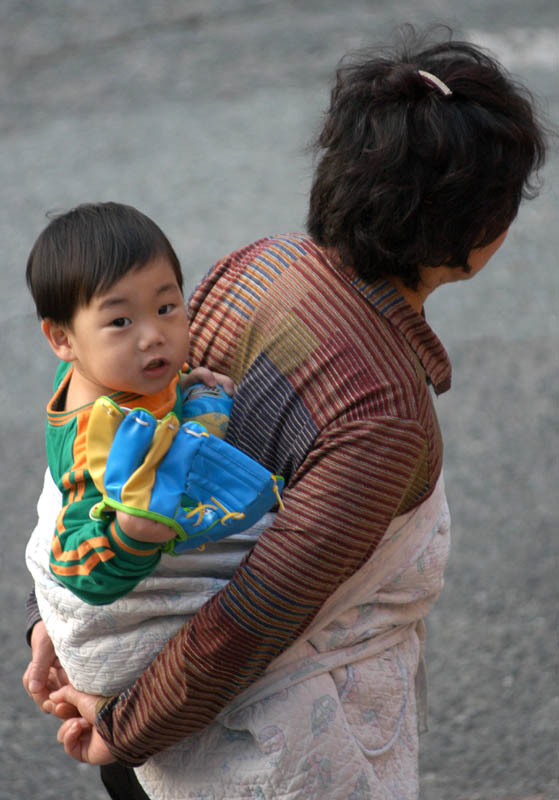
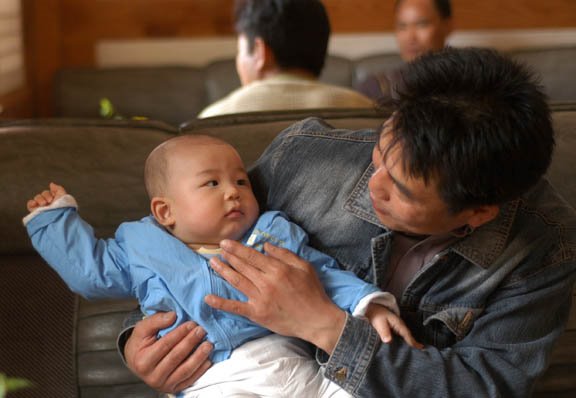
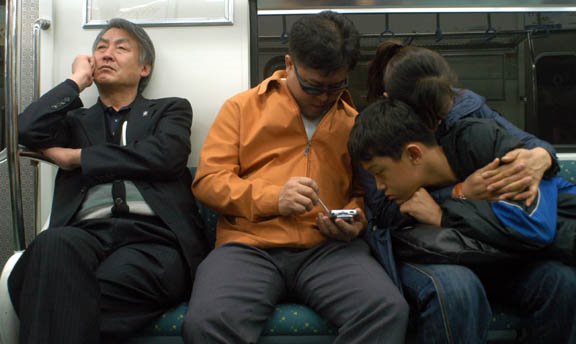
The problem with bus tours is that one never gets enough time to properly explore such sites. Dozens of structures, courtyards and pagodas were there to be explored, but we only had thirty minutes or so before we had to return to the bus. On the way back I stopped at a trinket shop to see if they had any flashing-Buddha keychains (many temples do) and I came across this man and his son in some nice window light. It must be odd, cosmically speaking, when a tourist photographs another tourist in a trinket shop.


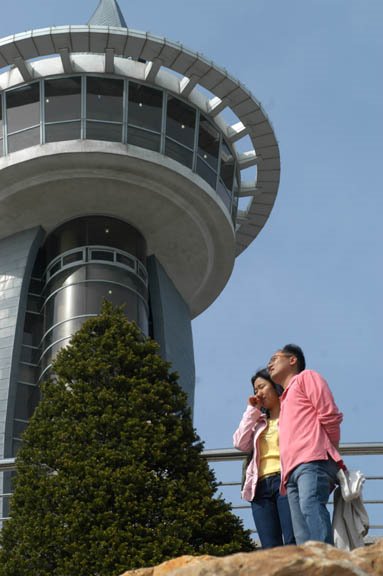
After a long ride, the bus took us to our final destination: Tangkeut, The End of Korea. Unless you put on a bathing suit or jumped in a boat, you could not go any further south on the peninsula than here, and the people of Hye-nam were proud of this. They even erected a sleek metal tower at the site's summit so you could look out over the sea.
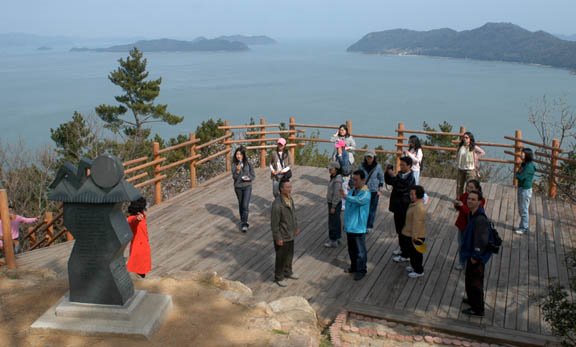


We took photos from a platform overlooking the tiny islands surrounding Tangkeut.


As we walked down to take a piss, Na-ri told me that there had been a curse on the men's bathroom at Tangkeut. It was rumored that people who pissed within died soon thereafter. As I took my place among all the dead men at the urinals, I wondered how I would meet my untimely demise. My first thought was the motorcycle. No, I thought, too predictable. Cursed lavatories probably lead to mysterious, suburban-myth style deaths like being crushed by a falling fast-food sign or choking on an octopus tentacle.

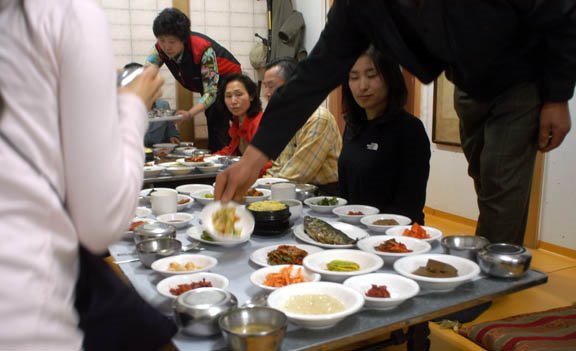
Following this climax in our journey, Mr. Kim treated us all to dinner at a traditional Korean restaurant specializing in a marinated, bar-b-qued beef called Galbi.

"The people of Hye-nam are famous for their cooking," said Mr. Kim.

The meal ranks high on my "greatest life dining experiences." Tables covered in white dishes filled with a cornucopia of Korean food were set at our feet. Fish, beef, vegetables drenched in ginger, kimchi, spicy crabs and the truly fantastic Galbi made it's way into my mouth. It was an amazing meal.


The bus-driver got us home in record time, according to Mr. Yi. I spent the entirety of the return journey snuggled up with my iPod and a book. We disembarked at 10:30. Na-ri's father gave each staff member a five-kilo box of sweet yams to take home, and it took all my remaining strength to lug the box of starch 100 yards to the taxi stand.

Like I said before, bus tours suck because one doesn't have the time to properly explore the amazing places where the bus stops. To my mind, the best part of the trip wasn't the stops or even the amazing food, it was getting to know my fellow teachers outside of work.

Within ESS, the Korean teachers are friendly, but focused on the task at hand. My communication with them is usually limited to talking about classes and helping them understand or pronounce difficult English idioms, phrases and words. They wear pressed suits, black slacks and meticulously manage their makeup. When I come back from a series of classes, I am covered in chalk dust as if I just got attacked with a chalk-grenade and the Korean teachers still look like the partners in a major Korean law firm.

On the bus, at the stops, and in the restaurants, it was like I was hanging out with the Korean teacher's alter-egos. Like I said earlier, the ladies wore jeans, t-shirts and tennis shoes. They giggled like little girls, held hands and joked with Gavin and I. They cut up at the restaurants and enjoyed themselves, and I enjoyed being a part of their group. I felt less like a stranger in a strange land. This was one of the experiences I was looking for when I came to Korea.

Well, that's all I have for you this time. Here are a few more photos from the week.


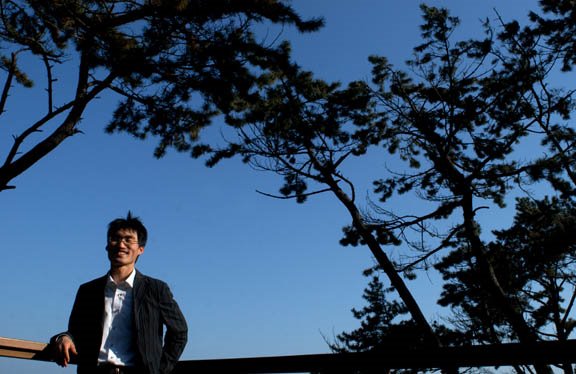
Gavin and I spent Sunday in Haeundae. This was taken at the APEC island.


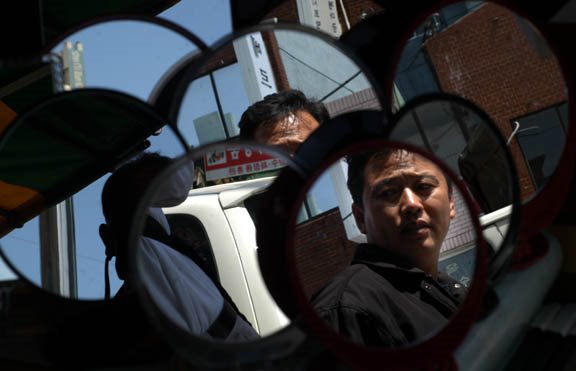
A mirror salesman in Nampo-dong.


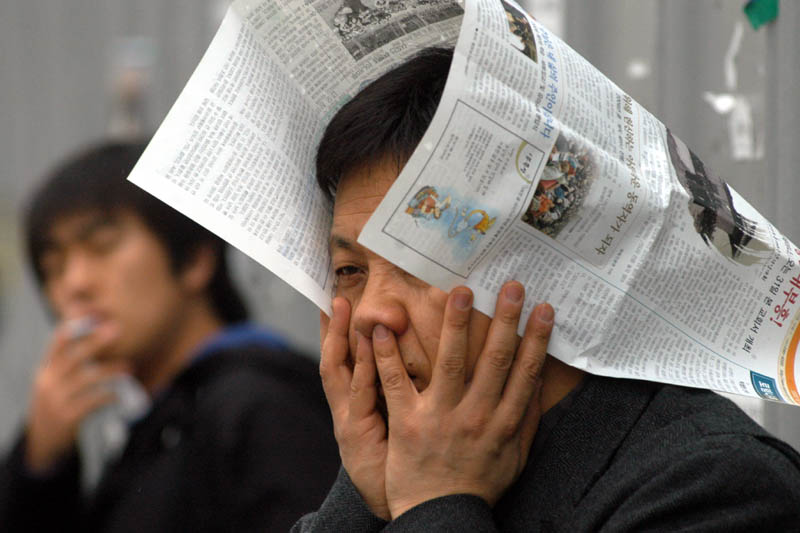
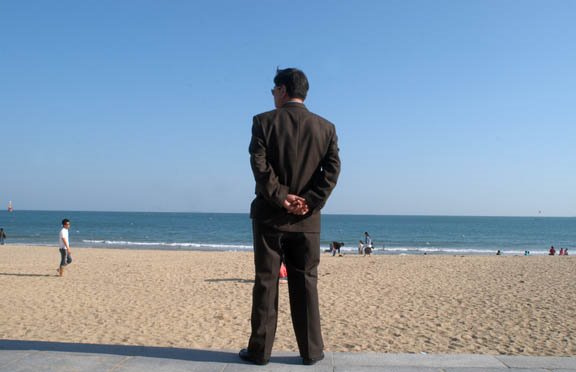
Old guy on the boardwalk in Haeundae.


No Korean Files this week, as I am building case for the next update. I hope everyone is doing well, and please take the time to check out my website. The URL again is as follows:

www.notesjones.com

Sunday, April 09, 2006

Welcome back to SoKoNotes, where once a week stories of cultural confusion are spun from the colorful fabric of firsthand experience. I am getting better and better at my Hangul. I was strolling through the Gukje Market Wednesday when I happened across this old lady lounging by her wares: richly colored cloth used for making traditional Korean dresses called Hanbok (pronounced Han-bow). Her eyes went wide as I pointed to each bolt of cloth and indicated their color using only Korean.


My Hangul is improving, albeit very slowly, every week. Through my interactions with the teachers, people at the gym, the ajummas at Kimbop Joongu and In-hye, my Korean teacher, I am becoming more and more proficient with the language. I pick up several words or phrases a week and try them out whenever possible. Through my triumphs and my defeats, I am piecing together the Hangul jigsaw puzzle.

Just today I found a big piece: The Hangul word for 'do.' In order to have something 'done,' many Koreans simply add the word 'do' to the noun in question. Want to make a hotel reservation? Just say "hotel reservation do," and they'll know exactly what you mean. Armed with this new information, I scored a modest victory against the seemingly impenetrable language barrier: I picked up the telephone and had lunch delivered. Paedal Haseyo. Delivery do.

There are three major problems with learning this seemingly simple language. The first and biggest issue surrounds the grammatical differences between English and Hangul. In English it is normal to first state the subject, then insert the verb and follow with the object acted on by that verb: I eat bread. In Hangul, The subject comes first, followed by the object and the verb is found at the end of a sentence. I bread eat.

Simple? Yes and no. It's like thinking backwards, which is easier than one might think when forming sentences. The real problems creep in when I listen to someone speaking Hangul. My brain, stuck in the subject-verb-object pattern I grew up with, often confuses the object for the verb. Complicating things further is that most Koreans do not speak in simple three-word sentences. Most Koreans speak Hangul like most Americans speak English, most conversations involving many more and varied parts of speech that I have yet to study: Indirect and direct objects, adverbs, adjectives and conjunctions just to name a few.

The second problem is vocabulary. The words are so alien, so completely unlike anything my ears have ever gathered before that unless I use or encounter a word multiple times a day (such as the word for 'give me'), it simply does not stick. There are exceptions (aren't there always?). I memorized the word for mountain trail, "san-kil," without anyone's help, and it came in handy while hiking Jangsan a few weeks back.

The third stumbling block centers around the particles. Speakers of Hangul attach all sorts of maddening little sounds onto the ends of words to indicate the speaker's relationship to the person spoken to, the direction, pronoun, subject, object, topic or indirect object. Ahhhhhhhh!!! So often these little sounds snag my mind and I lose focus as my brain tries to remember if 'eso' is the direction or placement marker. Compounding this is the myriad ways in which a verb can change tense. Most of the time all I hear when someone is talking to me in Hangul are a few nouns and simple verbs. I have to pretty much guess the rest.

So you can imagine my joy when a few weeks back my Korean teacher, In-hye, suggested we go on a picnic together. I told her (in English, of course) that I had heard the city of Jin-hae was THE place to be to see the cherry trees, which would blossom in early April. We would spend the whole day together, giving me ample opportunity to exercise my wimpy Korean language skills. The date was set for April 8th. April 8th was yesterday. This is my report from Jin-hae: Cherry blossom central.

We left early in the morning. The bus was crowded with blossom-enthusiasts dressed for the warm spring weather, backpacks slung over their shoulders, cameras around their necks. They chatted excitedly as we pulled away from the station. In-hye and I had to stand in the aisle.

The concrete canyon of the city came to an abrupt end at the wide Nakdong river, the gray-and neon gauntlet of PC rooms and apparel stores replaced by the earth-toned farming villages and shaggy brown-and-green hills of the countryside. Many of the steep mountainsides were bejeweled with clusters of wild pink cherry trees in full-bloom.

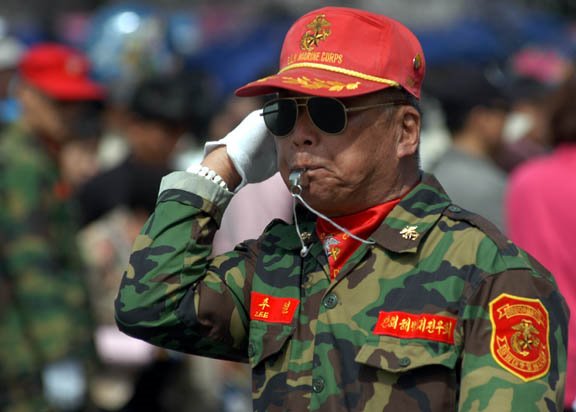
The festivities were just getting started when we arrived in Jin-hae. Vendors slow-cooked slabs of bone-in pork on motorized spits while ajummas stirred massive aluminum caldrons of steaming dwinjang jiggae. Wizened Marine veterans helped direct traffic and guide tourists.


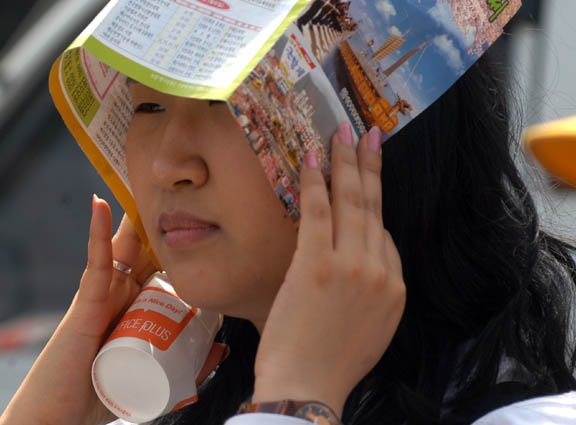
As the sun crept higher in the sky, the complexion-conscience Koreans covered their faces with whatever was on-hand.


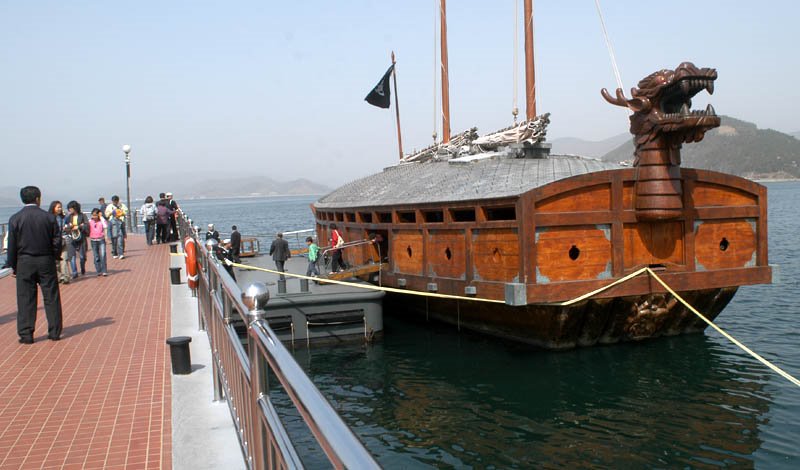
In-hye and I caught a bus traveling to the local Naval Academy to see the Yi, Sun-shin museum. Though not his birthplace (as I reported in an earlier update), Jin-hae was the famed Admiral's post for much of his career. An extremely accurate 150-ton replica of his ironclad Geobukseon, or "Turtle Ships," is also floating on display at the academy. We couldn't pass this up.

The traffic was unreal, and the passengers in the bus baked as the bus inched its way towards the academy. "Top-da, top-da," said the rotund old woman sitting next to me over and over again as she fanned herself with the festival brochure. The slow pace allowed In-hye to catch up with her text-messaging while I stared out the window. Moored across the bay were five huge, low-slung Korean destroyers, their massive anti-shipping guns glistening in the sunlight. I had no idea the Korean navy was so modern.

The decks bristled with antiaircraft batteries and torpedo tubes. There were obvious launchers for cruise-missiles and some wicked-looking radar equipment clustered atop the mast. The ships were terrible to behold: Massive tools of war, the most modern instruments in an age-old symphony of death and diplomatic failure stretching back thousands of years. There was no mistaking the purpose of these ships: To end life, to kill people, lots of people, quickly and efficiently. It staggered my mind.

If only that much money and consideration went into preserving human life, I thought.

The bus finally arrived at its destination and my companion and I viewed the destroyer's wooden predecessor: The Geobukseon.


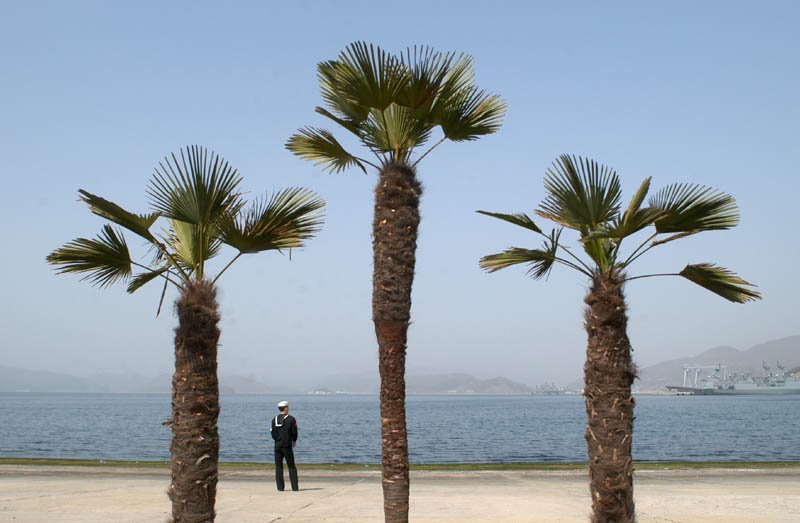
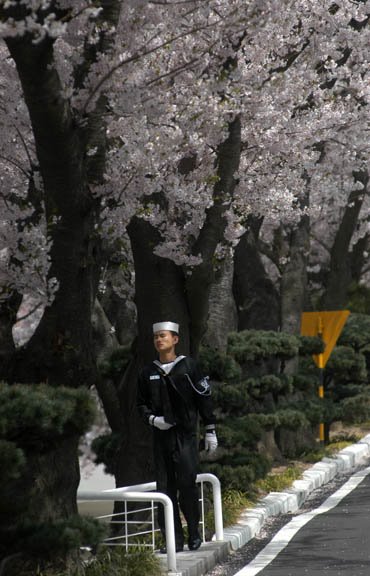
The line to go inside the replica was absurdly long. Still, In-hye and I tried to stick it out. While we waited, I photographed the sailors as they patrolled the concrete 'beach.'


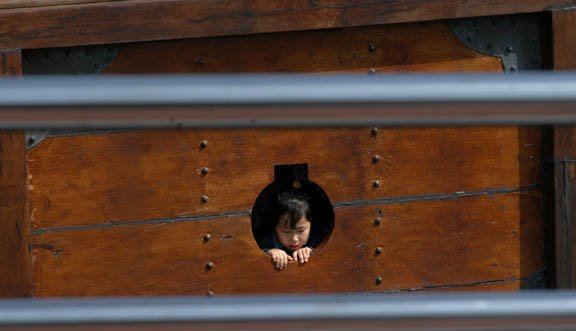
However, after fifteen minutes the line had moved only a few feet. In-hye and I decided to forego a proper inspection of the Geobukseon's interior. Instead we settled on a more-pedestrian examination of it's exterior. According to a plaque adjacent to the dock, the ship could travel at up to six knots. It sported a fire-arrow proof iron roof and sixteen holes in the wooden hull where canon would have normally been poking out. All that poked out of the port holes now was the occasional child.


A tour through the Yi, Sun-shin museum gave me some accurate numbers on the famed Admiral. He was actually incarcerated following his demotion, and when the Joseon emperor finally broke him out and handed him what was left of the Korean Navy, he only had twelve ships. It was at that point that he turned these remaining ships into Geobuksan and trounced a Japanese force 133 warships strong.

Besides being an amazing naval commander, Sun-shin was also a poet and a scholar. This was a poem translated by the museum.

"By moonlight I sit all alone
In the tower on Hansan Isle
My sword is on my thigh
I am beside myself with care
From somewhere a shrill piping sound
Thrills and pierces my bowels"

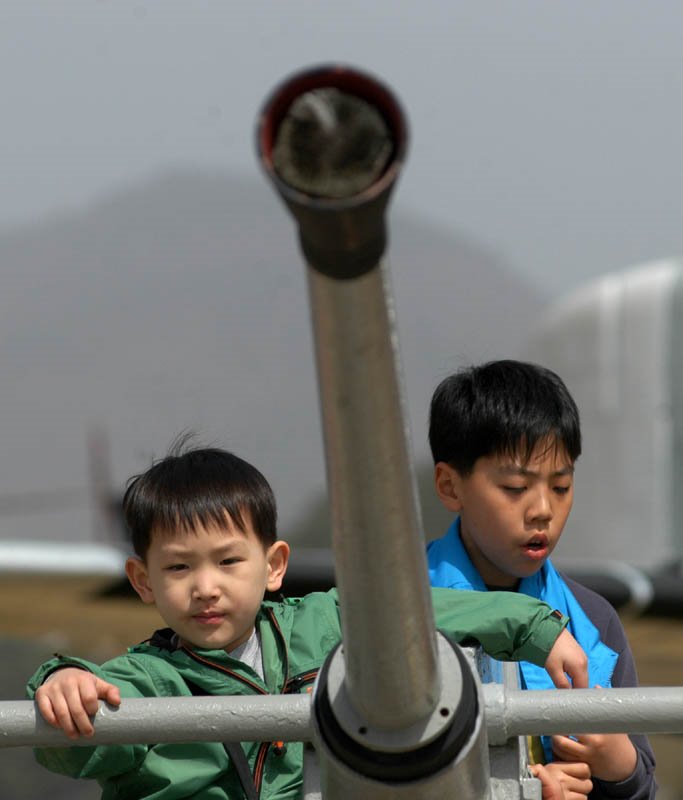
Afterwards In-hye and I waited for a friend of hers from college to arrive with his car and pick us up so we wouldn't have to crowd onto another bus for the sweltering ride back to Jin-hae proper. I took a few shots of people hanging out by water front. The sailors from the academy were selling ice-cream. Children climbed all over the guns on-display.


In among the stationary weaponry was a 21-foot single-mast sailboat perched in a concrete cradle. "The Forerunner" was inscribed in the back and a plaque told the story of a young Korean man who sailed the tiny vessel from Los Angeles all the way across the Pacific Ocean to Busan in the 1990s. The voyage took seven months.

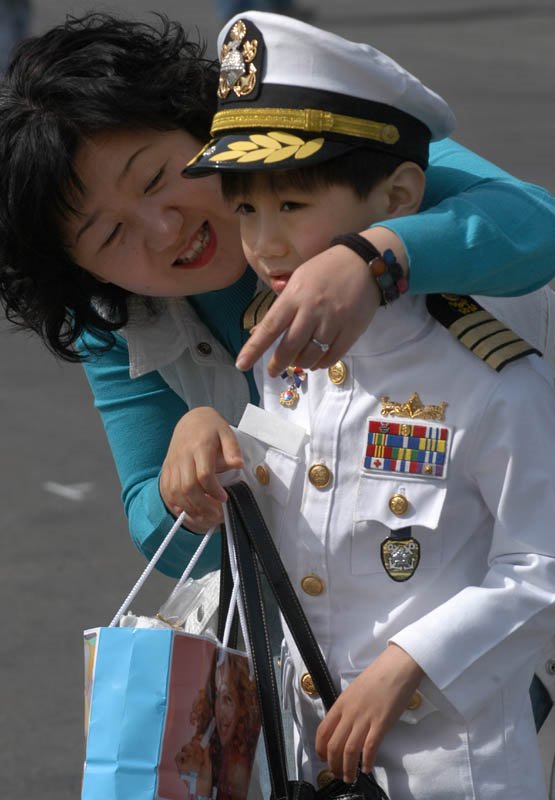
There were a lot of military families around, walking arm-in-arm with thei uniform-clad sons. I'm sure this family had a strong military background. Both this boy and his brother were in white officer's uniforms, presumably like their father's or grandfather's. Or maybe they're parents are just crazy. Who knows.


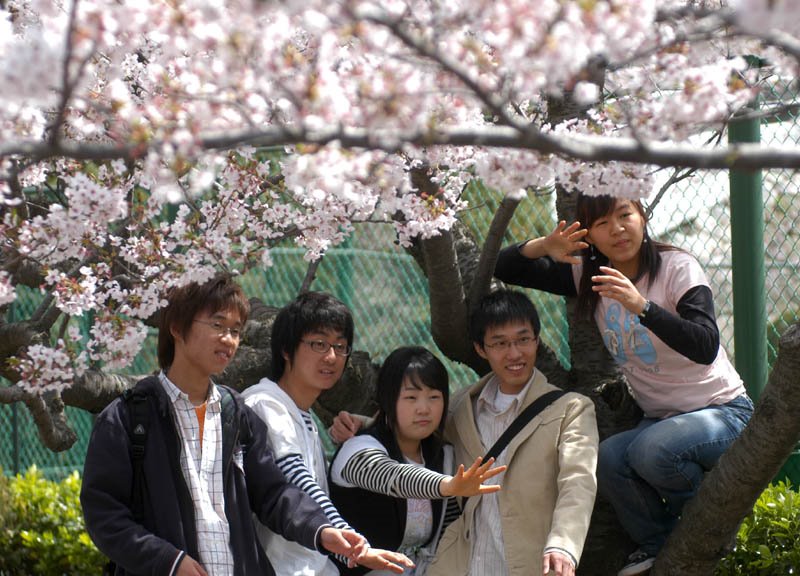
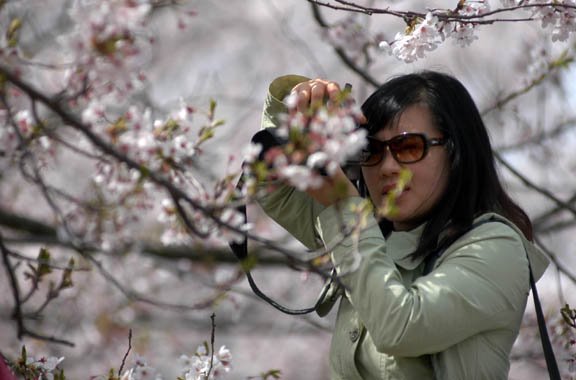
Other people sat under the cherry trees and waited for the bus. They took pictures of the flowers. I took pictures of them taking pictures of each other. Koreans love pictures.


The beautiful pink cherry trees lined the driveway up to the academy's main building. The soldiers directing traffic made sure departing tourists drove down the driveway on their way out.


In-hye's friend Joseph pulled up at a half-past one in his tiny teal Matiz. The incredibly small car, which is a little smaller than a Honda Civic hatchback, has been affectionately nicknamed the "puppy car" by the Korean public. Joseph, a chemical engineer working for an oil-refining company, only paid eight million won, or about 8000 U.S. dollars, for the high-mileage car, and with good reason. Gas costs nearly six U.S. dollars per gallon here.

Both Joseph and In-hye are devote Christians. They attend church every Sunday almost without fail, and Joseph is lead guitarist in his church's praise band. "I used to be into rock and roll, metal," he said later on while we drove back to Busan. He had to go to practice that night, but he wanted to hang out with us until then.

One critical difference that I find between Christians in Korea and Christians in the United States is the level of proselytizing fervor. I have never, ever been accosted by Korean Christians wanting to know if I have been saved. Periodically, Mormons will hand me literature in the Lotte Underground Mall and speak a few words about where from and when I came, but they are not as pushy as some of the diehards I encountered in Mississippi. Most of the proselytizers I see handing out literature pass me up. Maybe they figure that I'm already Christian because I'm white. Or maybe they figure I'm damned to hell for the same reason. Who knows.

In-hye knows I don't go to church, and it doesn't seem to dissuade her from interacting with me. Neither she nor Joseph pushed their beliefs on me. All of our religious conversation centered on the gospel music they both enjoyed (and played) and Joseph's pivotal role in praise band. She knows nothing of my beliefs.

I paid close attention to the questions Joseph asked me during our day together. I was curious: What information is a priority to Koreans when confronted with a stranger from a strange land? The guidebooks say that due to the heavy influence of Mahayana Buddhism and Confusionism, many Koreans' pay close attention to age and social rank. These beliefs are closely linked to the language as well. With people who are older or of a higher rank Koreans use a more formal, respectful form of Hangul. With friends, a speaker simplifies the language. The "imnidas" and "sumnikas" fall off and give way to "da" and "ka."

Joseph's conversational manners bolstered this theory. One of the first questions he asked me concerned my job. Over lunch he asked my age and referenced his own. We used the neutral, informal-yet-polite form of Hangul common to most guidebooks with which to speak to one another. My hangul sucks. His English was good. You can guess which language we used the most.

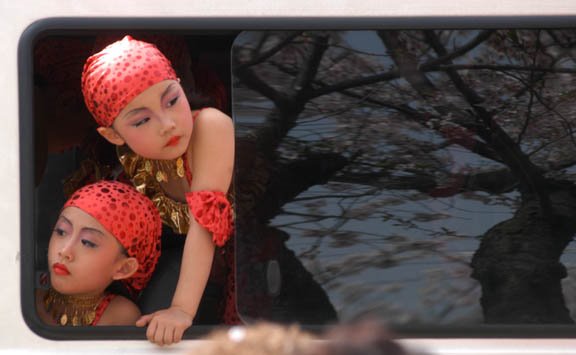
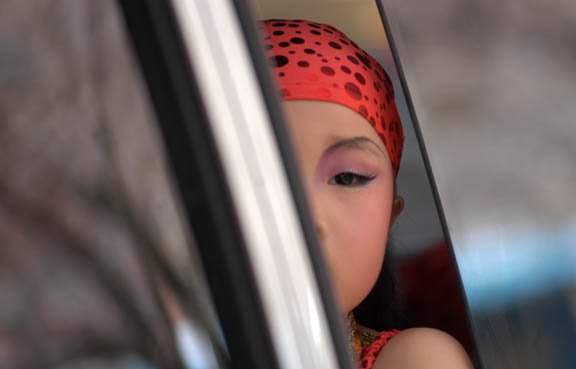
While trying to find the big festival parade, we missed it completely. In-hye was really bummed, so instead we located and attended a dance performance in a square ringed with cherry trees. Dancers of all styles and traditions took the stage and performed for the crowd. In-hye and I parked ass on the concrete in front of the stage. While we waited for the first act, I photographed some of the performers getting ready "backstage."

These girls are leaning out of their van, watching as other dancers take the stage. I love how the cherry trees are reflected in the black-tinted glass.


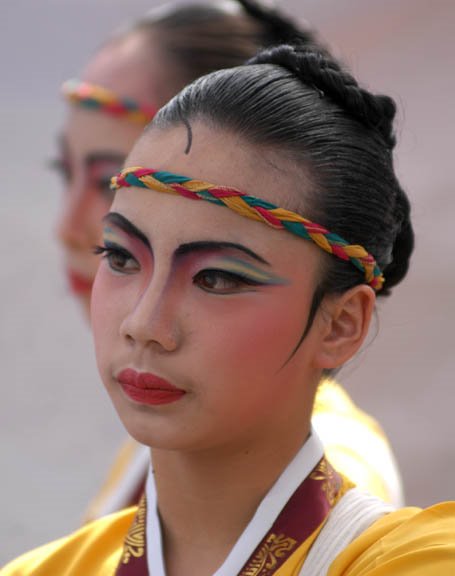
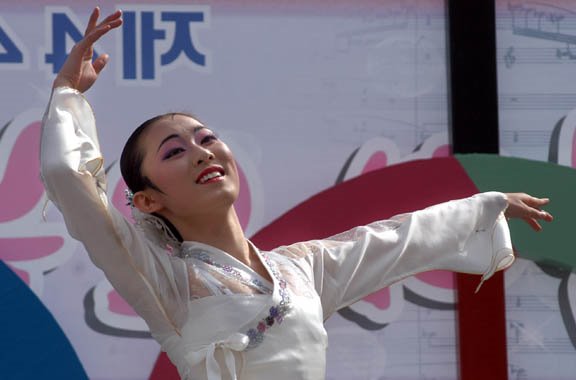
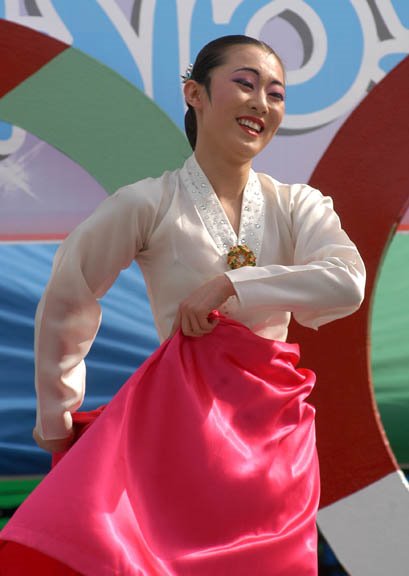
Like I said, there were dancers of all breeds: Korean traditionalists, dance-poets, hip-hop dancers and belly-dancers. Far and away the most compelling acts were the traditionalists. There were six women performing a host of ancient dances, all in Hanbok. The wore elaborate make-up.


Every time they took the stage the emcee would play the heart-stopping, thunderous drums and woodwinds of traditional Korean music. Even now, sitting in front of my computer, the memory of that boisterous, tumultuous music combined with the leaping, spinning, joyful movements of the dancers makes my eyes water. My heart is filled with emotion even as I write these words.

Following the traditional dancers would usually be a hip-hop act. A girl or girls, probably in their late teens, would take the stage and gyrate to Korean pop music, which on its face is really no different from American pop music. The only change is the language. The dancer's movements dripped with a sordid, soulless sexuality, the kind one finds in rap videos and live Brittany Spears performances.

Some of the traditional Korean dances were no less sexually suggestive, but there was a difference. Perhaps it was their scintillating, unwavering smile, or perhaps it was due to the careful subtlety of their gyrations, but I the dancers spoke to a deeper connection, a relationship between both sides of the human equation unexpressed by the aggressively sexual hip-hop and jazz dancers.


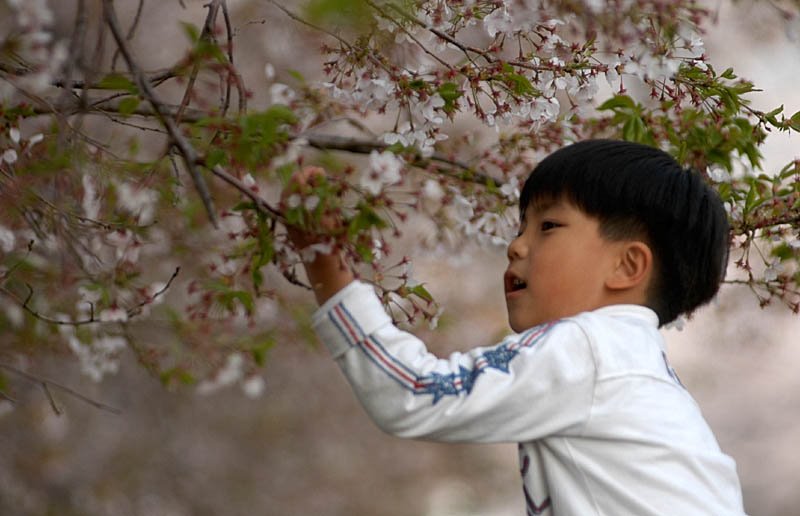
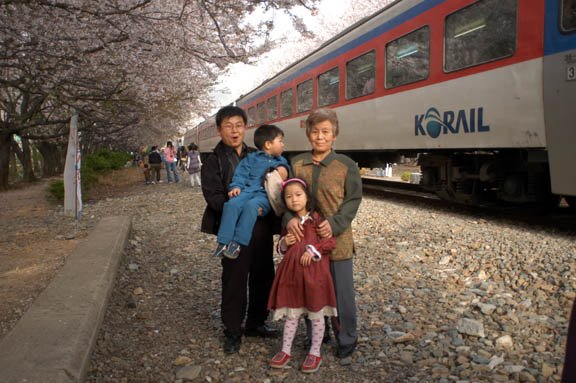
Following the performance, we piled into Joseph's "puppy car" in search of cherry trees. We chanced across a railroad track swarming with people, the verge by the rails lined in tall, majestic cherries. Joseph let In-hye and I out by the tracks and he parked the car as we began walking down the tracks. We balanced on the rails as the falling white petals danced in the air all around us. Children laughed as they ran with their arms outstretched, trying to catch the "spring snow."


At five o'clock we had to leave so Joseph could practice with the church praise band. We ate KFC before parting company. All in all, it was a very good day. There are no Korean Files this weekend. It has taken me five hours to put all of the above information down, and I'm finished for this week. Spring is the season for touring and festivals. Next weekend Mr. Kim is treating the whole staff to a trip from Busan all the way to the west coast of the peninsula. It will start at 6AM on Saturday and take us all the way till late Saturday night. Furthermore, next weekend is the start of the Gyeong-ju Dok and Dong Dong Ju festival. Rice cakes and booze in Korea's holy city. I promise to have a full report, including pictures, next Sunday. I hope everyone is doing really well. Peace. --Notes

Sunday, April 02, 2006

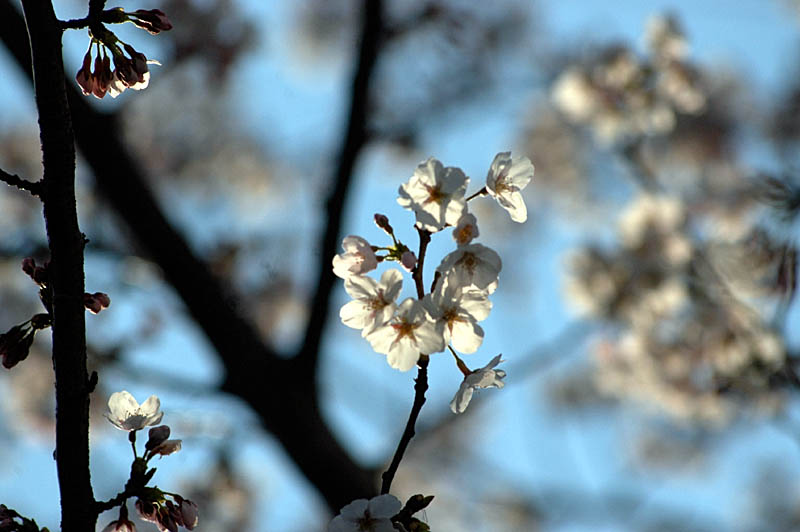
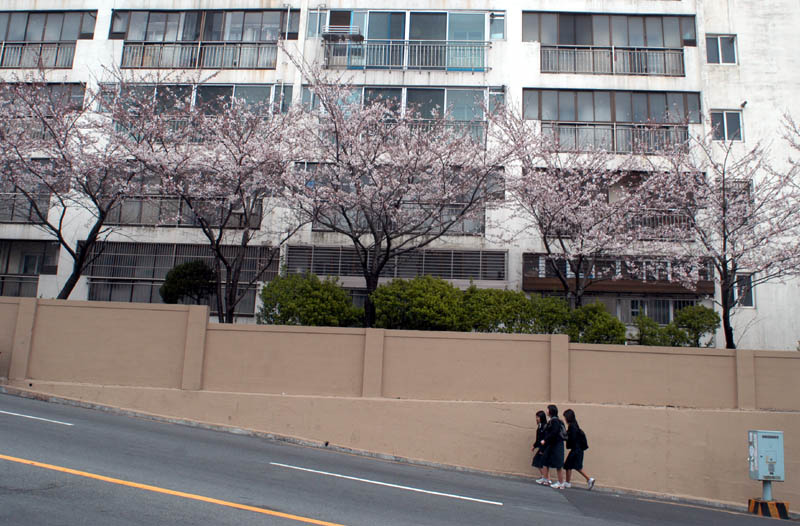
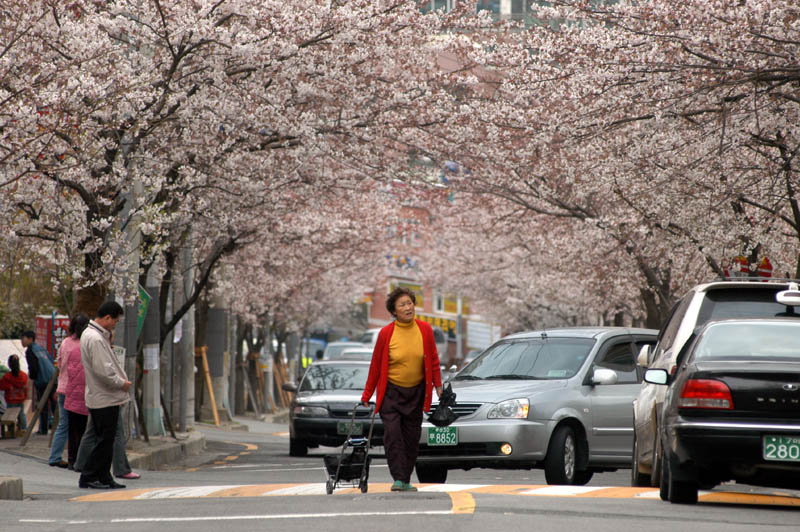
The cherry trees are in blossom. It happened almost overnight. I got on the bus one morning, looked out the window and my usually clear view of the harbor was impeded by millions of tiny white flowers. Within a few days the normally nondescript trees that lined the streets of Young-do island commanded my attention with their brilliant pinkish-white blossoms.


After our mutual language lesson, In-hye and I strolled among the beautiful cherries on the way to her apartment. People were everywhere. School had just let out, and the children looked up and admired the blossoms as they walked home.


The streets looked like a final winter storm had come in the night and coated only the trees in a brilliant, pinkish snow.


In-hye and I have plans to travel to Jinhae on Saturday and see the country's largest collection of cherry trees.

Jin-hae is also the birthplace of Admiral Yi, Sun-shin. In the late 16th century, Admiral Yi repelled a massive Japanese invasion force with only a small collection of ships outfitted with thick iron armor. These "Turtle Ships," as he called them were nearly impervious to the Japanese attacks. Admiral Yi lured his foe into shallow inland waters that he and his commanders knew by heart, and ambushed them. Trapped, outgunned and outmaneuvered, only a handful of the 400-plus Japanese fleet made it back in one piece.

Admiral Yi was an admirable man in character as well as deeds. At one point, the Joseon emperor of Korea was unhappy with Admiral Yi for being cautious in a key battle against the Japanese a number of years earlier. The imbecile demoted Admiral Yi all the way to the lowest rank in the Korean navy and took away his command.

According to the report made by one of my high school students, Admiral Yi did not flinch when the emperor demoted him. He took his medicine and his place among the men he once commanded without complaint. He became accustomed to the simple life of an ordinary foot soldier and he gained respect among the rank-and-file for his humility. His wisdom and patience paid off.

Without their brilliant tactician, the Koreans began loosing hand-over-fist to the Japanese, handing over port after port to the conquerers. The emperor quickly and quietly reinstated Admiral Yi, gave him what was left of the battered Korean navy, and ordered him to do the impossible, which he did in the battle described above.

A statue of Admiral Yi stands in Yongdusan park, dutifully watching over the deep-water harbor that has been the catalyst for Busan's growth and prosperity. The Koreans celebrate his life every year in Jinhae in conjunction with the cherry blossom festival, and I look forward to learning more about this great man.

The coming of spring has allowed a few bubbles of warm air to rise up from south Asia and collide with all that remains of the bitter winter cold. Clouds darken the sky weekly and soak the streets with a driveling rain. For most of November, December and January, the dry cold winter air kept the sky a deep blue day-in and day-out. As the warm weather returns, so does the rain.

I am not a big fan of the rain, especially on the weekend when I like to ride my motorcycle around the city and explore new places. I find it to be so depressing.


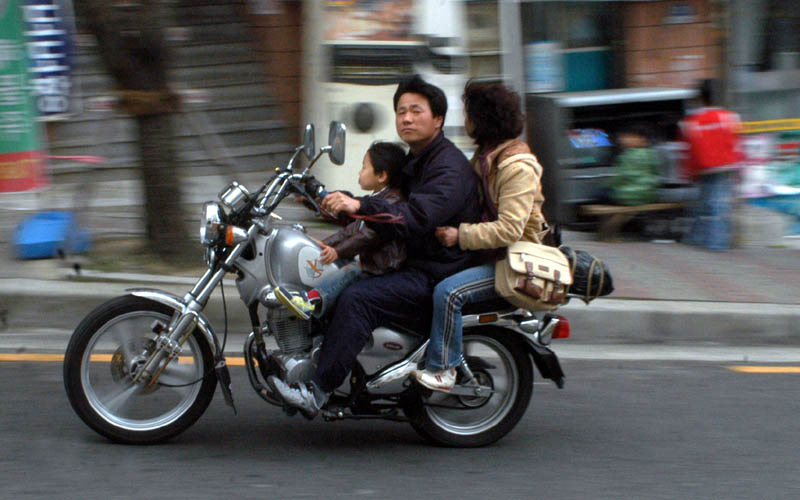
Other people are not so easily deterred. Check out this family on their motorcycle. It disturbs me how frequently I see a family on a motorcycle and none of them have helmets.


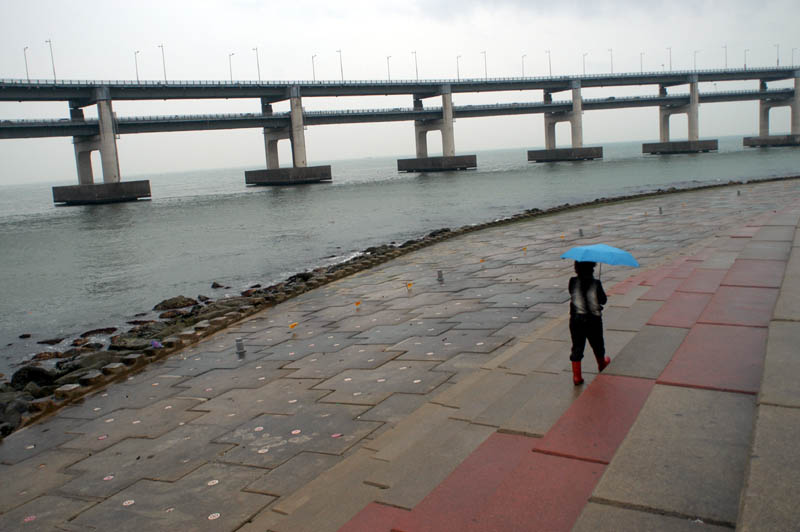
Gavin and I went out to Gwangali this weekend because I had read on the internet about a raw fish festival to be held there. Turns out the website got the date wrong and all we found was gray clouds, rain and a few diehards in galoshes out for a stroll.


Sunday was better suited for exploring, the weather having cleared up over night. However, I was tired, and my exhaustion compelled me to spend a day indoors getting some down time. I worked on my website for most of the day. In the afternoon, I moseyed around Young-do, basking in the late afternoon sunlight. More people then usual were out of their house doing likewise.


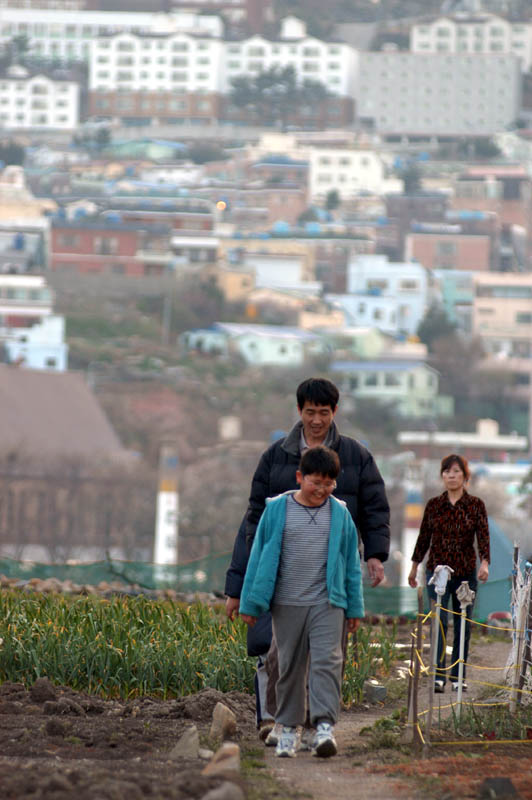
I climbed a small terraced hill near Dongsamjugong and came across a long, handmade stone wall on the summit. A family joined me, laughing as they walked between the rows of produce.


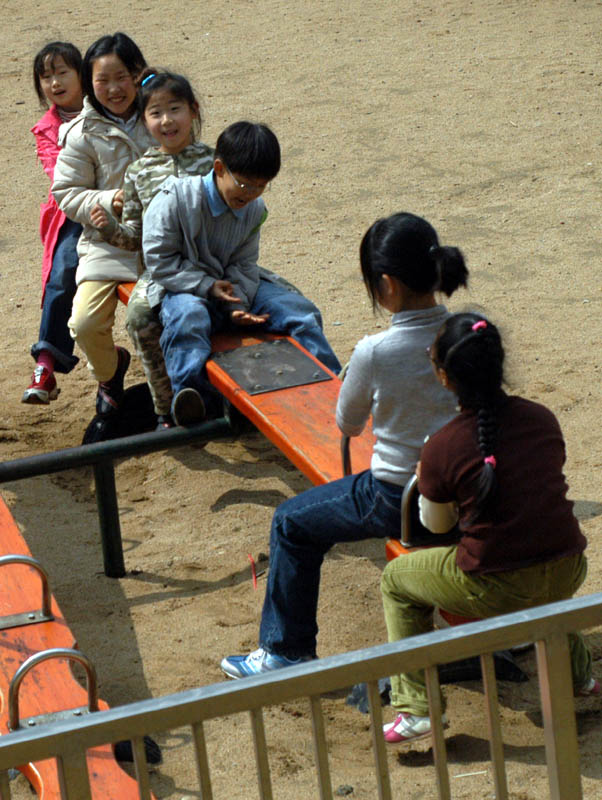
Children romped around in the playground by Dongsamjugong.


I have reached the midpoint of my journey in Korea. There are six months behind me and six more ahead of me. I look back and wonder where the time went, and though I try to focus on the shoebox of accomplishments, my mind invariably wanders towards the warehouse of things left undone.

Complicating matters is a growing longing for home. Korea can be a very lonely place. The language barrier tends to reduce most conversation to little more than stock phrases from my handbook. What few people who actually can speak a little English usually do so very poorly. Even with the best English speakers I still spend a lot of time sorting through their words, trying to figure out what they are saying and then trying to craft my own sentences around a perceived level of comprehension. This can be exhausting, and I often lose my focus on the person. It is hard to build relationships this way.

Complicating matters is the Koreans' tendency to hold westerners at arms-length, so to speak. A friend of mine told me that Korean women don't like being seen walking alone with a western men because such women are perceived as prostitutes. I don't know how much of that is true, but I do know that whenever I start talking to a Korean in English in public, they get very nervous. Other Koreans stare hard at them. Whenever we go somewhere together, the Korean staff is careful not to appear too close to Gavin, Dave and I. They like us, I know they do, but it feels like they don't want anyone outside of ESS to know that.

I also miss my family. There is something to be said for having a group of people who love you no matter what, who ask nothing of you except that you exist, who will always be ready to throw their arms around you and shed some light on the darkness. I draw much of my personal strength and confidence in myself from their love for me. Without them near, I have been forced to assess myself and my life from the sobering vantage point of near-total autonomy.

One night last week I dreamed that I was in a Chili's restaurant with my mother, father and sister. We just sort of walked in and suddenly all of these smiling, busty green-eyed brunettes started bringing us food: Steak, fries, burgers, double-stuffed potatoes and bowls of soup and salad piled up on our table. My parents were hugging me and my sister was cracking jokes and laughing at the smiling waitresses as they hit on me. In the background of the dream my mind was chanting this odd sort of monosyllabic litany of western foodstuffs to a slow, trance-techno beat.

"Pizza and potatoes and burgers and fries and..."

I woke up the next morning and my mind was in darkness, the dream having only reinforced my solitude.

Having Gavin around helps a lot. He is a good friend and an excellent roommate. We bounce teaching ideas off of one another, collaborate on projects and watch each other's back. Heck, if it weren't for him, I'd still be melting brain cells with soju!

Gavin and I also share a similar question: What next? This question is a poisonous seed in my mind that has sprouted and grows larger with every day that I get closer to completing my contract and departing Korea. My original idea was to save enough money to build a freelance photography career in the States. However, over the course of six months the realities of such an endeavor have stacked up against itself. What was once a dream seems more like a wild gamble without a lot more money and time.

Some people spend a decade or more building the contacts necessary to get enough work on which to live. Also, the camera equipment I would need is professional grade (read: really, REALLY expensive). A car, laptop with wireless FTP capabilities, health insurance, car insurance, a place to live, food...The list goes on and on, the calculator in my head tallying a bigger and bigger number.

With a modest savings I would have after my time here, freelancing is still a gamble. Even if I lived at home, with my rent and food taken care of, I'd be starting from zero professionally. I would have to wait tables, shoot weddings, or assist other photographers to make ends meet while I climbed the ladder. Do I want to do all of that? Or do I want to complete another year in Korea and pile up another stack of cash? My sister might be teaching in Japan. Should I join her? The money is not as good, but 'they' say cultural experience can't be beat. Can I start a career after that?

And so goes the thinking of a man without a clear route in life. I go to bed every night wrapped up with these thoughts, and I wake up to them in the morning. They walk with me to the gym and they distract me while I teach class. Some days I think maybe the way will be made clear for me if I just let it. Just live your life, Stephen. Quit worrying. God or fate will provide. But am I so important that the Almighty even gives a damn about me? What if God has forgotten me? What if my fate is to have none at all? No one can take responsibility for my life but me, right?

No matter how I cut it, sitting on my laurels is not an option. I don't want to be like Julie: A year behind me, a little money in my pocket and no where to go but home. I need a next step. If I can't find one, I'll stay here, teach and make money. I like teaching, I like money, and both of those things will vanish in America.

Sorry about the heaviness. I guess it would be uncouth for me to wrap up SoKoNotes on such a low note. Here are a few phrases of Konglish for you to try and figure out. What were they thinking? Post your replies on my comments page.

"I give a present that cream."

"My favorite foot was cake."

I'll try and have something more to say next week. One of the problems of living in a place for six months is that it starts to lose the brilliant polished shine of its former 'newness.' Despite the language barrier, despite the low-level racism, despite the loneliness, Busan has become my home, and I view it through the narrow slits of familiarity. I can tell because my camera's memory card has no photos on it even by Thursday. I can tell because I see the same streets and buildings day-in and day-out, even when I try not to. The physical make-up of the city is now as familiar as Atlanta. I could tell you how to get from Haeundae to PNU no problem. Now all that remains to be explored is it's human side, and as I said before, the language barrier is going to make that difficult. But hey, I have six months...

--Notes

Sunday, March 26, 2006

Another week in Korea has come and gone.


Which reminds me: There are fewer egregious notebook entries this week than last. Perhaps all our hard work in the classroom is paying off. Or maybe Mrs. Nam reads SoKoNotes. Let's hope not. Here are a couple stand-outs. See if you can figure out what the student was trying to say.

"I don't relief sometimes."

"They are so land at me."

Why is it that wherever I go in this city somebody offers me a shot of soju or a beer? It never fails. I cannot walk past a group of old men picnicking without a friendly offering of booze shouted in my direction. What's with this? It's like people take one look at me and say to themselves, "Yeup, that guy needs a drink."

Unless I have a lot of time to sober up or I am riding the subway home, I always decline. Driving in Busan is dangerous enough as it is. Driving drunk on a motorcycle in Busan is patently suicidal behavior in the same league as wrestling crocodiles or Russian roulette.

I put a lot of Korean asphalt under my new black Kumho tires this weekend. On Saturday afternoon I met Kristen at her apartment on the crest of Half-Moon Hill and we saddled up for a jaunt into the Korean countryside with little more than a cheesy tourist map, a bottle of water and my camera. The road snaked its way along the high shoulder of Half-Moon Hill, the gaps in the trees offering beautiful views of the wind-whipped ocean far below, and eventually deposited us onto a multi-lane county road leading towards Ulsan.

Kristen had driven this road once before with her friend and co-worker Winnie within the safe steel pillars and doors of a car. Riding on the back of a motorcycle was an entirely different way to experience the Korean countryside.

"I enjoy being a passenger," said Kristen later. "Your hair is blowing, it's much more liberating."

When she was eleven, Kristen and her father traveled from their stomping grounds in Northern Wisconsin up through Canada to Maine and then all the way home through the central midwestern states - entirely by motorcycle. It rained almost the whole trip.

"We went through two rainsuits each," she said. During the long hours of driving, Kristen's father worried about Kristen possibly falling asleep. On a similar journey a few years earlier with her sister, Kristen's father had even gone so far as to tie his daughter's hands together around his waist to prevent her from slumbering her way off of the moving vehicle.

There would be no need for any jerry-rigged safety measures on our trip down the Korean coast. It was daylight, the sun was shining and we both had helmets. Earlier I had downed two cups of Aurora coffee (imported from Atlanta courtesy of my wonderful father) and I was as wired and alert as a desert fox as I navigated the schizoid Korean traffic streaking down the highway.

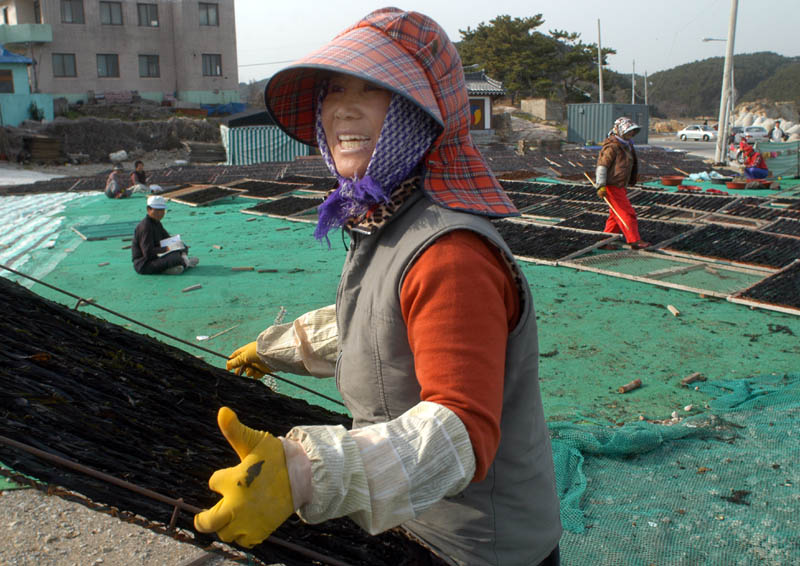
At an intersection sporting a giant bowling pin Kristen and I made a right-hand turn for the coast. The poorly paved road lead us to a tiny fishing village. We parked the motorcycle and walked down to the sea. Dozens of fishermen dotted the seawall, casting their rods, drinking soju and talking. Old ajummas dried meter-long strands of seaweed called "mi-ya" on chicken-wire racks in the sunshine. The wavy, black sea vegetable tinted the cool spring air with its brackish odor.


We walked along the road until coming across two candy-striped tents by a long-abandoned military post. Through the semi-transparent plastic windows could be seen patrons drinking soju and cider, eating fresh raw seafood chopped up on a wooden block outside. I came across an ajumma carefully skining delicate sea animals alive and asked her about the creature dying in her hands. "Hangul Mal-o moy ye yo," I blurted out.

The woman, who appeared to be in her mid-forties, smiled wryly and thrust the wet, orange piece of flesh forward. Eat this, she said. Oh crap, I just wanted to know what it is, I thought in alarm. Did I say something wrong? Kristen and I faltered a second, glancing at one another as if wondering what the other person might do. Kristen took the lead. She accepted the proffered mystery meat in her hand, and I followed suit. All I was thinking as I shoved the gelatonous beast into my mouth was, "I have never, ever eaten anything this color before."

It tasted incredibly salty and the texture was akin to stiffened egg whites. I chewed, muling over disquiting thought that this mouthful of wierdness had just recently been, and might actually still be alive. I fought the urge to spit it up. Kristen had already swallowed hers, and the look in her eyes as she spied me still chewing said, "you're actually chewing that thing?"

Kristen and I decided to go for the gusto. We walked into the panjang macha and ordered some raw seafood. The young woman who ran the joint spoke a little English, and she took us for a tour of the buckets filled with imprisoned sealife where we ordered our lunch. Twenty minutes later a plate of raw So-rah (clams, I think) and Go-dong (conch) arrived on our table with a paltry side of mi-ya and fresh carrots. The shellfish was extremely tough and chewy. Kristen remarked that it felt like we were eating someone's ear.

On the way back to the bike, we stopped to pee. Kristen found some interesting Konglish and she took a photo. Just so everyone is on the same page, it's a crab breaking a cigarette while taking a crap.


After a brief stop to take a few more photographs, we left for home.


On Sunday I slept late and worked on my website. When my eyes stared to glaze over from staring at my computer screen, I decided it was time to get out of the house. A shower and a bite to eat and I was out the door, headed for Oryukdo.

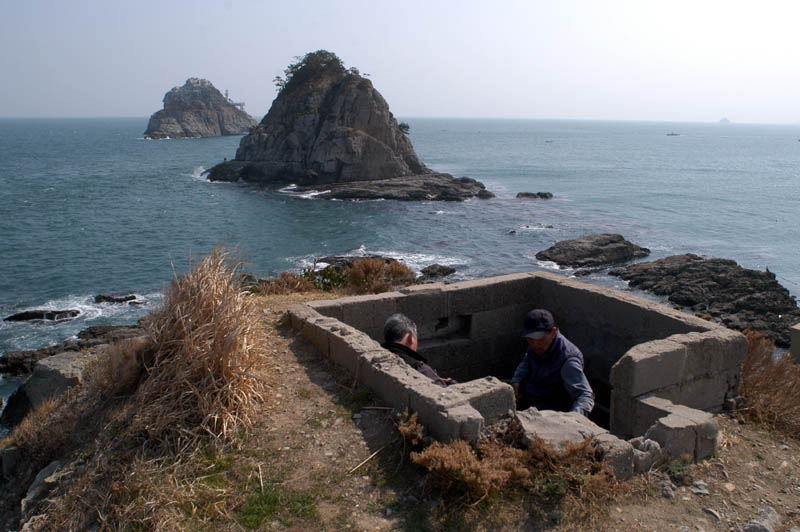
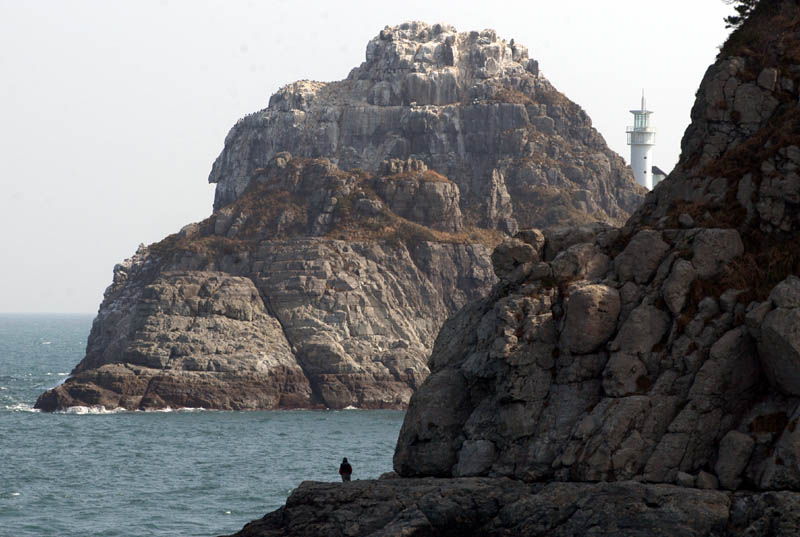
Oryukdo, which translates "the five-six islands," is the "symbol of Busan," according to offical tourism literature. Busan is very proud of its large, bustling deep-water port, and every ship that enters the port passes by the line of rocky crags jutting out of the water. An operational lighthouse, originally built in 1937, perches on the furthest island. The islands got their name from the way the rising tide divides one island in two. It is a popular fishing destination and the land adjacent to Oryukdo is the location for a major housing complex called SK View.

I puttered by the massive SK View construction site on my motorcycle, marveling at its size and audacity. Past the complex, the road peaked at an overlook and then dropped steeply down to the fishing village by Oryukdo. I think the village was originally a temporary home for workers on an earlier construction project or the soldiers who once manned the coastal military posts, because almost every building was abandoned, the windows long-since stripped of their glass, the dusty rooms filled with the broken, discarded artifacts of absent human life.


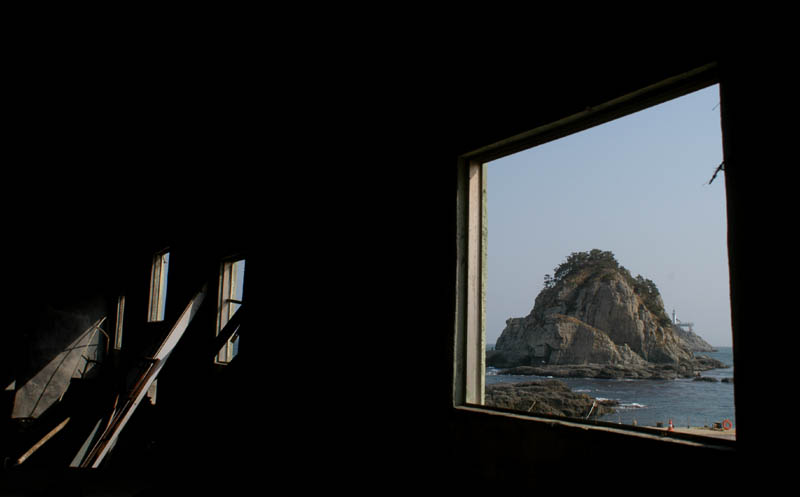
Through a few windows could be seen Oryukdo itself. That must have been nice for whoever lived there.


Oryukdo itself was impressive. The islands are so perfectly aligned that it took me a few minutes to realize that I wasn't looking at two of the islands, I was looking at three.


The lighthouse jutted up from the last island, almost perfectly framed by the first and third islands.


People picnicked in the abandoned machine-gun nests, drinking soju and chatting me up.


I enjoy trying out my language skills, though the intoxication levels of my conversation partners tends to be a blessing and a curse. It's a blessing because their speech slows down. It's a curse because I think they're talking pure nonsense. All I can really discern is that they want me to sit down and get soused with them.

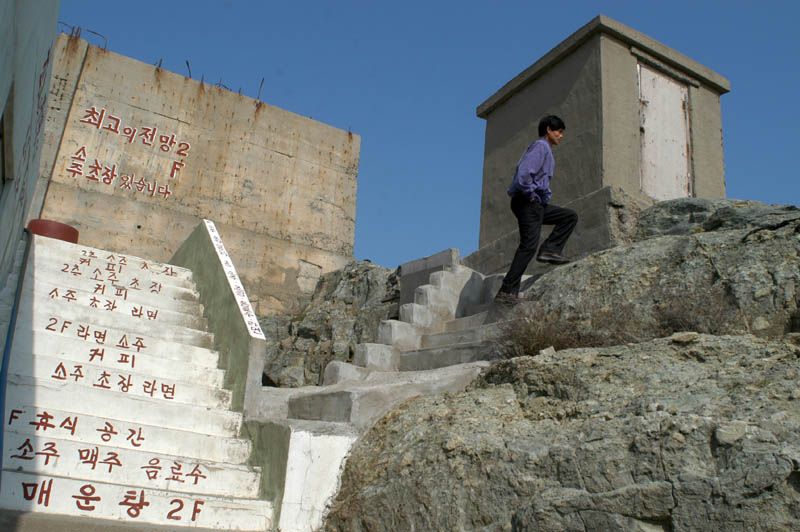
Closer to the sea was a staircase leading down to a raw-fish restaurant.


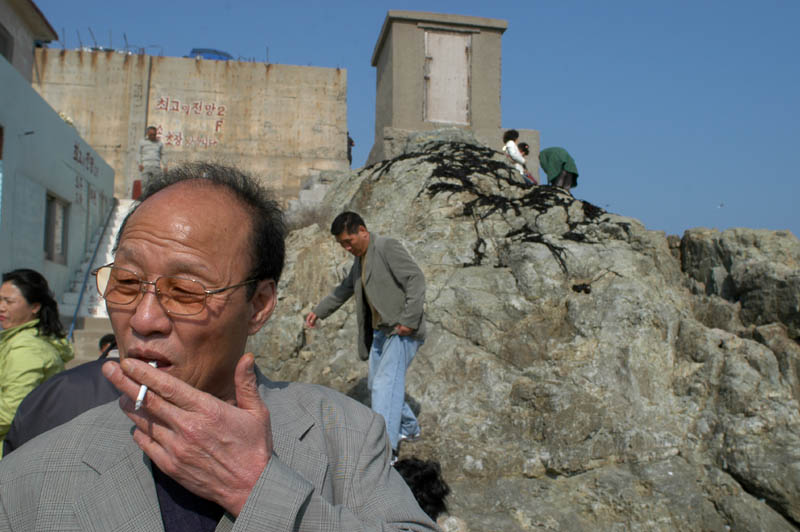
I walked down and photographed the people basking in the sunshine, the whole scene framed by the white-tipped ocean on one side and the abandoned, faded-pastel concrete buildings on the other.


As they dined ships of all sizes and designs slowly made their way into and out of Busan harbor. I got to watch the hydrofoil ferry race into the harbor, a massive plume of water rooster-tailing out behind it. What had been an tiny blip on the horizon when I arrived hours earlier became a huge containership marked with the word EVERGREEN and stacked high with earthtoned shipping containers. A host of tugboats intercepted it as it passed Oryukdo and entered the port.

The trees are in blossom, and the weather is warming up. With the warmer weather the motorcycle is really starting to show its worth. Now that I am not restricted to the subway and bus systems, all that I have to worry about is time. In the coming months, look for more trips into the Korean "outback" right here on SoKoNotes. So long! --Notes