Monday, September 11, 2006

My time in Korea has come to an end.


It’s been a while since I updated, and I apologize for the delay, but the current of life picked up over the last couple of weeks and I just never found the time to update SoKoNotes. I started this update from seat 51A on a Boeing 747 bound for the United States and I finished it up a few days after returning to the USA.

As I sat in the terminal at Busan’s Gimhae airport preparing to board the plane for Narita, I looked around me. There were a few Western foreigners in the terminal. From somewhere behind me I heard a voice speaking in English. It was a man talking to his wife. The voice was just close enough to penetrate approaching reality and just distant enough to seem like it was coming from a dream.

It was surreal to sit there and listen to strangers talking and understand what they were saying. For so long I have lived in the artificial silence of a language barrier, unable to understand more than a few words. From behind me came the sound of my past, the sound of my homeland, the sound I will need to reacquaint myself with these next few weeks.

I continued to listen off and on to the Westerners, who sat behind me on the airplane. Their conversation was nothing special, but I simply marveled at their words. Simply listening to them speak and understanding their words was fascinating. I thought about the structure of language and how strange a tongue English actually is. I wondered what it would be like to listen to English and have no idea what was being said.

The halls in Narita were crowded with Westerners. It felt a little uncomfortable, like slipping on a shoe you haven’t worn in a while, to be among them. For one year I have been a minority, and I have long enjoyed both the anonymity and the minor celebrity my white face and blonde hair afforded me.

As I walked the halls towards my gate, I suddenly felt stripped of those qualities. I became boring old Stephen Jones from Atlanta all over again. As I boarded the plane and the nice Japanese gate workers spoke to me in English, I realized that nobody around me knew of the powerful experiences I had lived this past year.

It felt just like September of 2003 when I scaled Mount Katahdin and completed the Appalachian Trail. Over six months I had learned all the habits, skills and tricks of a long-distance hiker, and the minute I stepped into my parents’ minivan and drove out of Baxter State Park, it all became practically useless, history, trail behind me. I shaved my beard. I hung my pack on a nail in the attic. I started looking for a job.

The one thing I never hung up were my memories of the experience. To this day I can flip through one of the many notebooks I kept on the trail, read the entry and instantly be carried to that exact day on the Trail. I can smell the air, I can taste the sweat, and I can feel the ground under my feet. There were people I met there that continue to be my friends and experiences that helped shape and mold me into the man I am today.

The very same concept holds true for Korea. My experience in this small nation has been no less enriching and amazing than the journey on the Appalachian Trail. I learned more about being an adult in one year than in the entirety of my ‘adulthood.’ I rose to challenge that I was completely unprepared for and I left a success. I lived in a foreign land and learned how to solve the problems contained within that relationship. I discovered elements of myself that were good and bad and I became more familiar with both. I made a friend who changed my perception of myself and taught me how to love another person with my whole self.

Korea has been good to me in so many ways. Korea has affected me deeply, even my language.

I caught myself thanking English-speaking people with a ‘Kamsamnida’ and as I traversed the Narita terminal I accidentally greeted a few new faces with ‘annyong hasayo.’ I felt embarrassed, but sort of proud that such words were reflexive and natural. These changes speak to effects on my being that I cannot guess at, changes in my perception of the world that I have not yet realized.

My last week at ESS Best Jr. went by without much fanfare. I brought my camera and tripod to class with me and took photos with all of my favorite students. Advanced Three and Four were saddened to see me go. The students gave me candy and letters and promised to treat the incoming replacement - A Canadian named Laura Spencer- with dignity and respect.

I spent entire blocks of class simply teaching them how to pronounce here name. Most of the students have a hard time with L’s and R’s. They inadvertently pronounced her name, ‘Ralla’ or ‘Rolla’ or ‘Rollar.’ Han-sol, in Advanced Three, turned the class’ poor pronunciation into a joke and nicknamed Laura ‘Roller-skate Spencer.’ Someone in Dave’s class coined the name, ‘Ms. Pencil.’

The youngest children were the most perplexed by my imminent departure. The middle school students all wrote me cards and Eun-hee had the entire 1S students make a heart-shaped goodbye card for me. It was sort of odd to read their letters and all at once be touched in my heart and want to correct their grammar at the same time.

Some of the students were very personal in their letters, and told me things that made me feel like I had actually done a good job. The students praised me for my enthusiasm, patience and how much fun they had with me. They said they could tell I really cared, and they meant it.

However, it was these very qualities that the students liked so much that had the opposite effect with my employer. The state of my relationship to ESS Best Jr. had grown cold and impersonal in the last few months of my tenure. Mrs. Nam, who when I arrived would pay me compliments and trade jokes with me, was just a notch better than my enemy when I left.

I greatly angered that woman in the Spring by directly confronting her style and the methods of teaching, methods encouraged by Mr. Kim, methods I considered old-fashioned and a waste of the students’ time. Mrs. Nam caught me playing with 3B before class. We had turned the blue podium into a pirate ship by laying it on the floor and we were pretending to sail through the classroom. I guess it was a little over the top, and I braced for the worse when I got back up to the teacher’s lounge after class.

Mrs. Nam didn’t disappoint. She began to berate me in front of everyone in the office. She had some valid points about proper discipline and teacher conduct, but I have a short fuse, and I was angry over the public humiliation. I met her head on.

Emboldened by my status as a Native Speaker, I got into a screaming match with my boss, and I spoke my mind on Mr. Kim’s methods. For Mrs. Nam, this was a direct insult, and all that kept me from getting fired was my status as a Native Speaker. From that point on, the compliments and jokes ended. At the core of my relationship to Mrs. Nam, and by proxy my relationship to all of the Korean teachers who used Mr. Kim’s methods, was a mutual lack of respect and distrust.

I also had to teach closer to Mr. Kim’s methods in order to keep from being dismissed. I despised the drudgery and total lack of imagination inherent to these methods, and a dark, angry place grew under my skin. When Mrs. Nam and the other Korean teachers took me to lunch on my last day, they all sat apart from Gavin, Dave and I and we all barely spoke to one another.

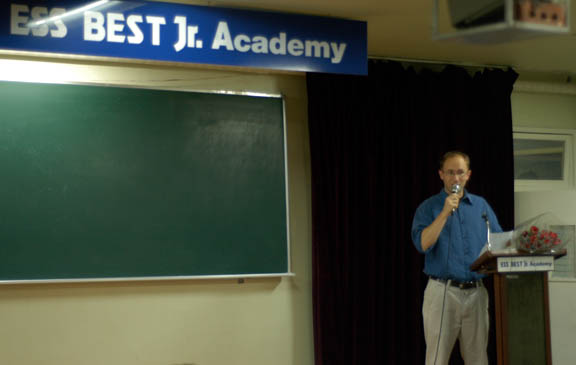
Still, through all of this strife, I made out alive. ESS Best Jr. bought me my plane ticket, paid me my last paycheck, bonus and had the students gather in the auditorium Friday night to say farewell. Earlier that week, I wrote a speech and my girlfriend, Hyun-jeong, translated it into Korean for me. Here is the photograph of me reading the English version of the speech, which is below it.


Well, here we are. Twelve months ago I stood at this very spot and greeted you for the first time. Let me tell, time flies, and what can seem like an eternity passes in the blink of an eye.
Twelve months ago I stood behind this podium still a boy: Scared and insecure, unprepared for the great challenge before me. Over those twelve months, you and I grew together. I became familiar with your strengths, weaknesses and personalities, and I came to know me own personality, strengths and weaknesses, too.
But there is more. I knew that when I stepped into that classroom, you would ask me to be the adult, to be a voice of justice, moderation and wisdom. By addressing these demands, I have learned powerful life lessons. I have learned to be patient, thoughtful and caring. I have learned how to be a good friend by cheering you on when you succeeded and being supportive when you failed. I always strived to answer your questions, and I have taught myself to be humble when I didn’t know the answers. In many ways, I arrived in Korea a child, and I will leave as an adult. You shared in that transition. You challenged me to be more than I am, and I rose to that challenge.
I stand before you now preparing to depart for my homeland. It is hard to say goodbye to you all at once. I want each of you to know that wherever you go in life, you have a friend and a brother in me, and as long as I live, my house and my heart will always be open to you. I want to take each of you by the shoulders and look you in the eyes so that when I say this, you’ll know it comes from my heart: Thank you. I hope to see you again someday.

* * *

Afterward, Mr. Kim said a few words for the kids. I don't know what he said.
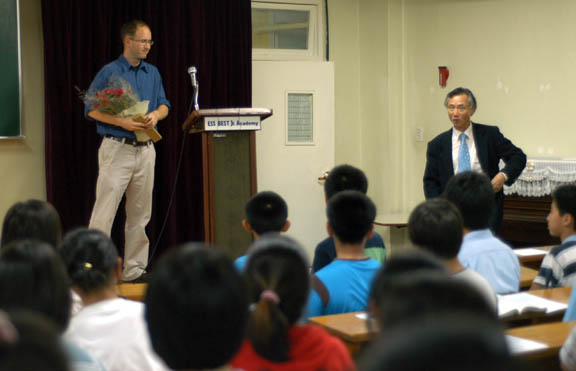


Hyun-jeong translated the speech so well that Mr. Kim read it to the students for me before I did. After I gave my speech, the students gave me a standing ovation. I shook hands and traded smiles as I walked down the aisle, Gavin filming the whole affair with my videocamera, Dave taking stills. It felt great.

All the rancor and bitterness I held in my heart for my employers evaporated. Yoo-jin and Han-eol gave me flowers and an impromptu speech (that was really impressive). The Korean teachers even gave me a nice letter and Mr. Lee gave me an amazing Korean mural which now rests in my dining room. Even Mrs. Nam gave me a hug. I felt sort of dazed.

Afterwards, I waited around the teacher’s office for the second-year middle school students to finish class. They had promised me a treat. I set up my camera and waited.

Dave rummaged through my drawer for overlooked goodies. Mrs. Nam and Ms. Ha chatted. I sat and stared at my empty desk, wondering where the time went. I pray that when I die, I don't feel the same way. So much of life doesn't feel like it's actually being lived sometimes, and then a part of it ends and I am left wondering how I could have lived it differently.

Of course, that is not the way I feel about my time in Korea, but until that moment, it had felt that way. I had been exhausted much of the time, stressed out from managing all of those classes, a disgruntled boss and a language barrier. I spent too much time feeling negative and angry, defensive and powerless. In the end, it was time very, very well-spent. The power of leaving lifted me out from those dark clouds so that I could see the truth. I love this place, I love these people and I will hold no grudge against any of them.

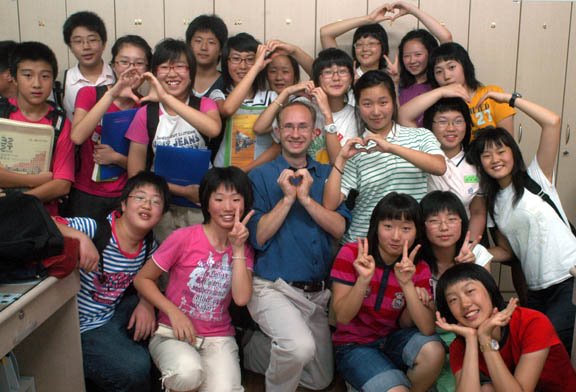
At 10 o clock the second year middle school students poured out of the sweltering auditorium and into the teachers office where I was sitting. We snapped photos, traded gifts and laughed. Here's a photo. Notice the befuddled look on the guy on the far left. Today was his first day.


Mr. Kim broke the party up with a series of sharp commands in Korean. The students all came to attention.

‘Don’t you all need to go home to your mommies and daddies?’ he enunciated in a flat, syrupy tone of voice that carried more meaning than his words. ‘I think we should let Mr. Jones go home,’ he finished, as if I was inconvenienced by the students. We all obediently filed downstairs and a few of the students made plans to take me to lunch the last Sunday I was in town.

I met them at Starbucks in the early afternoon and ate seafood noodle soup. I marveled at their English, which was much better than I had originally thought. They told me about their plans for the future and how much they were going to miss me. I bought them icecream and we exchanged a few more gifts, email addresses, and even a few tears. We took pictures at the Gwangbokdong intersection.


What I found so wonderful about the meeting was that I felt no uncomfortable change in status from Mr. Jones the teacher to Stephen Jones the foreigner. They treated me with the same respect. I felt honored to have been their teacher, so aware of the fact that the passing of my face is like that of water under a bridge to these children, so easily replaced by another and another and another with each passing year.

I smiled and got embarrassingly emotional as I sat and prepared the photos for SoKoNotes. Here are the group photos I took with my favorite classes. This first picture is of my sixth graders, Advance Four. I had this class the longest - nearly eight months. They went from being my most hated class to being one of my most loved.
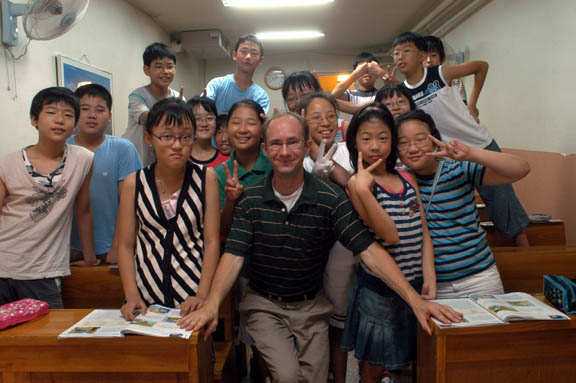


The next photo is of my all-time favorite class at ESS Best Jr...Advanced Three. This was the best group of children I have ever taught. They had real panache, character and enthusiasm that made me smile every day. They could make a Winter day Spring. They were an inspiration. One of the little boys, Jin-soo (to my left), spoke better English than most of the children in the school regardless of age. When I would award a student an "Outstanding" for making a really good sentence, Jin-soo would get up out of his seat, run outside the classroom and declare "Outstanding!" Then he would run back in the classroom and declare with joyful abandon, "IN-standing!" Does it get any funnier than that?
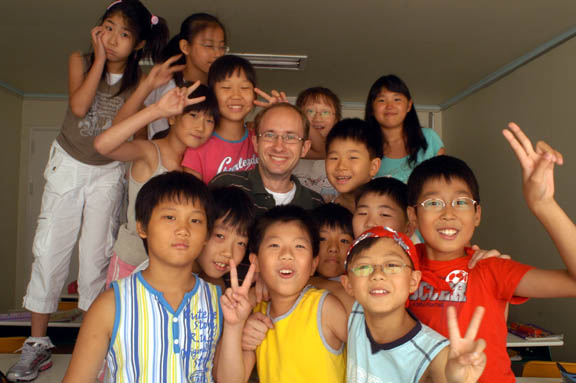


This is Advanced One, my most troubled advanced class. This class wasn't composed entirely of students who had properly earned an 'advanced' ranking. There were a few dopes and goofballs, but it was these jokers who made this class so much fun. One of them, Joon-byeong, was particularly funny. Whenever I gave out word-search puzzles, Joon-byeong ignored the English words he was supposed to find in favor of the strange, random, meaningless mix of consonants and vowels that appealed to his warped sense of humor.

"Teacher! Teacher! Look!" Joon-byeong would say and point to a haphazard combination like JZXXCER. "Jazzecksser!" Joon-byeong would yell and burst into raucous laughter.
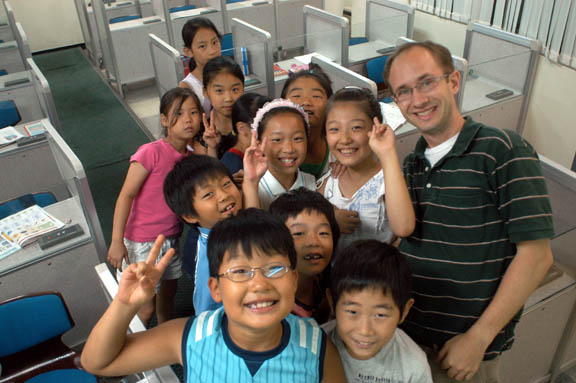


Next is 4S, a completely unremarkable class except for how hard they tried. Oftentimes at ESS, there are simply too many bright kids for the advanced class, so they less gifted ones get knocked down to the next level, "S." The "S" kids tend to be very good students, but not quite as talented in picking up languages as the advanced kids. They are really nice and fun and I only had them once a week, which bummed me out.


Another class that I struggled with early on and then grew to love was 1-2A. These incredibly young children were really bright and could be fun to teach. However, ESS Best Jr. didn't properly equip me for teaching these kids. There was neither adequate materials or enough time to really engage them, so we mostly just played games. It was babysitting. Fun babysitting, though. This was the best photo I could manage out of this bunch.
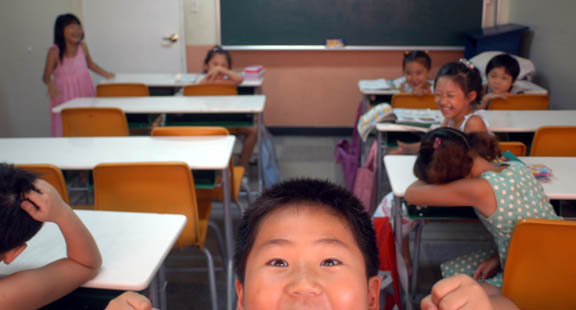


Nothing in my life has reminded me of how much I've lost by growing up quite like the children. They reminded me, and then they gave it all back to me over the course of twelve months. Although I've grown up a lot in the last year, I've also been put back in touch with my inner child. They say as you grow older, you grow harder. Maybe so. But I would say I am a harder man with a softer heart.

A lot of the kids wrote me letters. Their English is splotchy, but their words are sincere and beautiful to me. Here are a few of their letters to me, verbatim.

Mr. Jones

Hello! I’m Mi-gun. First, I’m very sad because you will leave ESS. But I’ll not cry because you will go to your country to achieve your dream. You are my best foreigner teacher. When I didn’t have pride of English, you helped me very kindly. So it is very helpful to me. I like your smile and your cool character. We had practiced the play, we went to Summer Camp, those were very good times! I will never forget you. You love taking pictures, don’t you? So you will be the best photographer. I’m sure about that. Don’t forget us! Thank you very much!! I was really happy with you. Be happy.

To Mr. Jones you likes Korea and taking photos.

Sincerely, Mi-gun.

* * *

To: Mr. John

How goes it, Mr. John? I’m your a pupil, Ji-won. Thank you for the tip. Thanks. I’m sad, because you are go to the America. But I’m never cry. Um, that explains why your English is good. I envy you. I wish I could speak English like you. AH! And you miss me. You can always get me on the phone. We all miss you. Please come and see us sometime. Could I see you again? Goodbye my teacher, Mr. Jones.

--A wise saying--

Little deeds of kindness, little words of love help to make earth happy like the heaven above.

Ji-won.


* * *

To Mr. Jones!

Hi Mr. Jones. I’m Da-mi. I write a first letter to you, because you will go your hometown. I met you on September first in 2005. Do you remember? I remember then. But you’ll go your hometown, by the way I’m very sad. I think you are the best teacher. We had great times. I miss you so much. Maybe you will a great teacher in USA. I believe you. I wish go Havard University School. Then I will meet you. I remember first and last Summer camp with you. In the future we will meet in Havard. Maybe you are a teacher and I’m a student. I wish...Idon’t know much English, but in the future I give you a perfect letter to you. Bye Mr. Jones. You must not forget me.

From Da-mi

* * *

Hello Mr. Jones. I’m the cute girl, SHin-eun!!!
Teacher. You’ve going back home, so I’m very sad!! And thank you for teaching me!!! Teacher! Teacher! This box is for you, and I made it. I’ll give you photo. Mr. Jones. Your class is fun!! And thank you for the bag. Ohhhhh! This is my address. I will send you a letter and please write back. Teacher. Always stay healthy and don’t forget me!!! Good bye teacher.

I’m Eagle. I love you. Teacher. Shin-eun.

* * *

I love you too. All of my students. I love you, too.

It’s funny. Only a few boys wrote letters to me. One of them, a third-year middle school student abstained from writing me letters. Instead, he began sending me bizarre, schizoid email messages I took to be friendly. He was always a really quiet boy who suddenly came to life in the final weeks of my stay. His English is horrible, but I know he means well. Here is one of those funny messages I received after I left.

OH - I'm sorry ...   My answer the letter is late .   I'm !  I'm ! see my picture in your homepage ~.      Um ....     When hiking in the mountain  , I'm help Ha Jeon Young teacher !  I'm  proud of myself ~   and thank you ..  You're very very take a picture ?  well!!
However ~ I love you   hahahahahahahaha - Young-jun.

* * *

Following my last day with ESS Best Jr., I went to Jejudo with my girlfriend, Hyun-jeong. We had been planning the trip for a few weeks, as it had been our dream to get out of Busan and be a real couple, even if for only a few days. Up until this point, I had been a secret Hyun-jeong kept from her mother, who like some Koreans, probably would not have sanctioned our relationship.

As the airplane approached the runway over Jeju, I felt like I was descending into a central American banana republic like El Salvador or Nicaragua. Lush green farms covered the island, broken only by the occasional road or village. Mountains rose in the distance, shrouded in clouds. I could see the ocean through the window on the other side of the aircraft. The glass oval filled and emptied with blue while my window filled and emptied with green as the plane tilted from side to side on its final decent.

Rental cars were cheap, in the neighborhood of $30 a day. However, the woman behind the counter informed me that I would need an international drivers license in order to rent the vehicle. This was disappointing. I tried to make due with my Mississippi license, which I insisted was internationally certified (despite any markings to that effect), but the woman stood her ground and flat out denied me my God-given American RIGHT to drive a car!

So we took a bus.

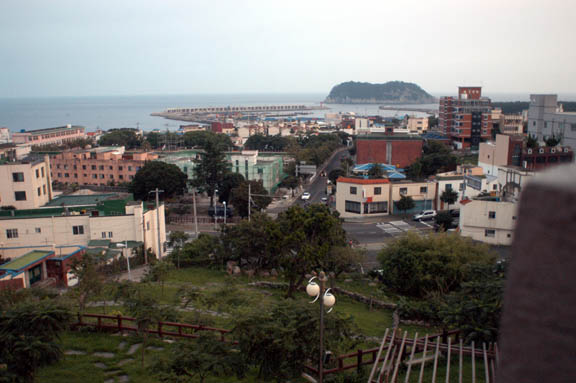
The bus took us to the other side of the island, to a town called Seogwipo, where there had been an Ironman triathlon the day before. Here is a shot of Seogwipo.


And here is a shot of a man with a bicycle, presumably to highlight the previously aforementioned information concerning a triathlon that had previously occurred on the date prior to our imminent arrival in the glorious Korean city of Seogwipo. Right.


Our hotel room was, well, not what I had paid for. Actually, it was very far from what I had paid for. My sixty dollars a night had bought us what looked like a set from a porno filmed in the 1970s. Earthy browns, oranges and yellows were the colors of choice, though the walls were white. Our bathtub was an olive green set on an orange-tile floor. The air conditioner wasn't on, so the room was an oven. A pitiful electric fan standing by the TV was our only respite until 5PM, when the air conditioner was slated to come on-line. None of this mattered to either of us. We were free! This was our own little slice of heaven, a veritable Eden compared to the awful, stifling purgatory of Busan.

That afternoon we decided to go to the east end of the island and see the famous sub-island of Ewdo. We spent a couple of hours looking for the ferry in Seogwipo before giving up and hailing a cab to take us to the bus terminal. Upon entering the cab, the driver informed us that there was no bus to Ewdo now, that we had missed it. He kindly offered to take us there for $30. OK, I said, willing to see some of the island at almost any price. I had lost my mind.

The trip to Ewdo was long, and once we got there, the woman at the ferry terminal told us that the last ferry had already left and we were too late. We walked out of the terminal under cloudy skies, the afternoon slight quickly slipping away. There was no bus terminal in sight, just a huge parking lot and a long, bleak gray breakwater twenty feet tall stretching into the ocean. A group of taxis was gathered in one corner of the parking lot, and they grinned at us as we walked by.

One of the taxi drivers ran up to us. He had a cocky grin on his face that instantly told me that Hyun-jeong and I were being milked for cash. He almost jokingly offered to take us back to Seogwipo. Sensing a scam, I protested, but he put his arm around me and did his best to convince me that there was no bus back to Seogwipo and his cab was the only method of transportation back to our hotel, thirty miles distant. I was enraged, but I had no choice. Hyun-jeong agreed with him, and so I had no recourse but to pay the man $28 (he gave us a discount) to take us back to our hotel.

The cabs had managed to talk me out of sixty dollars. I would learn later on that such charlatan behavior is common among Jejudo Taxi drivers. On the bright side, we got to see a lot of the Jeju countryside from the window of the cabs.

To make up for our blunder, we decided to stick close to home for dinner. We walked down to where the river met the ocean and followed it down a beautiful winding stone path to a waterfall lit RockCity-style by sodium-vapor lights. The air was cool and the path was sheltered by trees and bordered by the river on one side and the cliff wall on the other. We took pictures.


For dinner we ate the famous Jejudo Black Pork Samgyupsal, so named for the famous black pigs raised on human feces.

Raised on human feces!?! What!?! Wait a minute...

Gavin had heard a rumor that the pigs were fed human excrement because it made their flesh taste better. This, I presume, had been fed to Gavin via Dave, who had got it from one of his adult students back when he was working for ESS Adult. Dave and his wife spun many tales such as these, all culled from their students. I never told Dave or Susanna this, but I think now it was all alot of Korean urban legends, or so I hoped as I wolfed down black pork samgyupsal in that restaurant on Jejudo.

Hyun-jeong didn't seem bothered by the rumors of the black pigs' disgusting diet, and told me such rumors were just that - rumors. Rumor or no, the samgyupsal was the best I had ever eaten in Korea. (For those of you who don't know, samgyupsal is basically half-inch thick, unseasoned bacon that you grill on your table, cut into pieces and wrap in leaves with kimchi, vegetables and soybean sauce. Very, very delicious)

The next day we decided to hike Jejudo's signature mountain: Hallasan. Jejudo is basically the remains of an ancient volcano, and Hallsan is the cone. It rises over 2000 feet into the sky and sports a small crater lake at the top.

Hyun-jeong and I jumped into a cab that morning and directed him to the bus terminal.

"Oh?" He asked. "Where are you going?" Hyun-jeong told him and he shook his head. "Hallasan? You can't go there, it's too late to catch a bus. There is no bus there now." I looked at my watch. It was 10 o clock in the morning. The cabbie continued. "I'll take you there now for 20,000 won, if you'd like." Hyun-jeong began to nod in approval, but I detected the hint of the same scam the cabbies pulled on us the day before on our cursed journey to Ewdo. I cursed under my breath.

"Pull over, let us out." I said and paid the cabbie his two dollars. The driver protested, but I insisted and we left his car. Hyun-jeong was confused, but I said we should at least check the bus terminal before we took a taxi. Hyun-jeong called the bus terminal while I scored some egg sandwiches for breakfast. Hyun-jeong was just hanging the phone up as I walked up to her with the steaming egg sandwich. She looked upset.

"The cab driver lied!" She said. "There is a bus to Hallasan, and it's only two thousand won!" What was more, the bus runs all day long. I felt vindicated. Later on, Hyun-jeong's friend Yoo-jin would confirm my suspicions that the Jeju taxi drivers were notorious for ripping tourists off. We were lucky to have only been 'taken for a ride' just once.

HJ and I rode the bus up to the trailhead for Hallasan. The rest area was shrouded in fog as we bought kimbop, candy bars, water and rain ponchos for the eight-kilometer trek to the top of the mountain. The lady behind the counter said that the park rangers were turning hikers away before they got to the top due to inclement weather, but that didn't stop us. After a brief stop to look at a Hallasan photo gallery, we were on our way up the well-graded trail to the summit.

The hike was really pleasant. A cloud clung to the mountain, lending the forest an uncanny silence. The air was cool, damp and still and the leaves on the trees and bushes glistened with moisture. I felt like Sam and Frodo from The Lord of The Rings trekking through the forests of Galadriel. We talked and laughed and had a good time as we slowly ascended higher into the clouds.

After six kilometers, we stopped for lunch at a camp site consisting of two tent platforms by a wooden staircase. Kimbop and Snickers bars were on the menu. I took a nap while Hyun-jeong snapped photos.


It was getting late, so afterwards we walked back down the mountain and caught another bus back to Seogwipo.

The next day we went to see an art gallery exhibiting the works of one of Hyun-jeong's favorite Korean artists, Lee Joong-seop. Joong-seop was one of Korea's greatest artists rising out of World War Two, with a style obviously influenced by the likes of Picasso.
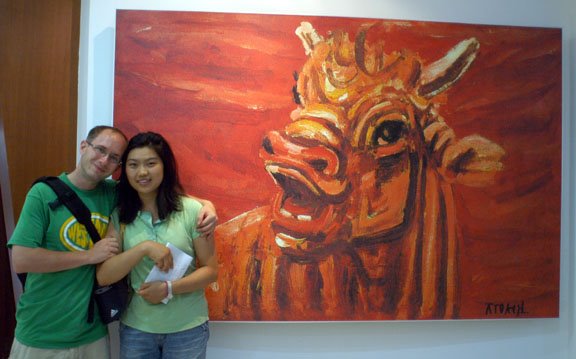


Though trained in Japan and married to a Japanese woman, Joong-seop took his art in a wholly Korean direction. He lived and painted in Seogwipo for a portion of his life, and a landscape he painted could be clearly viewed out the window of the museum, looking South.

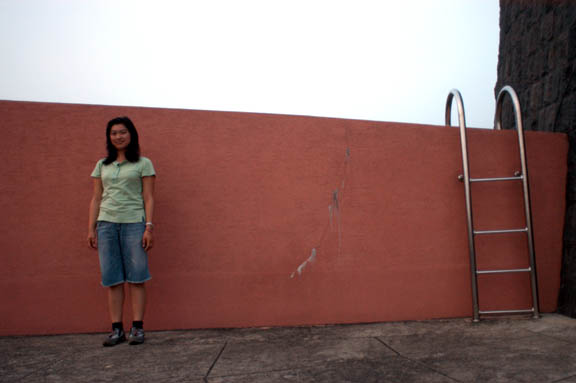
Hyun-jeong and I snuck onto the roof of the building and took photos. I felt like a teenager again, my dad's camera in my hands, getting into mischief with my friends. I tried climbing a wall.


Here is HJ. Isn't she cute?


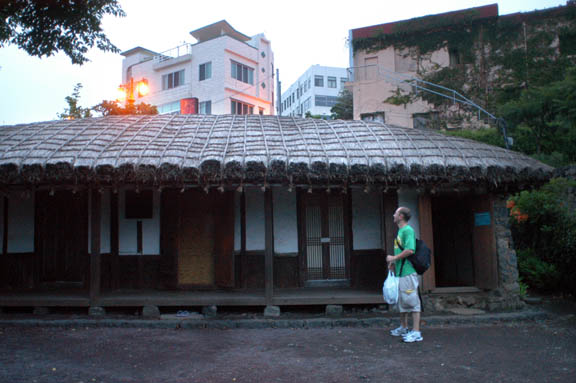
Here I am checking out the authentic replica of Lee Joong-seop's house. Hyun-jeong pointed out the stark difference between the age-old Korean design and the high-rise condo towering above it in the background. She has such a good eye.


After we flew home to Busan, I spent the remainder of my time saying good-bye to all of the people who helped me live and work in Busan. Here is Soo-ho, my banker. Soo-ho's only request was for white, American t-shirts, which he claims are higher quality than the Korean version one can buy in Nampo-dong.


This is a photo of the crew working at Kimbop Chunguk (Kimbop Paradise), a Korean franchise restaurant my coworkers considered junkfood. For the first three months of my stay in Korea, I ate nearly every meal at Kimbop Chunguk. They had everything: Jiggaes, baekbans, dabops, dankas, noodles, rice, mandu, and of course, Kimbop of all kinds. The ladies who worked there were kind to Gavin and I. They taught me a lot of my Korean food vocabulary, and were very patient as I practiced new Korean words and phrases on them. Lovely women. I wish them only the best.


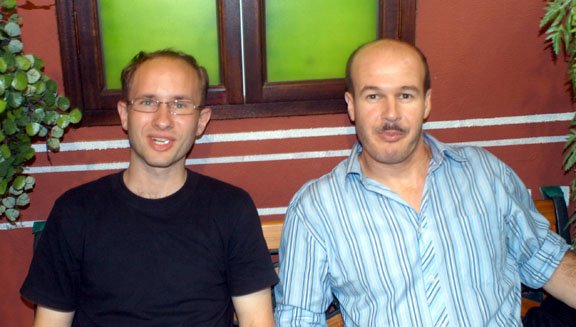
Naturally, some of the best friends I made were friends with Hyun-jeong first. Here is a pic of her Algerian friend Allal and I at an upscale Indian restaurant in Haeundae. Muslims are rare in Korea, and so it was really interesting and sometimes hilarious hanging out with Allal, who politely enjoyed standing out in the crowd, so to speak. He had a great sense of humor and a positive outlook on Korea, which is rare among foreigners here.


This next picture is of me and Yoo-jin, another of Hyun-jeong's friends. Yoo-jin and Hyun-jeong met while they traveled to the United States together in 2003. When they returned to Korea, they met every week to practice speaking English with one another, a sort of two-woman conversational English club. This is part of the reason Hyun-jeong speaks English as well as she does, and Yoo-jin was no different. Here we are at Haagen-daz together.
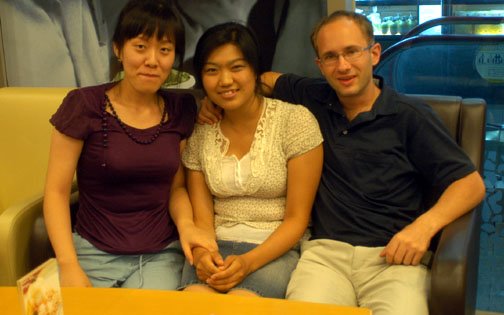


Yoo-jin has impeccable taste in food, and whenever we needed a restaurant recommendation, Hyun-jeong called Yoo-jin on her cellphone. It became sort of an inside joke with us, actually. I really liked how forward-thinking and positive a person Yoo-jin was. She also had a good sense of humor and honored me by exclusively speaking English whenever I was around, even to Hyun-jeong. An amazing person.

Here is another photo I took that night of my beautiful Hyun-jeong. Though the light is bad, her expression is priceless.
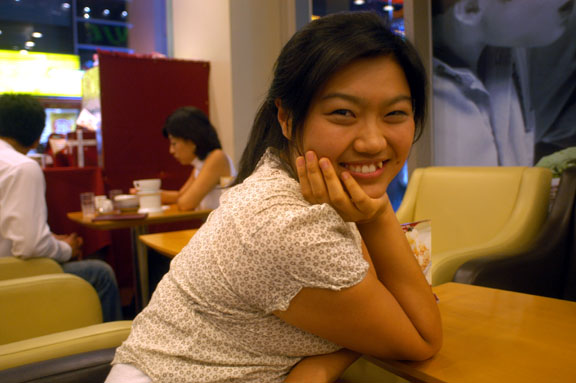


Of all the people I met in Korea, she is the one I will miss the most. Over the course of our three months together, I fell deeply in love with her. Our separation at the airport was possibly the most painful moment of the last four years. Will I ever see her again? I know so, but not the exact date. The current US-Korea visa requirements present a massive, unwarranted obstacle to our relationship being anything more than friendly. Hyun-jeong needs to jump through numerous hoops, some of them financial, in order to get even a tourist visa to the US.

The sick thing is how easy it is for me to get to Korea. All I have to do is step on an airplane pointed towards Seoul with my passport in hand. POC - Piece of Cake. So I'll probably visit her when the time and money become available.

The other person I left behind is Gavin, whom I invited to Korea back in November of 2005. Gavin turned out to be a brilliant teacher, and we had a lot of fun together over the ensuing months. He took me to dinner at the Lotte buffet a few weeks ago, where we crammed all the steak, lamb and sushi we could into our mouths for forty smackers a piece. Here is a picture I took of him at a samgyupsal place in Haeundae. Check out the restaurant's emblem.
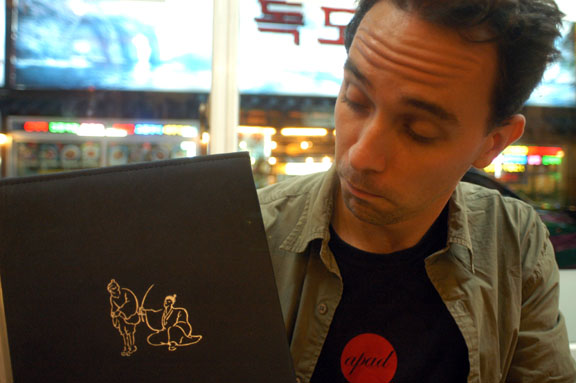


I will see Gavin again in January of 2007 when he returns to Atlanta to take a break.

I gained a little weight over the last few weeks as people bought me dinner, drinks and gave me candies and chocolates for parting gifts. I’m sad to say the ten pounds I lost by eating the Korean diet has been cut in half. I guess it’s fitting that I should put on a little weight before going to America, you know, to fit in.

When I stepped off of the plane in Detroit, a giant LCD screen showed George Bush addressing the nation, his voice booming through the airport. Westerners were everywhere. I felt small, alone and behind the times as I boarded the plane for Atlanta. When I got off the plane, my parents greeted me with cheers and open arms. It felt like a movie. My father and mother held me tightly, repeatedly telling me how good it was that I was home. I hugged them right back, glad to be home.

Atlanta is much like I left it, though now it sports the largest aquarium on the face of the planet Earth and the Braves are a lame, losing team for the first time since I was 12 years old. I only have a week to go before I step on another airplane and visit my friends Faith and Bernardo in Buenos Aires, Argentina for a couple of weeks. So stay tuned, I have more insights into the joys of international travel coming up in the next episode of SoKoNotes.

What? You thought the adventure was over with Korea? Good heavens, no!

In many ways, my life is just beginning. I have a photography business to build and get off the ground. I have to find a way to get Hyun-jeong into my country. I am not finished traveling. If anyone is interested, I can continue this blog for a long time to come.

Well, I've written enough. I'm tired. I'll write again in October when I get back from Argentina. Or I'll write from Argentina itself. Depends. Stay tuned! SoKoNotes will be right back!

Peace.

-Notes

Saturday, August 19, 2006

Hey, you! Stop talking! Get in line! It's the ESS Jr. Summer Camp edition of Sokonotes!


When I first arrived in Busan, Mike, Julie and Dennis picked me up at Busan Station. It was a very kind gesture, and as Dave, Gavin and I currently prepare for a new teacher to arrive at the end of August, I think about that first night in Korea and the three foreigners who took me in and showed me the ropes.

Mike helped put my suitcase and backpack in the trunk of a taxi and left me in the capable hands of Julie and Dennis, who whisked me off to the Hamjigreen apartment where I was to live for the next two months. I'd been traveling nearly sixteen hours. My eyes were heavy with exhaustion and my mind was stunned by culture shock. I remember the cab ride as one long neon blur amid a flurry of advice flying from the lips of my new co-workers.

Most of what Julie and Dennis were telling me was delivered almost like one long inside joke between the Louisiana native and the tall Canadian woman. They would say something about Busan or Korea or ESS Jr. and then give each other a knowing look or a smirk and then follow with a series of assurances not to worry, that I would figure things out. Well, I did. They were right. There is a lot about Korea that you can't describe to a stranger, things that must be experienced.

Over the next few weeks, I was let in on many of the inside jokes, and introduced to others that I would not come to understand until much, much later. One of those jokes centered around ESS Jr.'s annual summer camp. Mike and Dennis discussed the camp one night over whisky and beer at their apartment.

Mike brought out a clear glass jar containing a wicked-looking two-inch long praying mantis the color of new grass. "Little Homey," as Mike lovingly called the tiny predator, was taken hostage during the three-day camp three weeks prior to my arrival. Mike and Dennis got a macabre sort of pleasure from watching Little Homey kill and messily devour cockroaches proffered from the disgusting floors of their unkempt apartment.

As we sat around the table drinking whisky and watching the foodchain in action, Mike and Dennis talked a little about the camp. Horrible, they said. Boring as hell, they said. Nothing to do but sit around, they said and gave each other those same knowing looks. "This is the only good thing about it," one of them said and indicated the mantis, who was furiously shoving a cockroach leg into its mandibles.

I don't know what happened to Little Homey after Mike and Dennis left in October. He probably found a nice home in the bushes by Dongsamjugong, a long way from his birthplace in Surak, three hours north of Busan. Last week I visited that sleepy, four-building farming community with Dave, Gavin, nearly the entire Korean staff and eighty of the middle school students. Mike and Dennis weren't joking: The ESS Best Jr. Summer Camp was one of strangest experiences I have ever had, here or anywhere, at any time in my life. It took three days of my life.

Everyone met at the Catholic church at the end of Gwangbokdong road and loaded our stuff into three long orange tour buses. I made sure not to drink too much fluids, as like most tour buses in Korea, these were missing their "heads" and I didn't want a repeat of the Gyeong-ju disaster (SoKoNotes 09/18/05). The kids piled into the buses with us, adorned in shorts, t-shirts, and stylish mp3 players hanging around their necks. The drivers put the rumbling engines into gear and we were off to Surak.

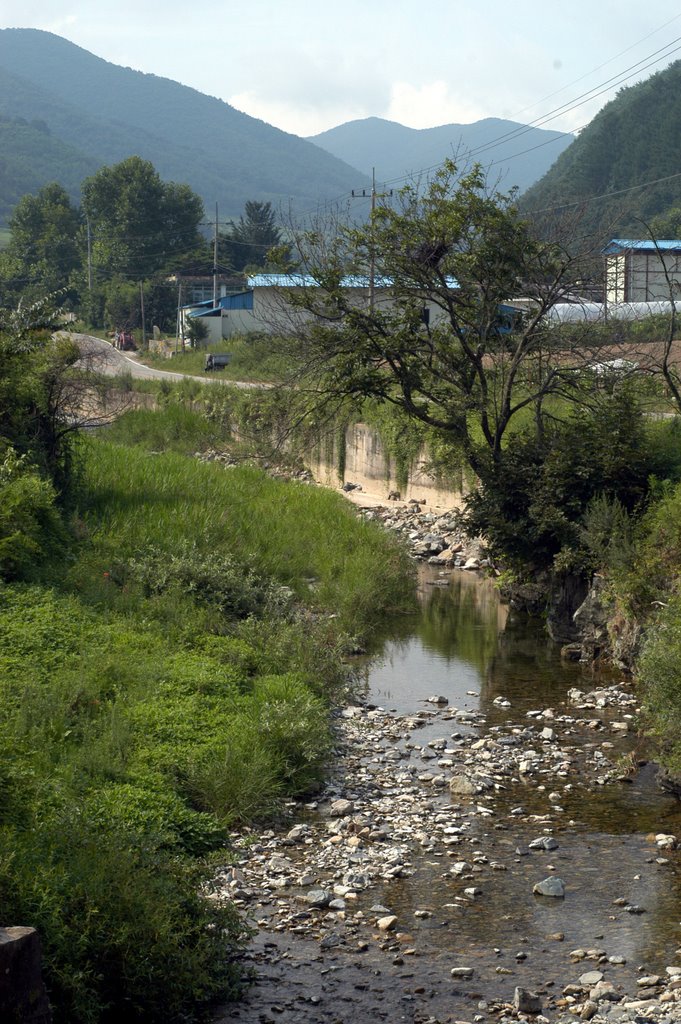
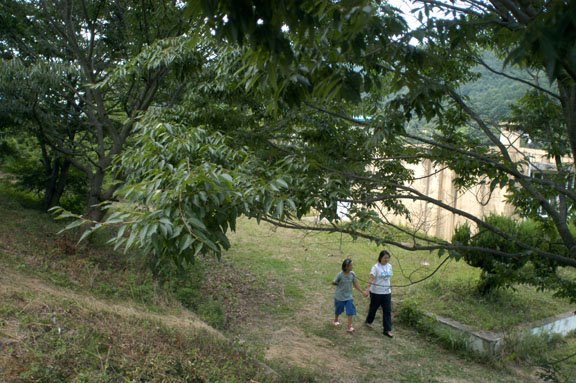
For the last eleven years, ESS Jr. has held its annual camp on a lot owned by Mr. Kim's father-in-law. The lot is surrounded by smalltime cucumber and gochu farms (gochus are a lot like jalapeno peppers) that line the narrow valley floor between two long mountain chains running North to South as far as the eye can see. Over dinner one night at camp, Mr. Kim told us his father-in-law picked the spot because it so closely resembled his former home in North Korea. Here's a quick landscape photo I took during a brief walk down the lone road snaking through the valley.


A restaurant and corner store were the only buildings found in a small village a few hundred meters up the road. Dave and I visited to the store twice, and I chatted up the "nongbu," or farmers, while Dave bought soda and snacks. They were kind, obviously good-natured people, and they all but begged to have their picture made. It was an honor.


The property itself was home to more than just Mr. Kim's father-in-law. As the bus turned and entered the gate, I saw a long, squat building that was once a school. It was badly run-down and old. Cracks and rusty pipes ran up its weathered, graying walls and the paint on the windows was filthy. Vines and bushes covered a molding marble statue of two children reading from a book.

According to my sources, Mr. Kim's father, who started ESS Best Jr., had plans of building an English boarding school in Surak where students could study all subjects - in English - all year long. Something went wrong, I don't know what, but all that remains of that dream is this decrepit building on this decrepit lot in a beautiful valley north of Busan.


An ESS Jr. banner, a microphone and some portable speakers were set up on the school's front steps. A long yellow and white banner set up at the opposite end of the field in front of the school welcomed students to the camp as they disembarked the buses. No sooner had they exited the bus than Mr. Kim made them form ranks behind their group flags and salute him as he took to the makeshift stage, switched on the microphone and welcomed them.

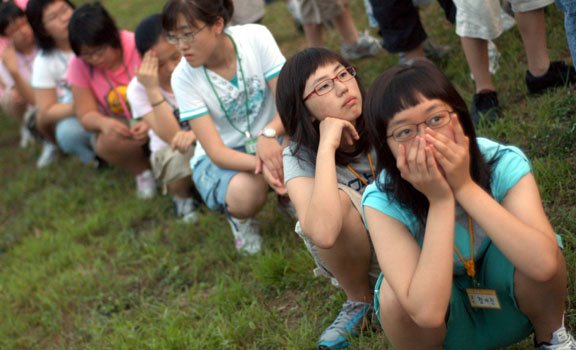
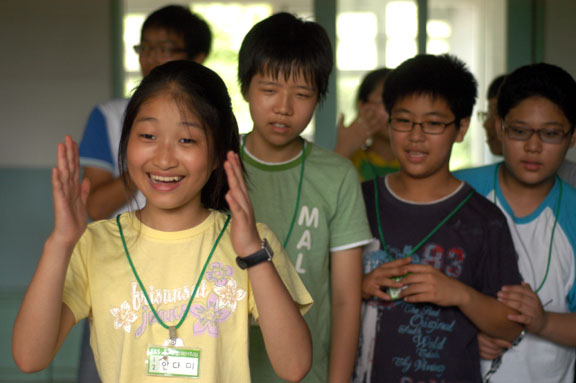
Over the course of the next three days, the students spent a lot of time making lines for Mr. Kim. It seemed like they couldn't do any activity before first lining up on the parade ground and listening to Mr. Kim talk about it first. Sometimes he made the children exercise, and sometimes they meditated. Sometimes Mr. Kim berated the students for something or the other and punished them. Here is Eun-bong, my most well-behaved third-year student, solumly going through the motions.


There was a lot of yelling and disciplining students who didn't line up properly. Sometimes it felt to me like 'making lines' was the focus of the camp, so often did the children form up.

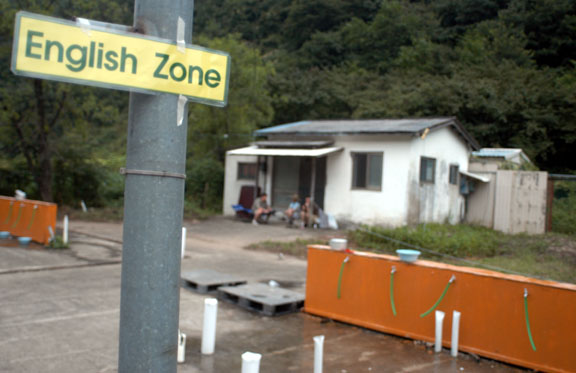
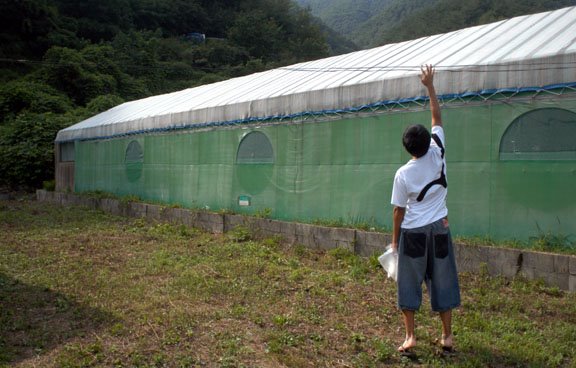
The camp was divided up into roughly three areas: The parade ground and old school building, the children's sleeping quarters and the 'English Zone.' The children slept in four long barracks-style concrete buildings covered with thick green tarps. During the day, they were little more than greenhouses, and to step inside one was to enter a sauna. During the night, they were drafty and cold. The children slept in sleeping bags on mats laid out on the concrete floors of these buildings.

Here is a picture of a student from my 1S class, Jae-hyeon, getting some relief from the heat by standing in the doorway to his barracks.


Dave, Gavin, Mr. Yi, Byeong-soo, the photographer, Tae-hoon and I all slept in a spartan cottage sitting on the corner of the property. It had a small kitchen, two bedrooms and a bathroom. Silver dollar-sized wolf spiders hunted moths and cockroaches along the walls and there was no air-conditioning. Gavin, bless him, had the foresight to buy a bug net big enough to fit around a king-sized bed. Dave, Gavin and I slept in relative safety while our Korean roomies entrusted the blood in their veins to the buzzing purple bug-zapper screwed to the living room wall.

The men's living quarters was adjacent to the English Zone: Basically a large concrete slab covered by a wrist-thick metal skeleton where once Mr. Kim's father dreamed of building a mess hall to feed all the students in his doomed boarding school. White PCB pipes for sewage and water jutted out of the slab, awaiting sinks and faucets that would never materialize.


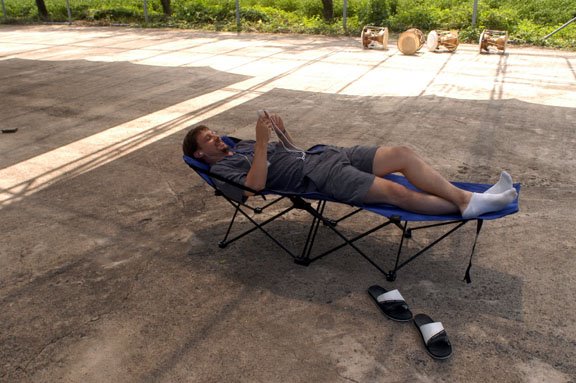
The high school students strung up a huge black net from the metal frame over the English Zone to provide shade for the students, who would spend a great deal of time there over the next three days. The shade provided a good place to kill time while we waited for the students to break ranks and engage in the various activities Mr. Kim planned for them. Here's Dave practicing for his upcoming vacation in Thailand.


There was a lot of time to kill, what with the kids always forming up and meditating all the time. Even when they weren't meditating or listening to Mr. Kim, there was still lots of time to kill as the Korean staff prepared the next activity. There were a lot of breaks, and you know what they say about idle hands. The boys quickly discovered how to pluck gigantic neon dragonflies off of low branches and telephone wires by their wings. They would then chase the girls around camp, the struggling insects held out in front of them.


We were all assigned to four groups. Mrs. Ha and I lead group one. One of the first activities of the day involved preparing our group for the debate happening the next day. The topic: Is the Internet a good thing? Our team was assigned to argue that the internet was not good, but a bad thing. Each child was required to add a unique point, in English, during the debate. Twenty children. Twenty reasons the internet is a bad thing.

Group one met in the sweltering barracks to discuss the topic. The students furiously fanned themselves against the heat as the seniors stood up and took charge. By 'took charge' I mean they stood there and waited patiently for someone to speak. The students were required to debate in English, but no one could speak English well enough to make the complex arguments needed to discuss an already difficult topic. An uncomfortable silence hung like the heat in the number one barracks as the students tried to form sentences in their heads.

Finally, Ms. Ha took charge and let the students make their arguments in Hangulmal. She dutifully wrote them down and then she and I carefully translated each argument into English while the children worked on another assignment. The students only gave us ten good sentences. We had to think of ten more on our own. After writing them all down, we handed them out and the students began memorizing them like lines from a script. Gavin, Dave and I helped them.

After the debate prep, the students met under the black tarp to cook Curry Rice for dinner. Dave was handed the recipe and told to read it step-by-step for the students. I was to be the official taster and Gavin was to help the students cook. They did this two times, once Thursday and once Friday. Usually one to four students took charge while the rest of the group hung back, spoons in hand, waiting to eat.

In group three, one girl, Ji-na, was the sole cook, and the workload was too much for her. Her curry was burning. The other students, who didn't care much for Ji-na because she was pudgy, confidant and self-reliant, stood around and insulted her, spoons in their hands.

"Burning, teacher. Smell!" They told me as I approached. This disgusted me and I shot back, "Oh, yeah? Have you done anything to help her?" I don't think they understand what I said, but they understood my tone and the direction my accusatory finger was pointing: Towards the ground where Ji-na was working furiously to keep the burning curry under control. Two or three put down their forks and tried to help Ji-na, who was obviously and audibly frustrated with them and shooed them off.

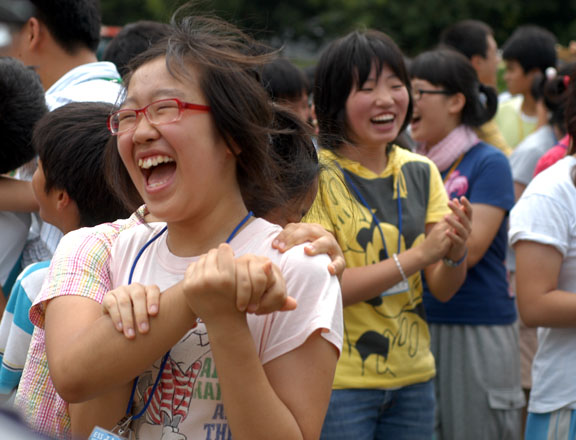
After dinner we all met at the parade ground to learn a 'folk dance' set to the Beach Boys' "Surfin' USA." I guess the Beach Boys is what passes for traditional American music, and of course, the dancing was little more than country-style line dancing with twirls, sidesteps and fingers pointing, disco-style, into the air. More lines, I thought, this time dancing. Dancing lines of children.

After dinner, we reconverted on the parade ground to gaze at the stars. The children brought their sleeping mats, laid them out on the grass, and looked up at the stars as I read from a prepared script on constellations. I read with a deep, serious voice like I was Leonard Nimoy and this was NOVA. The script itself was absurd, totally asinine. Gavin and Dave played mysterious tracks from their iPods while I read, and I thought I could hear them snickering from behind me. It was all I could do to keep a strait face.

Here is an excerpt from the script:

"The regions around the celestial south pole got some of their names when the astronomer Johan Bayer made his notes about the south regions of the sky. He followed the tradition of the names of the ancient, mainly connected to the sea and its creatures. Later on the French astronomer La Caille added the last 13 to fill the star-poor regions between the existing groups. He finally broke with the traditional name giving and used scientific equipment or instruments (there is only one exception, which is Mensa, the Table Mountain)"

My God, I thought as I read. Nobody was going to understand this garbage. These kids could barely name their favorite foods in English, and here I am reading about La Caille and Mensa, "The Table Mountain." Someone had spent all of ten minutes cutting and pasting random passages from the internet to make this script.

Clouds began to drift in as I started the second reading of the bogus constellations lesson. They reflected the light from a city on the other side of the eastern mountain and obscured the night sky. No stars could be seen, and still I read on. Once I finished, it was meditation time, so Gavin, Dave and I walked back to the cottage and had a good laugh.

The next day we held a mini-olympics, part of which involved a jump rope.


The four groups also took part in a scavenger hunt arranged by Gavin and I. It was fun making the clues into simple plays on English words, and even more fun watching the kids figure them out and race around the lot searching for the treasure: Plastic dollar bills to be redeemed for pencils and notebooks on Saturday. Gavin then read the questions for a massive four-group true-or-false quiz, which the students thoroughly enjoyed.


After the quiz, The Native teachers played a game with the kids in which the kids had to describe things to us in English and we had to guess what it was. The high school girls held the cards with the words written on them for the kids to describe. The kids really enjoyed the game, and some really impressed me, such as Da-mi, trying to describe something to Dave.


Later on, we held the debate on whether or not the internet was a good thing. All four groups converged on the English Zone and sat down. Two third-year students, Han-eol and Ah-jin, turned on their mics, introduced the topic like nobody had heard it before and waited for a lively debate to ensue. Silence. Nervous, awful silence. Mrs. Nam went from group to group, trying to encourage the students to speak.

A few students stood and read their lines from the tiny scraps of paper on which they were written, but it was obviously not sufficient for Mr. Kim, who stormed off. Later, the students formed ranks on the parade ground and received a lecture for the snafu that wasn't their fault at all.

It wasn't their fault because that wasn't the format Mrs. Nam, Dave and I originally discussed a month earlier while planning the debate. In the beginning of July we mapped out a classic two-on-two debate style and four topics for discussion. Only the oldest children would participate, and they would get to argue the topic and position of their choice so as to optimize their ability and be well-prepared for the debate. For the entire month of July, Dave and I worked with our third-year students on their various topics, creating arguments, teaching debating phrases and even staging a practice debate.

Two weeks before the camp, Mrs. Nam radically changed the format. The topic and debaters were going to be randomly chosen by Mr. Kim, she said, and the first and second-year students were going to take part, too. Dave and I were to start teaching the children "how to debate" immediately. Dave and I exchanged confused, stunned looks. Had we been living in reality this past month? What about the original plan, the one she herself had helped make?

We put these questions and others to Mrs. Nam. Dave even handed her the worksheet we all had drawn up, but she ignored everything and simply repeated the edict all over again, verbatim. Her tone was a hostile deadpan meant to cut off debate. Still, Dave pleaded with her for a rationale behind the sudden change in plans. Mrs. Nam narrowed her eyes, intentionally sighed and repeated the command a third time, this time slower, like we were morons. Dave and I shrugged. OK, whatever.

The debate was a sham, a clusterfuck. All that work went down the drain.

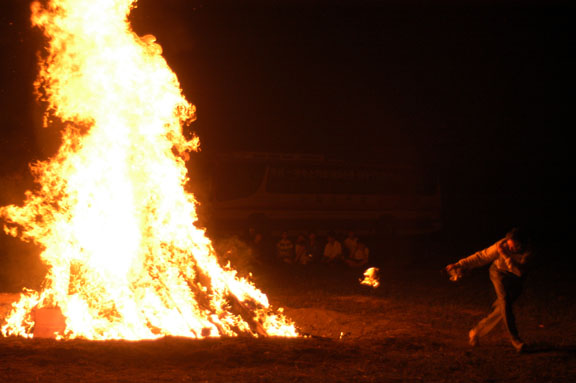
As we were 'debating,' the high school and college students who had volunteered to help out dug a fire pit in the middle of the parade ground and stacked it high with scrap wood, old clothes, cardboard boxes and other junk from around the property. They soaked the whole thing in gasoline and lighter fluid and strung a long metal wire from the base of the firepit to the roof of the school. I theorized that they were going to light the bonfire with a bottle rocket attached to the metal wire and launched from the building.

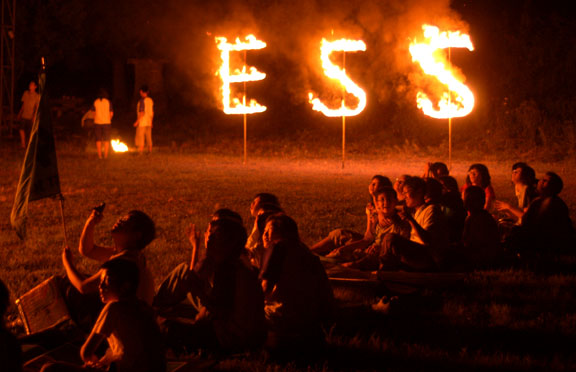
Other high school students cut rags into long strips, soaked them in gasoline, and wrapped them around three steel re-bar letters in the shape of ESS. They planted this at the edge of the field.

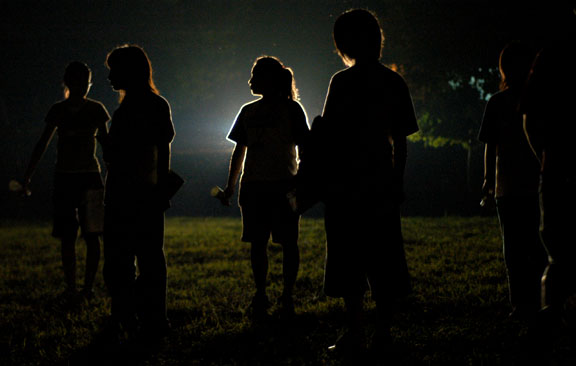
That night the students converged around the fire pit. Mr. Kim lit the field with the high beams from his Chairman sedan. The effect was eerie.


While the students set up their mats around the firepit, the high schoolers threw more gasoline on the junk collected in the fire pit. Sook-hyeon then read a speech, and it ended on a dramatic note that filled the air with anticipation as the students on the roof of the building lit a candle and sent it sliding down the wire towards the firepit. I guess they forgot about gravity though, because the can was too heavy for the wire, and it fell to the ground with an anticlimatic clunk. There was stifled laughter from somewhere in the darkness behind me and I could hear the high schoolers in front of me scrambling to find the fallen lantern and re-light it.

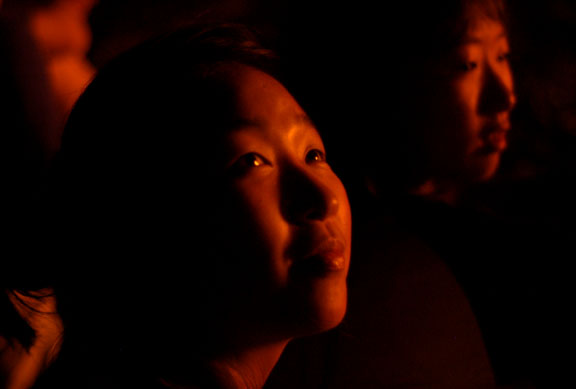
There was a long, awkward pause and then suddenly the bonfire roared to life with a fiery WHOOSH! A huge fireball climbed into the night sky and I saw the silhouettes of the high schoolers running for cover as the massive pile of gasoline-soaked junk exploded into flames. The students shrieked with fear and delight and clapped as roman candles and fireworks began to go off all around them. The orange-yellow light cast their faces in a warm glow and the air filled with the scent of burning plastic.


Mr. Kim then took a gasoline-soaked rag on a stick, lit it with the bonfire, and with the help of two students, set fire to the ESS sign.


Gavin later noted that nobody told us that there were roman candles hidden in the grass at our feet. We couldn't see well as we picked spots outside of the ring of students to stand and witness the event. If one of us or the children had been standing next to or over the fireworks, we could have been badly injured.

In fact, the entire event was marked by wild recklessness and inattention to safety. Where were the fire extinguishers? How far away was the nearest hospital? Did anyone know how a pile of gasoline-soaked wood and clothes would act once lit? What was worse, the high schoolers randomly ran up to the raging bonfire with a plastic gas can and tossed gasoline on the flames. The can was mostly empty, and probably mostly filled with fumes. The wrong spark and it could have gone off like a bomb. Another student repeatedly ran up to the fire with a pressurized aerosol can, aimed it at the base of the fire and turned it into a mini flame-thrower. Again, another stupid, potentially explosive act.

I was disgusted. This was behavior typical of the videos you see on websites like College Humor, the ones where reckless rednecks end up getting badly hurt. What was Mr. Kim thinking?

The next day went a little better. We hosted a situational English lesson in the main building. I played the part of a customs agent in LaGuardia airport, checking people's passports. I hammed it up and put on my best New York accent. I acted rude, doing my best to imitate a bored beaurocrat who cares more about his pension than the people trying to get into his country. I made sure to turn away anyone who couldn't properly pronounce the dialogue they had memorized.

"Hey buddy, you got problems, I got problems, we all got problems. Go over there and fill out form 576-B and come see me when you can speak some English...NEXT!"


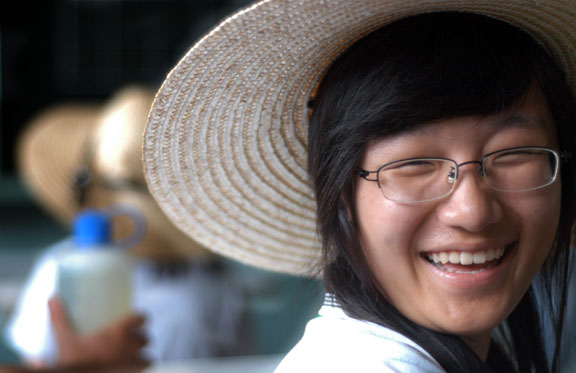
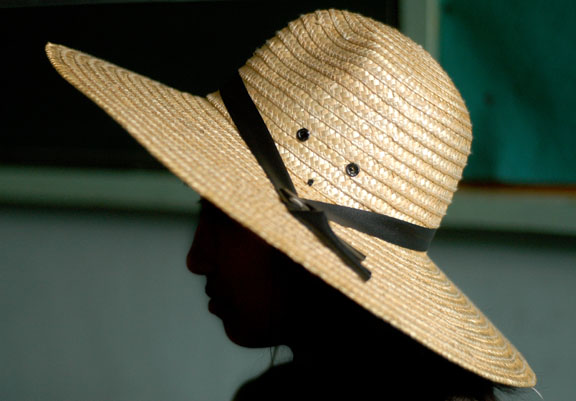
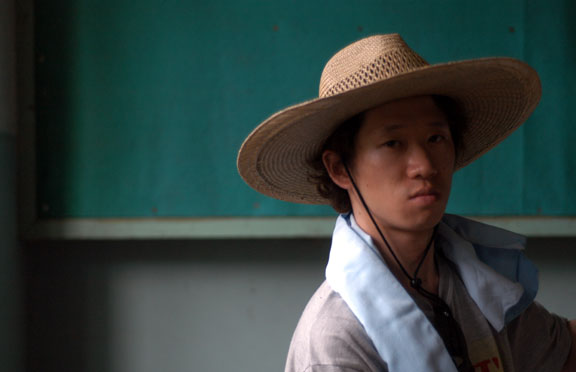
The weather was very hot. Mr. Kim would take the kids out jogging in the early morning, riding in his car ahead of the group as they pounded the pavement behind him. They would line up afterwards, soaked in sweat. The high school and college students were smart. Each wore a big-brimmed hat called a milljip moja. Here are a few examples. This first picture is of my former student, Seung-hwa.


This is Tae-hoon, the newest Korean teacher. He is the only male Korean teacher, and he struggled all weekend to balance the demands of being Korean with an obvious desire to be "one of the guys." A music composer who spent three years in New York, Tae-hoon returned to Busan to support his family.


Well, that's pretty much it. After the Situational English lesson and a departing speech from yours truly, we piled back onto the big orange buses and returned to Busan. The camp wasn't quite as bad as Mike and Dennis made it out to be, but it was certainly a far cry from the camps of my youth.

When I was a boy, camp was not about lines and discipline, it was about breaking out of the rut of daily life and having fun. When I was an adolescent, I went every summer for one week to Camp Mikel in North Georgia with my best friend Wes. We stayed for a week and did things like rock-climbing, obstacle course races, arts and crafts classes, five-ball soccer games, water fights, four-square, overnight backpacking trips, nature walks and dances. Everything was very well-planned.

One of my main problems with the ESS Jr. camp was the underutilized resources. There were soccer balls in the house and a field to play in. There were nature trails leading into the mountains. There were farms all around begging to be explored and explained to these city-dwelling children. Insects filled the air and a beautiful stream followed the country lane through the valley. They could have been learning traditional Korean crafts like pottery or sewing. They could have been learning about their heritage and history. And they could have done all of this in English.

Instead, the students were forming lines, listening to speeches, meditating and performing tasks they did every week in classrooms back in Busan. The only free time the children had besides the time spent waiting for the next activity or formation was the half-hour or so they spent splashing around in that creek. I really felt sorry for them.

However, I am alone in that regard. The children themselves never felt anything like selfpity or regret. One of the magical aspects of children is their amazing resiliency to boredom. Time and time again the children impress me with their ability to turn lemons into lemonade, to find the silver lining in every cloud, to have fun in non-fun situations. Heck, the happiest I saw them during the camp was after a meal, doing the dishes.

The kids who didn't help cook cleaned up. They gathered around the twin banks of water faucets near the men's cottage and scrubbed dishes together. All of the Korean teachers and Mr. Kim were in their rooms by that time, so it was de facto free time. The students worked together as teams to get the job done fast. Water splashed, children laughed, it was total chaos, but it was innocent and friendly and no one was going to get yelled at for it. I've never seen them so happy.

Many of the students used the three days away from home to reach out to one another and make new friends, or strengthen existing bonds. I even saw a few of the older children flirting with one another. I think they all really enjoyed the feeling of being on their own, away from their parents.

The next week I asked them what they thought of the camp, and most of them gave me a resounding thumbs-up. They had a blast. They didn't see the negative things that caught my eye. They never guessed that their lives were in danger the night of the bonfire, or that there were a million more constructive things that they could have been doing than listening to Dave drone on about cutting onions and carrots. They saw what they wanted to see, and what they saw was mostly positive. They had a good attitude. I was proud of them.

As for Gavin, Dave and I, we were bored out of our minds most of the time. There simply wasn't enough for us to do. We spent most of the time playing 20-questions and reading. We all did a fair share of just standing around, too. Luckily, the food made by Mr. Kim's wife and her friends was pretty good, and Gavin bought PB&J and trailmix for snacks. I brought the coffee pot, which made the early mornings easier to stomach. Dave brought his masterful wit, which made the whole thing a lot funnier.

I only have two and a half weeks left. One more week of teaching. I can't believe I'm at the end. Peace. --Notes

Sunday, August 06, 2006

My favorite individual at ESS Best Jr., by far, is the cleaning lady.


She is as good-natured and honest a person as I have ever met in my life. Every day she makes a point of saying 'hello' to me at the earliest opportunity, and should I neglect to take the time to return her warm greeting, should I be so self-important as to ignore her, she playfully ignores me back and feigns anger (her thick arms crossed over her barrel-chest and a scowl on her face) until I make amends. I am ashamed to admit that I don't know her name. All the teachers ever call her is 'the ajumma,' and that term fits her well.

You might translate the word 'ajumma,' as 'old woman,' but it would be a poor translation. The term 'ajumma' connotes much more respect than that. An ajumma is a woman usually over the age of forty, and it is that accumulation of years that justifies most of the high-degree of respect Koreans reserve for such women. I guess they figure if she's made it this far in this life, she's a force to be reckoned with. That certainly holds true for the tough, sweet, self-confidant woman who cleans ESS Best Jr.

The Ajumma is full of little quirks. She abhors open bathroom doors, scraps of paper left under the lecterns and empty chalk cases (she fills mine whenever I run off to get something from the office). The Ajumma enjoys pranks, teasing me and little rituals. Her favorite ritual with me takes place almost every day by the third floor receptionist desk as I count down the last five minutes till class starts. Those five minutes can be tense, and I need something to focus my mind, so I plunk a few coins in the coffee machine. I guess purchasing things comforts me.

The Ajumma hates coffee, but every day she watches intently as I put the two 100-won coins in the little red-and-white Maxwell instant drink dispenser and wait for the machine to brew me a cup of what could possibly pass for real coffee, or, well, maybe to someone who was from another planet and never drank coffee before in their entire life and was perhaps hallucinating or drunk or both. Anyway, every day I get a coffee before class, and every day The Ajumma stands nearby with her arms crossed, watching me.

I feel her eyes on me as I pull the steaming cup of un-coffee from the machine, and those eyes widen as she realizes I intend to drink the stuff:

"Coppee mashayo?" Are you going to drink that coffee? She asks.

The two f's in 'coffee' are p's because the Korean language has no character for the f-sound and replaces all f's with the hard, aspirated p-sound. Coffee is, of course, a Hangulized English word. The Ajumma sounds bewildered, or slightly concerned, as if she can't believe I'm drinking that crap yet again.

"Hmmmmm," I reply. "Coppee mashishoyo." The coffee is delicious, I lie. As I say this the ajumma grins and giggles warmly, probably because she knows I'm lying. I feel sheepish, and I immediately attempt to cover my lie and prove my resolve by earnestly offering to buy the ajumma a cup of her own coffee-flavored sugar. The giggling stops and the ajumma waves me off with a look of disgust on her face as if I just offered her a fried cockroach and batshit sandwich on rye.

"Anmashiyo," she scoffs and giggles once her back is turned to me. I smile.

Sometimes our conversation goes on from there, and I honestly believe that The Ajumma has taught me as much Korean as anyone since I arrived here eleven months ago. She and I lean on the receptionists' desk and chat as the children pass by on their way to class. The topic is almost invariably food, as that is where most of my vocabulary is focused, and I tell her how my girlfriend and I made Dwenjang jiggae the night before, or how I tried Chal guk-soo for the first time last weekend.

The children say 'hello teacher' or 'hello Jones teacher!' as they pass us by, and periodically one or two of them get in my face and assault me with 'hellos' or beg for stickers. The Ajumma notices my distress and usually scatters them with broad strokes of her hand and a few harsh admonitions delivered in a low growl or a series of sharp, staccato Korean words that I take to mean, 'get your ass to class.'

She has a soft place in her heart for the children, and dotes on them whenever they let her. However, many of the children barely notice her as she mops and scrapes the floors, walls and bathrooms in ESS Jr.

The surprising thing about the Ajumma is she isn't particularly gifted in the art of cleaning. For one thing, I've never seen her use soap or bleach of any kind on any surface in ESS Jr., and when it's my turn to mop the teachers' office, there is never any such solvents on hand. Hell, there's no hot water! As perception usually trumps reality at ESS Jr., actually cleaning the school isn't nearly as important as the perception that it is clean.

Like I said, I do the same thing in the teachers' office once a month. All the teachers have to spend one day a month cleaning the office. We draw lots and get assigned a day to complete our task. You can either vacuum or mop. I always mop because the Korean teachers loath it. Gavin finds the monthly ritual odd and Dave finds it repulsive. I agree with them both, but I still do it out of some sort of unthinking, automatic loyalty to my employer. Until I walk onto that 747 pointed at LAX, I am an employee of ESS Best Jr. Academy and I too am a slave to perception.

Of course, there is a term associated with those people or societies who are heavily focused on perception: Narcissism. I see evidence of it wherever I go in Korea. It presses in around me in the form of dozens of ads for plastic surgeons that line the walls of the subway stations. It is Ms. Ha's obsession with her makeup. It is the mirrors strategically placed beside the teacher's office and fourth floor landing and the way almost every single person who passes those mirrors can't help but check themselves out, including me. Thankfully, there isn't much to check (Yeup, still ugly!). Actually, if the issue here were just pure narcissism, it would be nothing more than endearing, but it's not.

In Korea, narcissism is coupled to an obsession with organization. How can you strive for absolute perfection if there is no standard to measure people by? No, only by holding people to arbitrary yardsticks can the urge to be perfect find an outlet. Enter the test.

A test is a miraculous tool for separating the 'haves' from the 'have nots.' ESS is obsessed with tests. Ms. Ha gives a test to my Advanced Four class every day. Oral tests, written tests, math tests, listening tests, you name it and ESS has a test for it. Korean children take a great deal of tests. In fact, sometimes I wonder what ESS is more interested in teaching: How to speak English, or how to take English tests. What I hate about tests is their arbitrary, limited scope.

A test is no more than a set of questions revealing more about the test-creators' beliefs on what constitutes intelligence than the actual intelligence of the person taking the test. Tests undermine learning by limiting what is considered important. Tests put blinders on children by hyper-focusing them. Tests undermine teachers by destabilizing students' faith in their lessons. Hey, Mr. Jones, if you really know what you're talking about, why did I fail this test?

Perhaps because the test was designed to make some people failures, I might say. Perhaps because the test and Mr. Jones measure intelligence in different ways. A test cannot tell you who you are or what you are capable of. It simply tells you that you and whoever made that test disagree on what constitutes 'knowledge.' A test shows what you don't know and probably don't care about, not what you do.

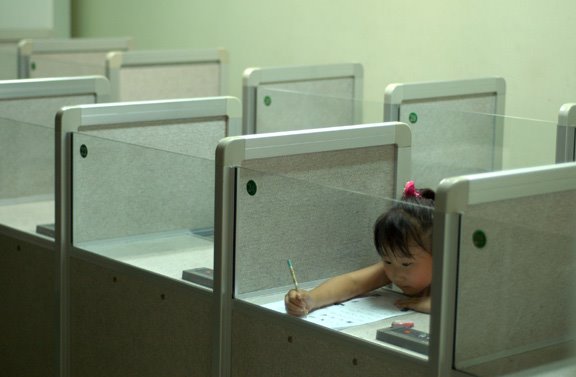
Like I said, from the time they are small children, Koreans take oodles of tests. Recently I found a prospective student taking her first test in the 'language lab' at ESS. This test would 'measure' her intelligence for placement in ESS.


I can't help but wonder what she was thinking right then.

Over the course of her life, she will take hundreds of tests, maybe thousands, culminating in the TOEIC tests that will help her land a job.

Last weekend Hyun-jeong and I made a trip out to Dongbaek island. Dongbaek is known for being the sight of the 2005 Asian Pacific Economic Conference, or APEC. Busan built a spaceship-esque building called Nurimaru to house the various heads of state (including W), and you can tour the building and see the chairs in which those heads rested their asses while discussing the fate of billions of people.

Hyun-jeong and I avoided Nurimaru and headed for a spot she found on the north side of the island by a walking path made of plastiwood snaking along the rocky coast. We walked behind a Korean family out for a late-afternoon stroll while making our way towards the spot: Two teenage daughters walking with their grandmother. The old woman wore a handmade white cotton hanbok with a simple pink and green flower pattern. She gracefully picked it up as she slowly ascended the stairs, the light cotton fabric blowing the warm breeze. Her granddaughters wore tight blue jeans studded with rhinestones and lowcut tank tops. They had stylist handbags over their shoulders and two-inch high-heels on their feet. The periodically stopped to wait for their grandmother, and stared at Hyun-jeong and I as we walked hand-in-hand past them.

After searching for a little while, we found an entrance to the beach and climbed the fence. We made our way to the waters' edge and set our things down. A group of Korean children gathered and played in the surf while Hyun-jeong and I took photos and felt the cool ocean water on our feet. The 'beach' was little more than wave-worn stones no smaller than my big toe. There was glass everywhere, but thankfully most of it had been rendered harmless by the rolling, stony surf.


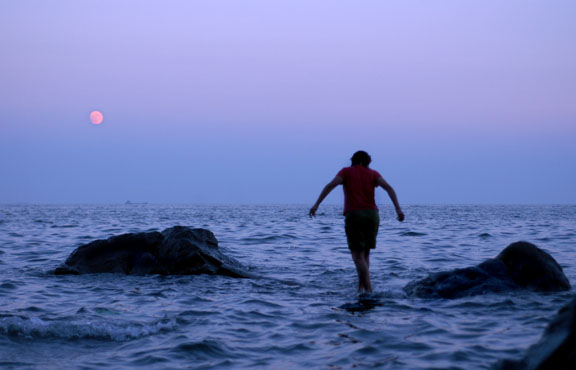
Nearby, a group of four old sisters swam in a pool under a giant boulder leaning over the ocean to our left. They laughed as I took pictures of them, the full moon behind them, rising over the sea east of Haeundae, glowing in the final rays of sunshine filtering through the early evening air.


They shared yams and cold, sweet watermelon with us. Their warm smiles and kind manner melted a great deal of the homesick negativity that had been building in me these last few weeks. Hyun-jeong and I agreed that it was a charmed evening. Our spirits were high and the sun had set as we scaled the rocky shoulder of Dongbaek and headed to Haeundae for beef soup and icecream.


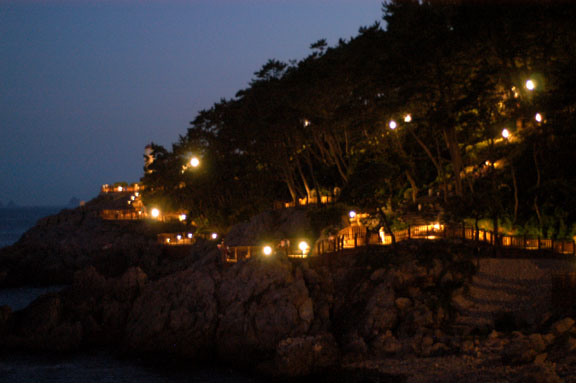
The credit for the above photo of the lights on Dongbaek goes to Hyun-jeong.

Well, here are the Korean Files for the week. I only have two.

"She is rich, and it is before" (...she becomes poor? T-shirt).

"Every chick and LOC" (Lost Octopus Catcher)

I just bought my tickets to Argentina, and Mr. Yi is going to buy my tickets back to Atlanta next week. I can't believe it. One year, and it's over. America still seems so far away, like I'm not even close to being done, but I am. I can feel it in my bones. I'm finished with my time in Korea.

Exactly one year ago, I woke up on August First at my parents' house in Atlanta. The birds were chirping and the air was quiet and heavy with the promise of another hot Atlanta summer day. I lay in bed for a few moments contemplating the tremendous life change I had recently undertook. A month earlier than that, I had handed my resignation letter to George Clark, my chief photographer and boss. I remember George reading that letter slowly and looking up at me, as if confused.

"Korea, huh?" He harumphed. "Why do you want to do there?"

With the help of my sister and her friends, I moved all of my things into the basement of my aunt and uncle's house and looked towards a new chapter: Teaching in Korea. That August morning marked the first of thirty days I would have to get ready for a journey to another country halfway around the world. It proved to be a busy month.

I found myself in a similar mindset the morning of August First, 2006. My computer came to life with Apple's trademark chord and I reached down to turn on the power converter so as not to wear the battery out. While I waited for my machine to wake up, I thought about that morning 365 days earlier. I thought about how I felt: Excited, relieved not to be working in Hattiesburg anymore, maybe a little frightened, but certain that my decision was the right one and I would be rewarded with rich life experiences and personal development as well as a healthy financial benefit.

Many of those rich life experiences have come to pass. I have grown considerably as a person, and I finally am starting to feel comfortable wearing the title of 'adult,' though I still have much to learn before I can fully appreciate the complexity of that term. However, the future is not the strait-forward, blazed path I had before me one year ago. As I have decided to go into business as a freelance photographer, the future is bright, the future holds promise, but it is a promise without contract or guarantee, it is promise that I have to make only to myself, and those promises can be the easiest to break. I have talent, but where will that lead me?

As I lay there in bed, I realized what has changed, and that is from now on, the path is not marked anymore. I will have to blaze it myself, and if I get lost, it's nobody's fault but mine.

Only one thing is certain right now: In three weeks I'll be sweating in Atlanta, eating a real bacon cheeseburger at The Vortex and drinking beers with my friend Jennifer while I look forward to a couple of relaxing weeks in Argentina. What happens next is a path yet to be made, much less walked.

Well, I just returned from the ESS Jr. summer camp. I'll be sure to share the experience with you next weekend, because it is literally going to take me all week to get all my thoughts down. Only two or three more entries left in SoKoNotes. I hope you have been with me the whole year. It's been a good one.

Peace. --Notes